
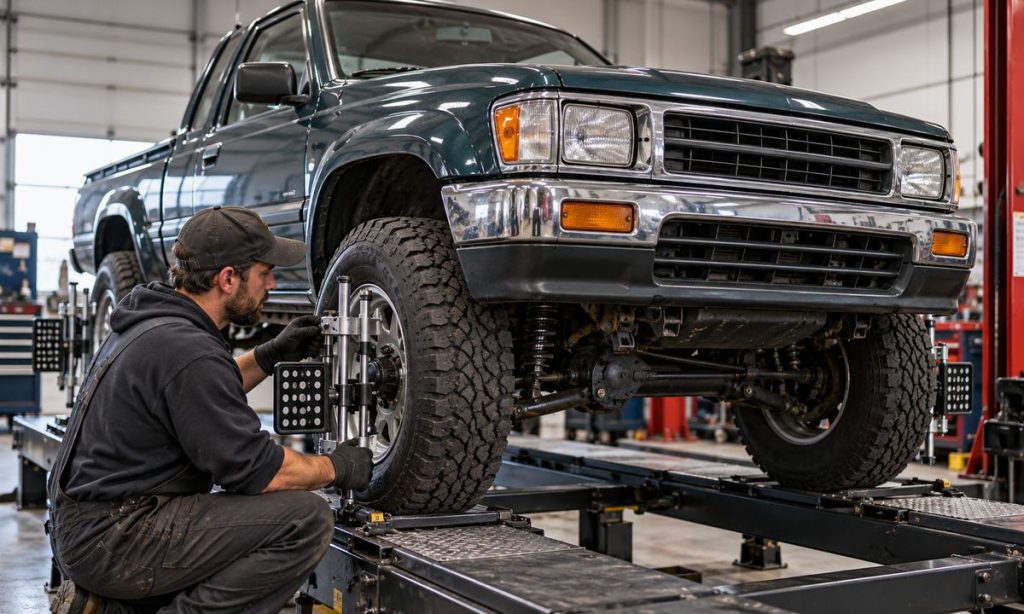
What causes uneven tire wear after suspension work on a Toyota Pickup 4×4 can include incorrect alignment, a ride-height change, worn or loose steering and suspension parts, tire-pressure problems, or a tire that was damaged or already worn before the repair. The timing makes the recent work an important clue, but it does not prove that the new part caused the wear. A 1991 Toyota Pickup may have decades of repairs, replacement parts, lifts, or altered wheels, so specifications and procedures must match its actual configuration. Compare the wear pattern across all four tires, check pressure and fasteners, and have alignment and component condition assessed by a qualified technician. Do not use an alignment adjustment to hide loose parts or continue driving on a tire with structural damage.
Start by describing the wear
Look at the full tread width on each tire and compare inside shoulder, center, and outside shoulder. One shoulder wearing faster can point toward alignment or suspension geometry concerns; wear on both shoulders or mainly in the center can also relate to pressure and loading. Scalloped or cupped patches may involve multiple factors, including imbalance, worn dampers, or alignment. These are clues, not a diagnosis. Tire construction, rotation history, inflation, road conditions, and driving style affect the pattern.
Note which corner has the wear, whether it began after the repair, and whether the truck pulls, wanders, vibrates, or makes new noises. Photographing and measuring tread at several points can help a shop compare the tires. A pattern on one tire may have a different cause from similar wear across the axle. Toyota guidance treats uneven tire wear and suspension noises as signs that adjustment or repair may be needed; it does not identify one cause from tread appearance alone.
Alignment may have changed during the repair
Replacing or moving suspension or steering components can change wheel angles or the truck’s ride height. Toe, camber, and caster describe different parts of wheel alignment. If a repair affects adjustable links, control arms, steering linkage, torsion bars, or ride height, the alignment may need to be measured and corrected using specifications that match the exact model and equipment. A 4×4’s front suspension design differs from many modern independent front suspensions; do not apply a generic pickup alignment chart.
A shop should inspect the steering and suspension for play before setting alignment. If ball joints, tie rods, bushings, or mounts are loose, alignment readings can change as the truck moves and tires may keep wearing unevenly. A bent component or frame damage can also prevent the angles from holding specification. Toyota’s service information for older models is available through its Technical Information System; use the repair information appropriate to the truck rather than guessing values.
Check for installation or ride-height issues
After suspension work, verify the correct parts were installed in the correct position and orientation. Check that fasteners, bushings, springs, torsion-bar settings, and shock mounts follow the part and vehicle instructions. Some bonded rubber bushings are designed to be tightened at a specified vehicle position; incorrect preload can affect ride height and component life. Because details vary by repair and model, a technician should verify the exact procedure rather than relying on a general rule.
If a lift, leveling change, replacement spring, or torsion adjustment changed ride height, the suspension may operate at different angles and its alignment range may change. Larger tires or wheels can create additional clearance or load issues. A recent repair that changes height does not make the truck suitable for arbitrary alignment settings. Have the cause and complete geometry checked before driving at highway speeds or carrying a heavy load if the truck handles unpredictably.
Do not overlook tires, pressure, or balance
A tire may already have uneven wear when suspension work begins, and that pattern can remain visible afterward. Check cold pressure against the truck’s label or documentation for the current tire setup. Inspect for cuts, bulges, exposed cords, embedded objects, and damage to the wheel. Incorrect size, mismatched tires, or pressure that is too low or high for the setup can change the contact patch and wear rate. Wheel imbalance more often contributes to vibration, but it may coexist with other problems.
What to ask the repair shop
- Were the installed parts correct for this truck’s year, 4×4 configuration, and modifications?
- Are steering and suspension joints, bushings, mounts, and fasteners free of play or damage?
- Did ride height change, and is it within the documented range for this setup?
- Can you provide before-and-after alignment readings using applicable specifications?
- Are tire pressure, tire size, wheel balance, and wheel condition appropriate?
- Is the affected tire safe to keep using, or does wear or damage require replacement?
Avoid requesting an alignment before the shop checks for looseness or damaged parts. An alignment cannot repair worn components, and adjusting around a fault may make the readings unreliable. Ask for the measurements and explanation of any out-of-range result. If a replacement component is installed, confirm the shop rechecks the relevant settings after the repair.
When to stop driving and get help
Stop and arrange inspection if tread is worn to the indicators, cords are visible, the tire has a bulge or deep cut, the steering changes suddenly, the truck pulls strongly, or a wheel or suspension part is loose. A damaged or severely worn tire can lose grip or fail. If the tire remains structurally sound but wear is uneven, schedule a prompt inspection and avoid long, high-speed trips until the cause is understood. Do not crawl under a truck supported only by a jack.
After alignment and loose-component checks, compare the installed parts with the 1991 Toyota Pickup 4×4 shock guide if shocks were replaced. Shock fitment is one part of suspension setup; it does not replace alignment or repair a damaged tire.
Frequently Asked Questions
Can new shocks cause uneven tire wear?
They may be related if the repair changed ride height, revealed another worn part, or was installed incorrectly, but tread wear alone cannot establish that. Have alignment and the full suspension checked.
Should I get an alignment after suspension work?
It depends on which parts were replaced or adjusted and the service procedure for the truck. Ask the repairer whether the work affects alignment and request measurements when appropriate.
Can I keep driving with one tire wearing on the inside?
Have it inspected soon. If cords show, the tread is at wear indicators, or the tire is damaged, do not continue driving on it. A technician should check alignment and suspension condition.
Will rotating the tires solve the problem?
Rotation may distribute wear only when tires are safe and the pattern is appropriate. It does not correct alignment, looseness, pressure errors, or damaged parts.
Can a lift kit change tire wear?
Changing ride height can affect suspension angles and alignment range. The effect depends on the specific kit and installation, so confirm geometry and tire clearance professionally.
Final Words
Uneven tire wear after suspension work on a Toyota Pickup 4×4 may reflect alignment changes, incorrect or loose parts, altered ride height, tire pressure, or wear that began earlier. Treat the timing as a clue, then inspect the entire setup and compare alignment readings with the correct specifications. If steering or tire condition raises a safety concern, stop driving and arrange qualified service.
References
- Toyota: What Is Wheel Alignment?.
- Toyota Owners Manuals (select applicable model information where available).
- Toyota Technical Information System (service publications and repair information).
- NHTSA TireWise: Tire Safety Ratings and Awareness.