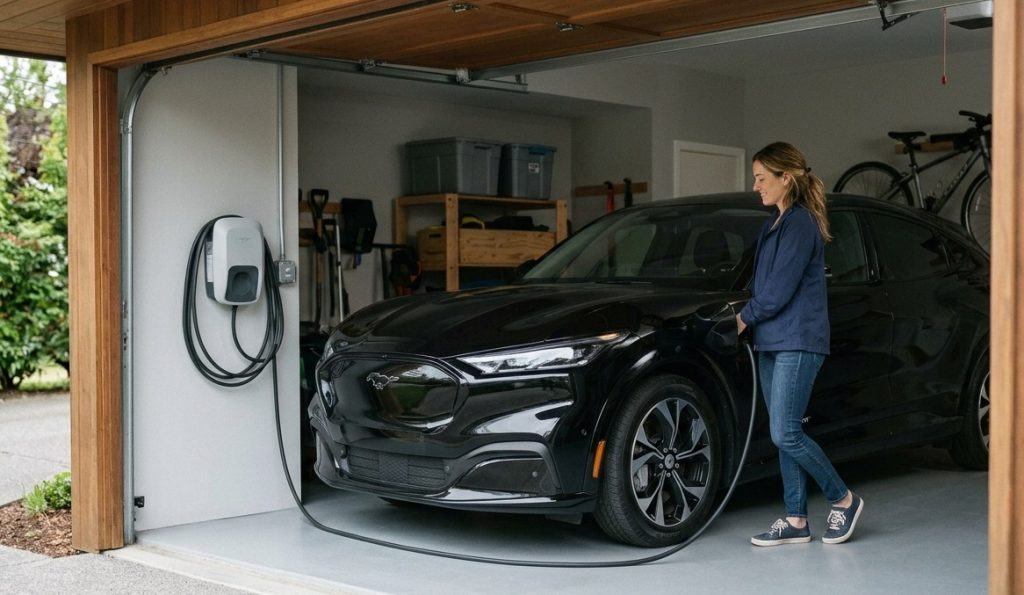
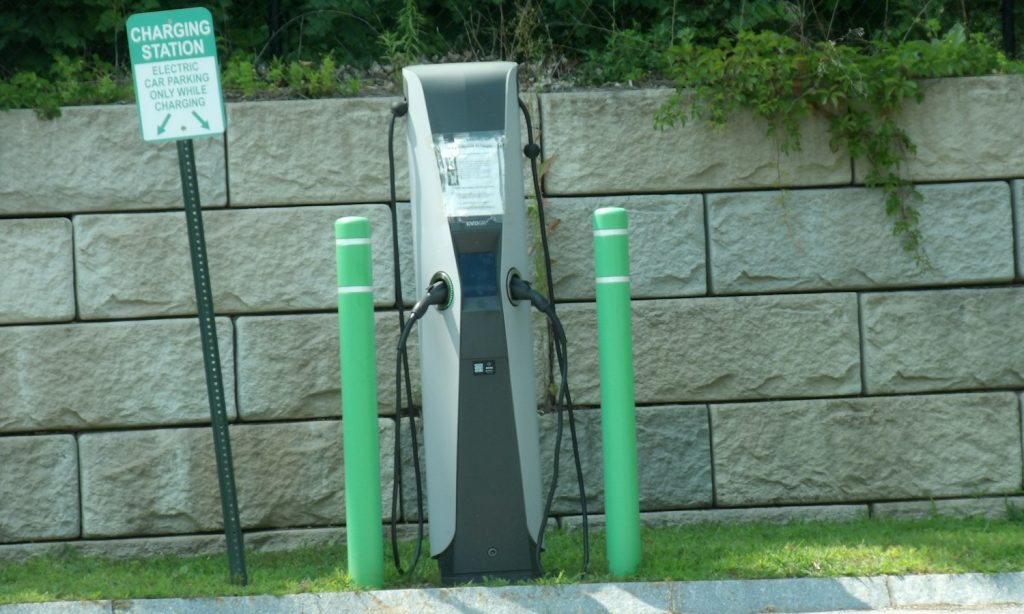
A Level 2 home charger for a Hyundai Kona Electric must match the car’s AC charge inlet and the home circuit. Hyundai’s U.S. specifications show an 11 kW onboard charger for 2024 and 2025 Kona Electric trims; the vehicle cannot use a charger’s higher maximum output to exceed its own AC limit. Hyundai’s published 2025 charge-time estimates are based on an 11 kW, 240V charger and vary by battery, trim, temperature, and charge state.
The five candidates below use a J1772 connector, as listed. Verify the actual port and model year on your Kona before buying. For home charging, follow Hyundai’s inlet and manual guidance; Hyundai’s supplied NACS adapter is described for DC fast charging and is not for AC Level 1 or Level 2 J1772 charging. A licensed electrician should assess the panel and install or inspect the circuit. This guide compares listing specifications; it is not electrical installation advice or a hands-on product test.
Hyundai: 2024 Kona Electric specifications · Hyundai: current Kona Electric specifications and charging estimates · Hyundai: approved NACS adapter limits
Quick comparison
| EVSE listing | Maximum current | Connection / listing certification | Main check |
|---|---|---|---|
| ELEGRP 40A J1772 portable EVSE | 16, 20, 24, 32, or 40A | NEMA 14-50 plug; listing states ETL certification | Choose only a current setting and outlet/circuit supported by the electrician and the charger instructions; do not treat the plug shape alone as proof the outlet is suitable. |
| Grizzl-E Classic 40A J1772 EVSE | Adjustable 16, 24, 32, or 40A | NEMA 14-50 plug; listing states UL certification | The stated 40A setting needs the branch circuit and receptacle specified by the manufacturer. Set the current to the installation’s approved limit. |
| EVIQO 48A J1772 hardwired station | Adjustable 6–48A | Hardwired; listing specifies 240V, dedicated 60A circuit at 48A, UL/ETL/ENERGY STAR claims | Hardwired installation requires a licensed electrician; the Kona’s onboard AC limit determines the vehicle’s draw. |
| Emporia 48A J1772 hardwired EVSE | Up to 48A hardwired | Hardwired with whip; listing states UL and ENERGY STAR certifications | Have the electrician confirm supply capacity, breaker, conductor size, and approved current setting before installation. |
| Grizzl-E Classic Connect 40A J1772 EVSE | 40A maximum; adjustable current | NEMA 14-50; listing states UL certification and app / Wi-Fi functions | The listing mentions a one-time activation fee for some advanced features. Check current terms and configure current for the circuit. |
These units do not all charge at the same rate. A higher amperage rating can require a higher-capacity circuit, and the Kona’s onboard charger remains the vehicle-side limit. Match the EVSE, branch circuit, and vehicle settings as one system.
ELEGRP 40A J1772 portable EVSE

What the listing says: 16, 20, 24, 32, or 40A; NEMA 14-50 plug; listing states ETL certification. The model is listed with J1772, so confirm the connector matches your Kona’s AC inlet and selected model year.
Before choosing: Choose only a current setting and outlet/circuit supported by the electrician and the charger instructions; do not treat the plug shape alone as proof the outlet is suitable. Check the current manufacturer installation manual, warranty, and listing details before purchase. Check the current listing.
Grizzl-E Classic 40A J1772 EVSE

What the listing says: Adjustable 16, 24, 32, or 40A; NEMA 14-50 plug; listing states UL certification. The model is listed with J1772, so confirm the connector matches your Kona’s AC inlet and selected model year.
Before choosing: The stated 40A setting needs the branch circuit and receptacle specified by the manufacturer. Set the current to the installation’s approved limit. Check the current manufacturer installation manual, warranty, and listing details before purchase. Check the current listing.
EVIQO 48A J1772 hardwired station

What the listing says: Adjustable 6–48A; Hardwired; listing specifies 240V, dedicated 60A circuit at 48A, UL/ETL/ENERGY STAR claims. The model is listed with J1772, so confirm the connector matches your Kona’s AC inlet and selected model year.
Before choosing: Hardwired installation requires a licensed electrician; the Kona’s onboard AC limit determines the vehicle’s draw. Check the current manufacturer installation manual, warranty, and listing details before purchase. Check the current listing.
Emporia 48A J1772 hardwired EVSE

What the listing says: Up to 48A hardwired; Hardwired with whip; listing states UL and ENERGY STAR certifications. The model is listed with J1772, so confirm the connector matches your Kona’s AC inlet and selected model year.
Before choosing: Have the electrician confirm supply capacity, breaker, conductor size, and approved current setting before installation. Check the current manufacturer installation manual, warranty, and listing details before purchase. Check the current listing.
Grizzl-E Classic Connect 40A J1772 EVSE

What the listing says: 40A maximum; adjustable current; NEMA 14-50; listing states UL certification and app / Wi-Fi functions. The model is listed with J1772, so confirm the connector matches your Kona’s AC inlet and selected model year.
Before choosing: The listing mentions a one-time activation fee for some advanced features. Check current terms and configure current for the circuit. Check the current manufacturer installation manual, warranty, and listing details before purchase. Check the current listing.
How to choose a home Kona Electric charger
- Check the vehicle’s charge port: identify the model year and confirm the AC inlet from the vehicle manual. A DC fast-charge adapter does not convert an AC home charger into a DC charger.
- Compare AC limits: the 2024 and 2025 U.S. Kona Electric specification pages list an 11 kW onboard charger. A 48A EVSE’s maximum does not mean the car draws all of that power.
- Pick plug-in or hardwired: plug-in units require a correctly rated receptacle and branch circuit; hardwired stations require appropriate fixed wiring. Have a licensed electrician choose and install the circuit under applicable code.
- Check current settings: the EVSE must be configured for the circuit and installation. Do not raise the current setting above what the electrician approved.
- Verify outdoor rating and cable reach: use the manufacturer’s rated installation environment and keep the cable path clear of vehicle tires, doors, and walking routes.
- Keep records: retain installation paperwork, charger model/serial number, warranty, and the manufacturer’s instructions.
Frequently asked questions
Will a 48A charger charge a Kona Electric faster than a 40A charger?
Not necessarily. Hyundai lists an 11 kW onboard AC charger for 2024 and 2025 Kona Electric trims. Actual rate depends on the car, charging station, circuit, settings, and conditions.
Can I plug in any J1772 charger?
Match the connector, EVSE certification, electrical supply, and installation instructions. Confirm the actual model year and port on your vehicle; a product title that says “universal” is not enough to verify the complete setup.
Can I use Hyundai’s NACS adapter for home Level 2 charging?
Hyundai’s adapter terms limit the approved NACS adapter to compatible DC fast charging and say it may not be used with AC Level 1 or Level 2 J1772 chargers. Check current Hyundai guidance for your exact vehicle.
Do I need an electrician?
Yes for a new hardwired station, and for any new or altered high-current circuit. Ask a licensed electrician to evaluate the panel and install equipment to the applicable code and charger instructions.
Will a 40A charger charge faster than the portable cord supplied with the car?
Level 2 charging can be faster than a standard 120V outlet, but actual time depends on vehicle settings, onboard limits, circuit, battery size, temperature, and state of charge. Use Hyundai’s estimates for the exact trim as a reference.
Conclusion
Choose a certified EVSE whose connector and current settings fit the Kona Electric and a professionally evaluated home circuit. For the 2024–2025 models cited here, an 11 kW onboard charger sets the vehicle-side ceiling; larger charger ratings do not bypass it. Confirm current product details and installation requirements with the manufacturer and electrician before buying.
Affiliate disclosure: This article contains Amazon affiliate links. If you purchase through them, CarInsightPro may earn a commission. As an Amazon Associate I earn from qualifying purchases.