
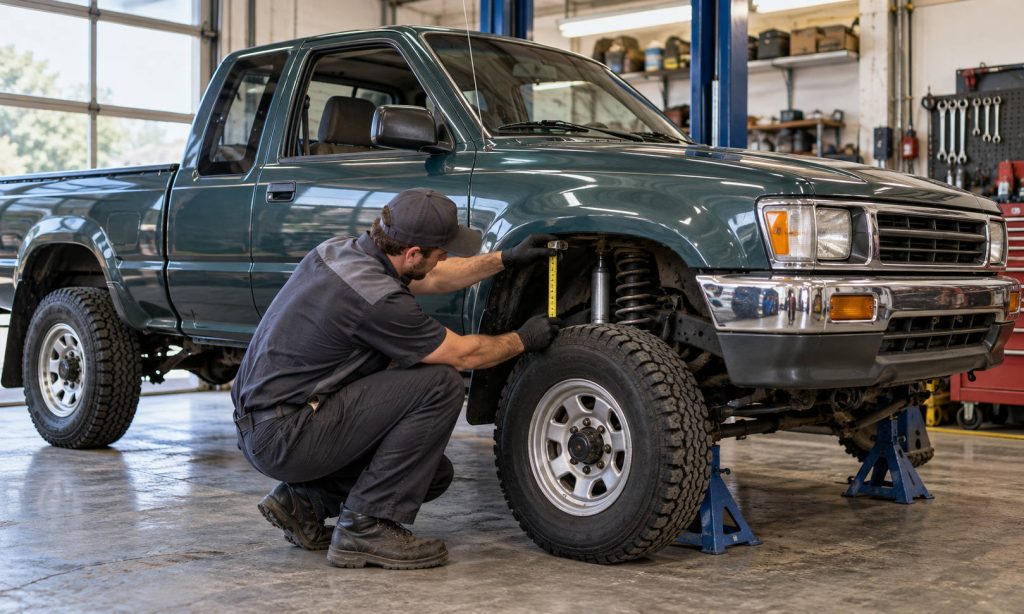
Matching replacement shocks to the ride height and use of a Toyota Pickup 4×4 starts with the truck’s actual suspension configuration, not just its model name. A 1991 Pickup can differ by engine, cab, bed, axle, and production details; years of repairs may also have changed its springs, torsion-bar setting, or lift hardware. A shock listed for “Toyota Pickup” may fit a stock truck but have too little travel on a raised suspension, or may be unsuitable for a constant cargo load. Verify the application by year and drivetrain, then confirm mount style and shock length across the suspension’s usable movement. The published 1991 Toyota Pickup 4×4 shock overview can help you compare the fitment details to verify; use the truck’s measured setup as the final check.
Identify what is actually under the truck
Record the model year, 4WD system, engine, cab, bed, and any chassis or payload variant shown on the vehicle identification label. Then inspect for modifications: torsion-bar adjustment, lift keys, altered control arms, a body lift, leaf-spring packs, add-a-leaf sections, lift blocks, shackles, or replacement spring hangers. A body lift changes body-to-frame height but does not increase suspension travel, so it does not automatically call for a longer shock. A suspension lift can change the shock’s operating position and available extension or compression.
Many 1984–1994 U.S. 4WD Toyota pickups use torsion-bar front suspension and rear leaf springs, but verify the truck’s exact version and previous work. A worn or sagging spring can make the truck sit lower without a lift. Installing a shock selected for a presumed lift may mask neither sag nor worn suspension parts.
Measure ride height and suspension travel
Measure ride height on level ground with the normal equipment and typical load in the truck. Use the measurement points specified in a service manual for the vehicle, and record left and right sides. Tire size can affect ground-based measurements, so do not use fender height alone as the only fitment reference. Compare the truck with its factory ride-height specification when available, and inspect springs, bushings, ball joints, and torsion-bar settings before choosing a shock.
A shock must fit between its mounts without topping out at full droop or bottoming before the suspension reaches its compression limit. A qualified technician can determine the required extended and compressed lengths by safely supporting the axle or control arm and moving the suspension through its range. Do not crawl under a truck supported only by a jack. Shock length is not a substitute for checking bump stops, brake hose slack, driveshaft angles, or other parts affected by a lift.
Check the application and mount details
Use a parts catalog that specifies the exact year, 4WD configuration, engine or chassis variant, and front or rear position. Compare the shock’s upper and lower mount type, bolt diameter, bushing width, body clearance, and any included hardware with the truck. Cross-reference the part number against the manufacturer’s application data. A retailer’s “fits” label alone may not account for a non-stock lift or replacement axle.
When the old shock is still installed, record its part number and compare its physical dimensions, but do not assume it is correct: it may be an earlier mismatched replacement. If the suspension is modified, ask the shock maker or a suspension shop to confirm an approved fit using the actual ride height and travel measurements. Some manufacturers note that replacement shocks can differ in length from original equipment and that mounting them may require controlled suspension positioning.
Match the shock to the way you use the pickup
For mostly empty pavement driving at stock height, prioritize the specified application and normal-range damping. A pickup that frequently carries a camper, tools, or a constant bed load needs compatible spring capacity and shock control; a shock alone does not increase payload or correct sag. For washboard roads or occasional trails, consider heat management and the suspension’s travel range, but do not assume a firmer shock adds load capacity or protects other components.
Public Toyota Pickup owner discussions often distinguish stock-height applications from trucks with torsion-bar adjustments, lift blocks, or different rear leaf packs. Some drivers report firmer ride characteristics after moving to a shock intended for a lifted setup. These are anecdotal reports and vary with tires, springs, load, and shock design. Use them as questions to ask, not as fitment evidence for your truck.
Replace and evaluate shocks in pairs
When one shock has failed or is being changed to a different damping type, replacing both shocks on the same axle helps keep left-to-right response consistent. Follow the vehicle and shock manufacturer’s installation instructions for hardware, fastener torque, and any required ride-height condition. Do not use a shock to pull a suspension component into alignment or force a mount into place.
After installation, check that the shock clears nearby parts through steering and suspension movement. Recheck for leaks, loose hardware, tire contact, and unusual ride or handling changes after a cautious road test. If the truck wanders, clunks, bottoms out, tops out, or sits unevenly, stop and have the suspension inspected rather than changing shock pressure or preload at random.
Common fitment mistakes
- Ordering by year and “4×4” alone without checking cab, engine, front/rear position, and current modifications.
- Confusing a body lift with a suspension lift.
- Choosing a shock solely by advertised lift inches without measuring travel.
- Using shock length to compensate for sagging leaf springs or incorrect torsion-bar ride height.
- Assuming an off-road shock raises payload or towing limits.
- Copying another owner’s part number without verifying the truck’s build and suspension.
Frequently Asked Questions
Can stock-height shocks fit a Pickup with torsion bars cranked up?
Not automatically. Raising the front at the torsion bars changes the shock’s resting position and may reduce available droop. Measure travel and confirm the part application with the manufacturer.
Does a body lift require longer shocks?
A body lift raises the body relative to the frame, not the suspension. It does not by itself change shock travel, though other modifications may.
Can stronger shocks fix a sagging rear leaf spring?
No. Shocks control suspension motion; they do not restore spring height or payload capacity. Inspect the leaf pack and replace or repair it as needed.
Should I replace front and rear shocks at the same time?
It is usually most important to replace shocks in axle pairs. Replace all four when inspection, wear, or the chosen suspension setup calls for it.
How can I confirm the correct shock length?
Use the maker’s application chart and verify extended and compressed travel on the actual truck. A suspension professional can measure this safely on a modified vehicle.
Final Words
For a Toyota Pickup 4×4, match the shock to the exact year and axle position, then account for actual ride height, travel, mounts, springs, and typical load. Confirm a modified truck with measured dimensions and the shock manufacturer’s technical support. For a model-specific parts overview, see the 1991 Toyota Pickup 4×4 shock guide, and verify that its application matches your truck before ordering.
Pingback: Brake Pad Bedding-In Basics for Toyota Pickup 4×4
Pingback: Nissan Titan Uneven Tire Wear After Suspension Work