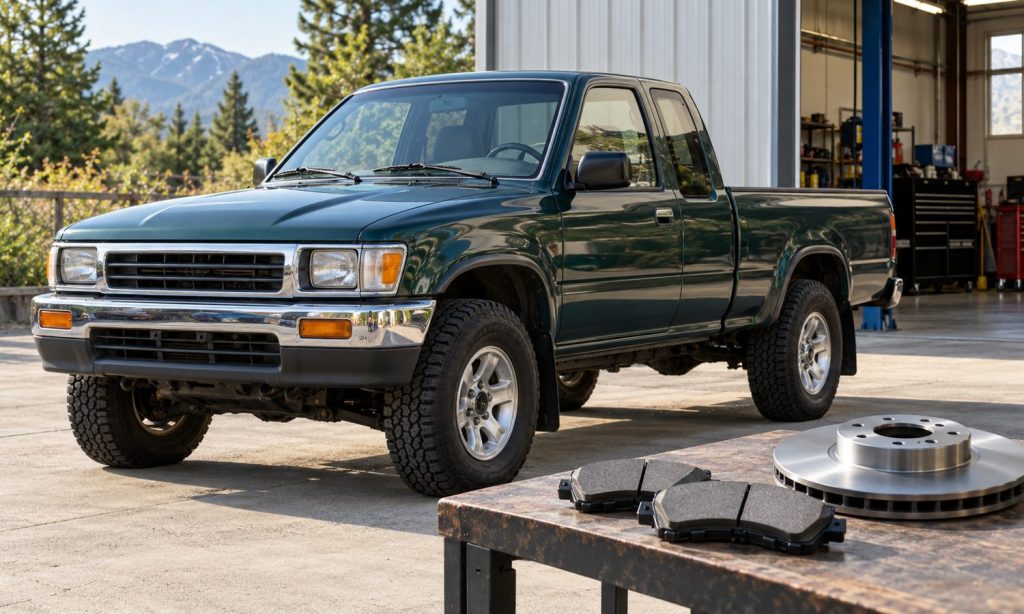
Brake pad bedding-in basics after a replacement on a Toyota Pickup 4×4 begin with one rule: use the instructions supplied for the installed pads and rotors, after a qualified technician has confirmed that the brakes work correctly. Bedding is the controlled settling of new friction surfaces during their initial use. It is not a cure for a soft pedal, a fluid leak, incorrect parts, or a sticking caliper. An older pickup may also have replacement axles, different brakes, or other modifications that make a generic internet routine unsuitable. Before you drive away, establish what was replaced, which instructions apply, and which symptoms require an immediate return to the shop. This guide explains that handover, the purpose of bedding, and the observations that matter without prescribing an unverified speed-and-stop sequence for your truck.
Find the instructions for your actual brake parts
Record the pickup’s model year, vehicle identification number, and any brake or axle conversions. Ask for the pad and rotor part numbers on the invoice. “Toyota Pickup 4×4” does not identify one brake package across every production year, and a parts listing for an unmodified truck may not describe what is installed today. The installer should resolve application questions before road testing.
Read the pad manufacturer’s installation and initial-use instructions together with the service information for the truck. Different friction formulations and rotor finishes can require different preparation or break-in approaches. Do not combine the braking stages from one instruction sheet with the cooling stages from another. If the paperwork is missing, have the installer obtain the correct instructions rather than copying a routine intended for racing pads.
Understand what bedding can accomplish
Bedding allows the pad and rotor contact surfaces to settle into their intended working relationship. Depending on the friction material, conditioning also involves establishing a consistent transfer layer on the rotor. The desired result is stable operation under the conditions specified for those parts. It is not a contest to make the brakes as hot as possible, and visible smoke is not proof of successful preparation.
No universal mileage proves that every brake job is bedded. A distance-based initial-use recommendation and a prescribed controlled braking sequence are different instructions. Follow the applicable one. Even when the manufacturer specifies an initial period of gentle use, emergency avoidance takes priority: apply the braking needed to avoid a collision, then have any resulting concerns checked safely.
Complete installation checks before initial driving
Ask the technician to confirm that the installation and stationary checks are complete. Relevant checks include correct parts and hardware, secure fasteners, proper pad movement, rotor condition, hydraulic integrity, and normal pedal operation. If rotors were retained, ask whether their measured condition meets the applicable service limits. A new set of pads does not establish that an old rotor remains serviceable.
The first movement after service should be part of the installer’s controlled verification, not your first encounter with a public-road intersection. If the pedal travels unexpectedly far, feels spongy, or does not produce predictable braking, do not continue into traffic. Tell the shop exactly what happened. A hydraulic or installation problem needs diagnosis; additional bedding attempts cannot be relied on to correct it.
Plan the initial-use period around safe conditions
Have the shop explain any operating restrictions before collecting the pickup. If a specific braking sequence is required, ask the technician how it will be completed legally and safely. Do not create sudden slowdowns in traffic, exceed speed limits, or use a crowded parking lot as a test track. A procedure that cannot be performed safely in the available location belongs with a suitably equipped professional.
Avoid scheduling the first trip around a heavy trailer, a steep descent, or a demanding off-road route when the installed parts require a controlled initial-use period. Discuss unavoidable loads with the installer beforehand. Keep a larger following margin and pay attention to braking response. Neither four-wheel drive nor a low transfer-case range establishes that newly serviced brakes are ready for demanding use.
Know when to stop and request inspection
Stop safely and arrange assistance for reduced braking, a sinking pedal, an apparent brake-fluid leak, severe pulling, or smoke from a wheel. Follow the truck’s owner’s manual for warning lights. Do not assume that an illuminated brake warning is simply part of bedding, and do not drive to the shop if braking is compromised. Tell the technician whether the symptom occurs during braking, after release, or while cruising.
Persistent grinding, substantial vibration, or a new repeated scraping sound also needs investigation. Record when it starts, whether it changes with road speed, and whether the steering wheel or pedal moves. Avoid diagnosing a warped rotor from vibration alone. The useful next step is an inspection of the installed brake system and related components, not a harder series of stops to try to erase the symptom.
Separate braking concerns from suspension concerns
A pickup that bounces, wanders, or feels unsettled deserves a broader inspection, especially if it has suspension modifications. Do not use those observations to conclude that the pads need more bedding. If the shop identifies a separate suspension issue, our guide to matching Toyota Pickup shocks to ride height and use explains the fitment questions. Shock selection is a separate task from brake friction conditioning.
Related guidance: a separate Toyota brake pad and rotor overview.
Frequently Asked Questions
Do rear drum shoes follow the same bedding instructions?
Do not assume so. Identify whether the serviced axle uses disc pads or drum shoes, then obtain the instructions for that assembly. Disc-pad guidance does not establish drum adjustment requirements or the correct procedure for a converted rear axle.
Can I wash the wheels immediately after a bedding drive?
Allow hot components to cool naturally before cleaning. Do not spray water onto hot brakes to accelerate cooling. Follow the parts instructions and avoid touching a rotor or caliper to judge temperature; recently used brakes can cause burns.
Should I repeat a routine because one stop was interrupted?
Ask the installer or follow the written instructions for interrupted conditioning. Do not improvise extra high-energy stops. Explain which stage was completed and why you stopped so the advice applies to the actual situation.
Does a quiet brake prove the job is complete?
No. Absence of noise does not verify rotor dimensions, hydraulic integrity, or fastener installation. Completion depends on the service checks and the applicable parts instructions, as well as predictable brake operation during the professional road test.
What should I keep in the service record?
Keep the invoice, installed part numbers, mileage, rotor measurements if provided, and the initial-use instructions. Note any symptoms and when you reported them. This helps a later technician distinguish the original service from changes that developed afterward.
Final Words
For a Toyota Pickup 4×4, successful brake bedding starts with verified fitment, completed installation checks, and the correct instructions for the installed friction parts. Have the technician explain what remains for you to do after collection. Treat abnormal braking as an inspection problem, and postpone demanding use until the applicable initial-use requirements are satisfied.
Reference
Toyota: dashboard warning-light guidance — consult the pickup’s own manual for its specific indicators and required response.