LED headlight fitment on a Ford Mustang Mach-E starts with the exact model year, market, and headlamp assembly—not with a bulb search. Many Mach-E versions use an integrated LED headlamp assembly, and Ford’s 2025 U.S. owner’s manual lists exterior LED lamps as non-serviceable items. That means an individual bulb swap may not be the repair path. Equipment and service instructions can differ by year and region, so identify the vehicle by VIN and compare the installed lamp’s part number before ordering. A beam-pattern check can help spot a problem after service, but it does not certify that a replacement lamp is correctly aimed.
Confirm which headlamp your Mach-E has
Mach-E lighting equipment has changed across model years, trims, markets, and option packages. Before buying a lamp, record the model year, trim, build market, and VIN. Check the owner’s manual’s exterior bulb chart and ask a Ford parts counter or qualified collision shop to confirm the headlamp assembly and any required control module. If the vehicle has been in a front-end impact or the lamp has been replaced before, compare the part number and connector against the vehicle rather than relying on a broad “fits Mach-E” listing.
Some Ford manuals describe the exterior LED lamps as non-serviceable and direct owners to an authorized dealer if they fail. On those versions, a failed low beam, high beam, daytime running lamp, or turn signal may require diagnosis of the lamp assembly or its electronics rather than installing a generic LED bulb. Do not pry open a sealed lamp or splice wiring unless the exact factory procedure calls for it. Water inside the lens, a cracked housing, intermittent operation, or a warning message also deserves diagnosis; replacing a lamp without finding a damaged connector, ground, or control module can leave the fault in place.
Match the assembly, not just the connector
A connector that plugs in does not prove a headlamp is correct. The housing, optics, driver electronics, mounting tabs, side of vehicle, and regulatory markings all matter. Confirm whether the part is for the left or right side, its market specification, and whether it matches the original equipment level. A North American lamp and a lamp designed for a right-hand-drive market can create different beam patterns. Check whether the quote includes a driver module, brackets, seals, or programming, and clarify whether those components transfer from the old unit.
Use the VIN-based catalog or a Ford dealer’s parts lookup to check superseded part numbers. For a used or aftermarket assembly, request clear photographs of the label and mounting points, verify that the lens is not clouded or cracked, and confirm the return policy. If the car has adaptive or automatic lighting features, ask whether calibration or configuration is needed after replacement. Do not assume that an advertised “plug and play” lamp preserves every feature on every Mach-E trim.
Why beam shape matters more than apparent brightness
A headlamp is an optical system. Its reflector or projector, lens, light source, and control electronics work together to put light in specific places. A lamp can look bright against a garage door yet illuminate the road poorly or send excessive light toward oncoming drivers. A clear low-beam cutoff is a useful visual clue: it helps show where the upper edge of the beam falls. It is not a photometric test, and a phone photo cannot measure glare or confirm compliance.
Do not install a replacement LED bulb in a housing designed for a different replaceable light source based only on a retailer’s compatibility list. NHTSA’s interpretation of Federal Motor Vehicle Safety Standard No. 108 explains that the standard evaluates the complete integral-beam headlamp and that currently no LED replaceable light source is listed for use in a replaceable-bulb headlamp. The specific Mach-E assembly should be identified first; this general rule is not permission to modify a lamp.
A careful visual check after work
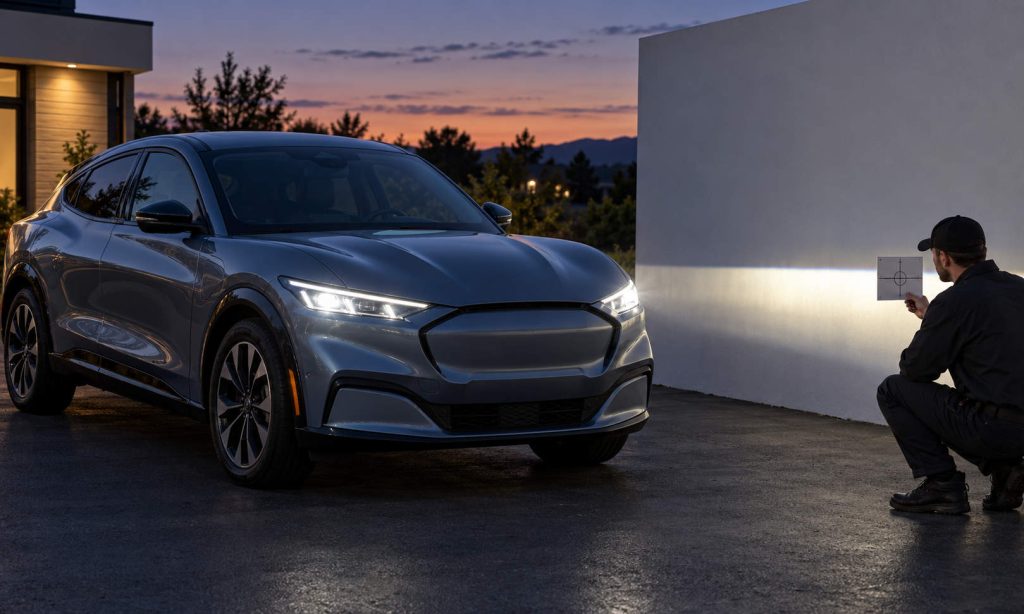
For a basic comparison, park on level ground facing a plain wall after dark. Set tire pressure correctly, remove unusual cargo, and place the vehicle at a consistent distance specified by the exact service information if available. Keep the car’s load and suspension settled, and note the height and shape of each low-beam cutoff. The two patterns should be stable and consistent with the vehicle’s manual or service procedure. A wall check can reveal a lamp pointing sharply upward, a missing cutoff, a large mismatch between sides, or a beam that shakes over bumps.
Do not turn an adjuster based on a guessed distance or an online diagram for another model year. Some Mach-E configurations use automatic or dynamic leveling, while other versions may have different service instructions. A level surface, headlamp tester, vehicle loading condition, and alignment target can all affect the result. If a lamp was replaced, the front bumper or suspension was disturbed, or the pattern is uneven, have a qualified shop check aim using the correct Ford procedure and suitable equipment.
What to inspect when the pattern looks wrong
First check simple causes: dirt or condensation on the lens, an uneven parking surface, incorrect tire pressures, cargo loading, or a visibly loose lamp. Then look for signs that the assembly is not seated: uneven gaps at the bumper, broken tabs, a missing fastener, or movement when the vehicle crosses a bump. A lamp that vibrates or whose beam moves independently can indicate a damaged mount or internal component. Stop night driving if the low beam is out, badly misdirected, or intermittently failing.
If both sides are affected, consider a shared electrical or configuration issue instead of assuming that two lamps failed at once. If only one feature fails, record which functions still work and whether a dashboard message appears. A technician can scan relevant modules, inspect power and ground, verify connectors, and check for applicable software updates or service information. Keep the repair invoice and part numbers; they help with warranty questions and future fitment.
Questions to ask before ordering or authorizing repair
- Does the VIN confirm this exact lamp and side?
- Is the headlamp a complete LED unit with no replaceable bulb?
- Does the quote include the control module, seals, brackets, and required setup?
- Will the shop check aim and run any required calibration after installation?
- Does the replacement match the vehicle’s market and regulatory specification?
Frequently Asked Questions
Can I replace only a bulb in a Ford Mach-E LED headlight?
That depends on the year and lamp. Ford’s 2025 U.S. manual says the exterior LED lamps are not serviceable items. Check the manual and VIN-specific parts information before ordering a bulb.
Will any Mach-E headlamp assembly fit my trim?
No. Side, year, market, options, connectors, and control modules can differ. Confirm the assembly by VIN and part number.
Can I check the beam pattern on a wall at home?
A wall can reveal an obvious mismatch or unstable beam, but it cannot confirm legal photometry or precise aim. Use the exact service procedure or a qualified shop for final alignment.
Should I adjust the headlamps after replacing an assembly?
Have aim checked after replacement, impact repair, or work that disturbed the lamp or front structure. Follow the correct procedure for the vehicle’s year and equipment.
Does a brighter LED bulb always improve visibility?
No. The source must work with the lamp optics and meet applicable requirements. A poorly matched source can create glare while leaving the road less evenly lit.
Final Words
For Ford Mach-E LED headlight fitment, start with the VIN, model year, market, and existing assembly number. Check whether the lamp is an integrated unit, confirm modules and features, and treat beam shape and aim as part of the repair. A simple wall check is useful for spotting a problem; a qualified technician should perform the final aim or calibration when service information requires it. If lighting operation is unreliable or the beam is badly directed, have it diagnosed before relying on the vehicle at night.