
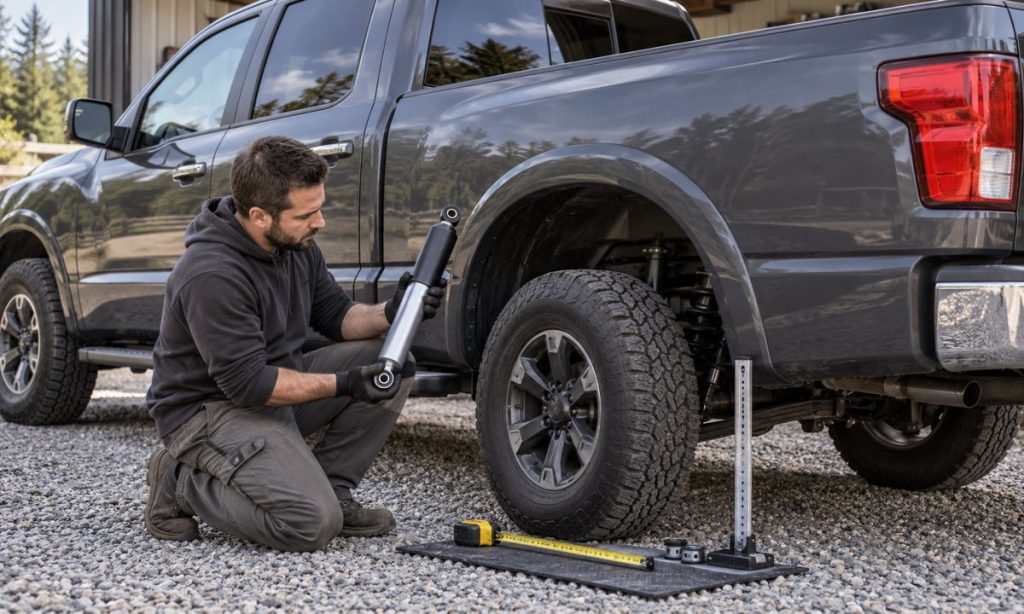
To match replacement shocks to the ride height and use of a Nissan Titan, start with the truck’s model year, Titan or Titan XD designation, cab, drivetrain, trim, suspension package, and any lift or leveling changes. Then confirm that the shock’s approved application and working travel fit the suspension as it sits now. A part described simply as “for Titan” may cover only one generation, axle position, drive type, or height range. Measure ride height consistently and identify the lift components before ordering. If off-road driving is part of your use, compare the off-road shocks for Nissan Titan guide, then verify the application for your exact Titan.
Start with the exact Titan configuration
Nissan has sold Titan and Titan XD trucks across different generations and configurations, with suspension details that vary by year, drivetrain, trim, and equipment. The Nissan owner-manual library and service information are useful starting points, but an owner manual may not provide every replacement-part dimension. Use the VIN in Nissan parts or service channels and confirm the shock position: front or rear. Do not combine a Titan XD application with a standard Titan solely because the name is similar.
Record the current wheel and tire size, any factory off-road package, and every modification that affects suspension position. Ask whether the truck has a body lift, leveling spacer, spring lift, suspension lift, replacement control arms, rear blocks, add-a-leaf springs, or nonstock springs. A body lift raises the body relative to the frame and does not create the same shock-length change as a suspension lift. A leveling spacer and a full lift can also affect suspension travel differently.
Measure ride height before selecting a shock
Park on a flat surface with the same typical load in the truck, set the tires to the recommended cold pressure, and measure each side from a repeatable point on the wheel center to a fixed fender or body reference. Write down left-front, right-front, left-rear, and right-rear measurements. A wheel-center-to-fender measurement reduces the effect of tire diameter compared with measuring from the ground. Repeat the measurements if the truck has recently been unloaded or if cargo, fuel, or equipment differs from normal use.
These measurements describe current stance; they do not by themselves determine the correct shock. Uneven measurements can reflect cargo, a sagging spring, worn parts, prior repairs, or an uneven surface. A tape measure cannot establish available travel or prove that a previous lift was installed correctly. If the truck sits unevenly or has unknown suspension parts, have the setup inspected before ordering around the current height.
Match suspension travel, not just advertised lift
A shock has a compressed length, an extended length, and usable travel between them. The chosen unit must fit the exact mounting points and control suspension movement through the vehicle’s intended operating range. If it is too short at full droop, it can top out and transfer impact loads to mounts or other parts. If it is too long when compressed, it can bottom out before the suspension reaches its designed limit. Either condition can damage components or limit wheel travel.
Use the suspension or shock manufacturer’s application data for the truck’s year, drive type, axle position, suspension package, and measured lift. Ask for written clarification when a listing only says “stock height,” “lifted,” or “fits all.” If you have modified control arms or springs, the application may depend on those parts as well. Do not select solely by matching the length of an old shock; it may be incorrect, worn, or intended for a different setup.
For a changed ride height, confirm that the shock retains appropriate bump and droop travel and that it does not contact nearby components. A qualified installer can verify measurements at the suspension’s limits using safe support equipment and the relevant service procedure. Do not place yourself under an unsupported truck or attempt to compress a spring by hand.
Choose for the way you use the Titan
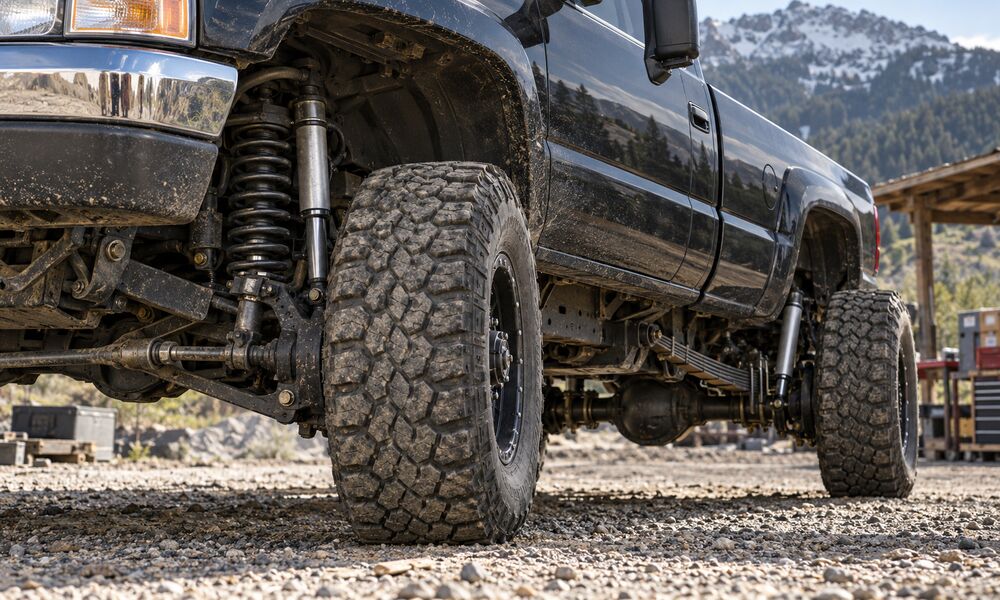
For mostly paved daily driving, prioritize the correct fit, stable control, and the ride behavior specified for the vehicle and suspension. Off-road driving adds repeated sharp impacts, larger suspension movements, heat, dust, and possible contact with rocks or brush. A shock intended for an off-road application may have different construction, tuning, protection, and maintenance requirements than an ordinary replacement. Those labels do not guarantee a better result in every use.
Frequent towing or payload changes also matter. The shock controls motion but does not increase the truck’s rated payload, axle, or towing capacity, and it cannot correct a spring or load-distribution problem on its own. Tell the parts professional how the Titan is actually used, including highway miles, rough roads, towing frequency, and typical cargo. If comfort is the main concern, describe what feels harsh or floaty and under what conditions rather than choosing by brand claims or appearance.
Confirm mounting and system details
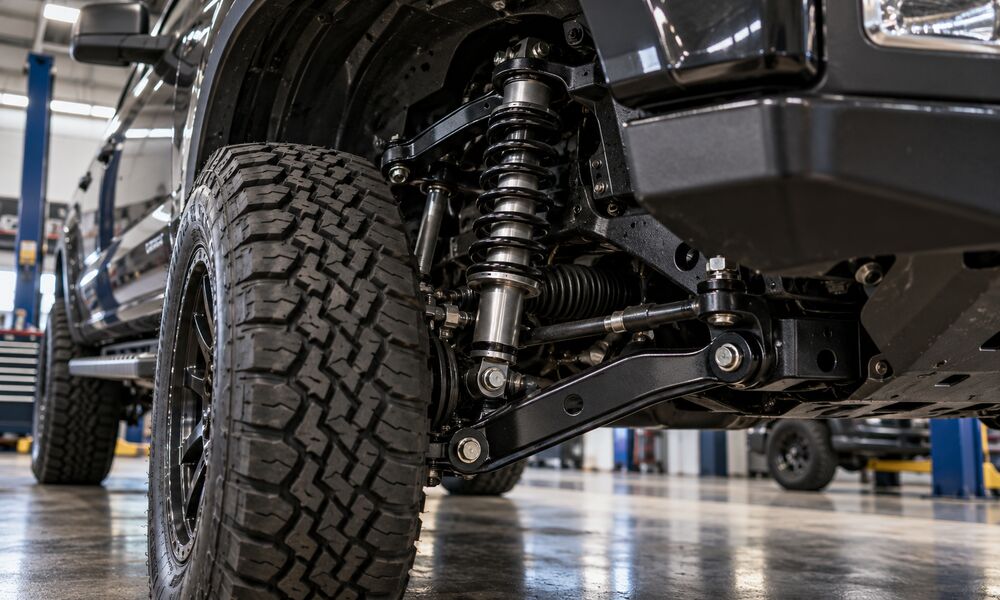
Before ordering, check upper and lower mount type, mounting width, bolt diameter, orientation, body clearance, and whether required sleeves or hardware are included. Confirm whether the replacement is a shock alone or a complete coil-over or strut assembly. Front and rear components are not interchangeable, and even the left and right positions may have different requirements on some systems. Follow the applicable Nissan service information and the component maker’s installation instructions.
If the truck has electronic or adaptive suspension equipment, verify whether the chosen replacement is compatible and whether additional parts or diagnostic steps are required. Also check whether the modification affects alignment, brake-line slack, sway-bar links, bump stops, or other suspension limits. Do not ignore a rubbing hose, stretched wire, or binding joint during travel. A changed ride height may require inspection of related components and alignment settings.
A practical pre-order checklist
- Confirm VIN, model year, Titan versus Titan XD, cab, drivetrain, trim, package, and axle position.
- List all lift, leveling, spring, control-arm, wheel, and tire changes.
- Measure current stance on level ground with a representative load, and record all four corners.
- Obtain the shock maker’s fitment range, mount details, compressed and extended lengths, and installation notes.
- Confirm travel and clearance for the truck’s actual suspension configuration, not only the advertised lift height.
- Ask a qualified installer to resolve unknown or conflicting measurements before ordering.
Record the Titan setup before choosing
Write down Titan or Titan XD, model year, trim, cab, drivetrain, axle position, tire size, installed lift or leveling components, and measured ride height. Keep the make and part numbers of any suspension components already installed. This gives a shock supplier enough detail to confirm approved compressed and extended lengths for that configuration. Do not assume fitment based on advertised lift alone.
Frequently Asked Questions
Can I use a longer shock to add lift to my Titan?
A longer shock does not by itself safely lift a vehicle. Ride height is set by springs, spacers, or suspension components, and shock travel must suit the resulting geometry.
Does a leveling kit require different shocks?
It depends on the kit design, the Titan generation, and the amount of height change. Follow the kit maker’s vehicle-specific instructions and confirm travel and fitment.
Do Titan and Titan XD shocks interchange?
Do not assume they do. Verify the exact year, model line, drivetrain, axle position, and suspension package in an application catalog or with Nissan.
Should I choose shocks based on towing?
Include towing and payload in the application discussion, but remember shocks do not raise the truck’s rated capacity or replace a needed spring or load correction.
Why are compressed and extended shock lengths important?
They help show whether a shock can move through the suspension’s operating range without topping out, bottoming out, or restricting travel.
Final Words
Match Nissan Titan replacement shocks to the exact truck configuration, measured ride height, suspension modifications, mount style, available travel, and real use. Verify that the application covers the front or rear position and Titan or Titan XD variant, then resolve any conflicting data before purchase or installation. Ride height is only one part of the fitment check; shock length and suspension geometry must also work together. If you are researching off-road shocks for a Nissan Titan, use the related guide as a separate starting point and verify its stated year and configuration against your own truck.
References
- Nissan: Factory-authorized TITAN and TITAN XD suspension lift kit announcement — illustrates that available lift applications can be specific to vehicle configurations.
- Nissan USA Owner Manuals and Guides — select the vehicle-specific owner documentation.
- Nissan TechInfo — factory-authorized service manual information.
Pingback: Nissan Titan Uneven Tire Wear After Suspension Work