
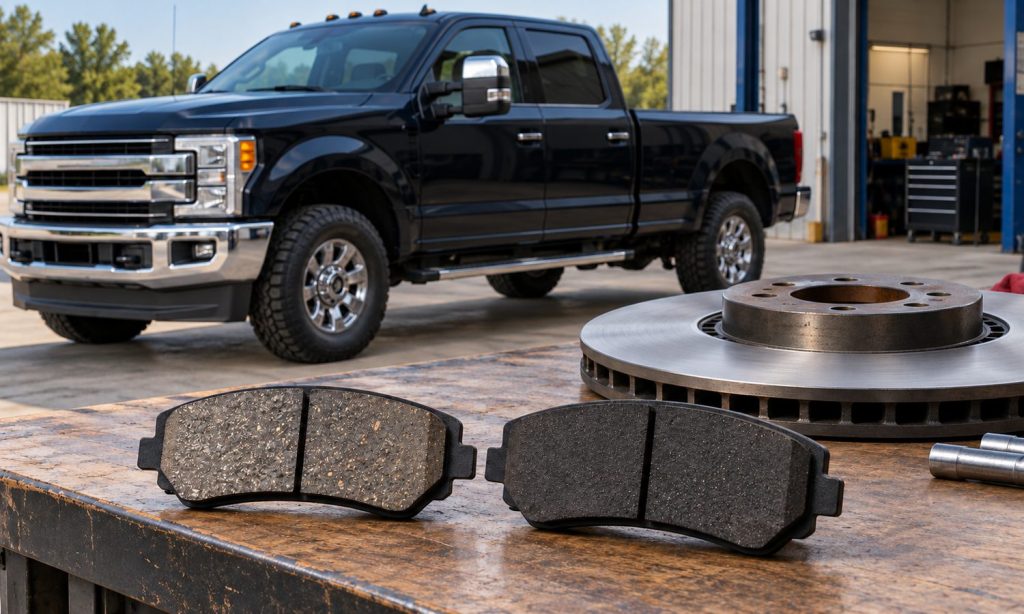
Comparing ceramic vs. semi-metallic brake pads for Ford F350 Super Duty means looking beyond the material name. Ceramic formulations commonly emphasize low visible dust and quiet everyday operation, while semi-metallic formulations use substantial metal content and are often associated with demanding thermal duty. Those are broad tendencies, not a guarantee that one pad will stop your truck sooner, last longer, or suit a particular trailer. The exact friction formula, approved application, rotor condition, and installation matter more than a category label. Start with your F350’s year, brake package, axle position, and working load. Then evaluate documented suitability for that configuration and duty. This guide explains what can change, what the labels cannot tell you, and which questions help you discuss a replacement with a qualified brake technician.
What the material descriptions actually mean
A brake pad is a blend of ingredients, not a block of one material. Ceramic pads contain ceramic constituents along with other friction modifiers, binders, and reinforcing materials. Semi-metallic pads contain a substantial metallic component within a composite friction material. Formulas differ between manufacturers and sometimes between applications sold under the same product family. Appearance alone cannot establish the composition or suitability of a pad.
Do not confuse a ceramic street pad with a carbon-ceramic rotor system. A pad described as ceramic may be intended for a conventional iron rotor; it does not convert the truck to a different brake system. Likewise, a label such as severe duty is a reason to examine the application documentation, not proof of compatibility with every Super Duty configuration.
Noise and wheel dust may change
Ceramic formulations often aim for less noticeable wheel dust and quieter operation. Semi-metallic formulations can produce more visible residue or audible operation, but neither outcome is universal. Shims, hardware, rotor finish, pad movement, and installation can influence noise. A squeal after service therefore does not identify the friction category or establish that the selected pad is wrong.
Judge dust and noise as ownership characteristics after confirming safe application. Clean-looking wheels are not a measurement of braking strength, and low visible dust does not mean that a pad produces no wear particles. Persistent grinding, a strong pull, substantial vibration, or reduced braking needs inspection rather than an assumption that the material is simply noisy.
Heat performance needs application-specific evidence
Friction behavior changes with temperature, and two formulas within one material category can behave differently. For an F350 used with a loaded trailer, ask whether the exact replacement is documented for the truck and intended service. A generic statement about heat resistance does not show how the complete braking system will behave during repeated stops or a long descent.
Be cautious with claims that all semi-metallic pads are superior when towing or that ceramic pads are unsuitable for every heavy truck. Neither conclusion follows from the label alone. Useful evidence identifies the tested parts, operating conditions, and relevant vehicle application. A comparison without that information cannot justify a stopping-distance promise for your F350.
Confirm fit before considering feel
Record the VIN, model year, pickup or chassis-cab configuration, axle position, and brake equipment. Confirm any production-date restrictions or brake changes shown in the application data. Single-rear-wheel and dual-rear-wheel trucks, different model years, and modified vehicles must be checked individually. Do not assume an F250 listing, a similar pad shape, or the same engine establishes an F350 match.
Have the installer inspect the complete assembly, including rotor dimensions and condition, caliper operation, hoses, hardware, and the source of uneven wear. Choosing a different friction material will not repair a hydraulic fault or restore a rotor below its service limit. If one side has worn much faster, determine why before installing another set.
Use a practical comparison checklist
Compare the information that can be verified for your truck. Keep subjective preferences separate from suitability requirements so a preference for cleaner wheels does not override an application restriction.
- Confirm the exact front or rear application and any required installation hardware.
- Describe normal loads, towing frequency, terrain, and stop-and-go use to the technician.
- Check whether the parts documentation addresses that duty and the installed rotor type.
- Ask which performance claims have relevant test support and which are general category descriptions.
- Obtain the initial-use instructions and clarify who will complete the post-service road test.
Keep the pad part number and service invoice. If braking feel changes, those records make the discussion more specific than saying the truck now has ceramic pads. Describe cold operation, repeated-stop behavior, pedal travel, and any noise separately; they are observations, not a diagnosis.
Towing limits and trailer brakes still apply
A pad-material change does not increase the truck’s certified weight ratings, hitch rating, or permitted trailer weight. Use the Ford towing guide and owner’s manual for the exact year and configuration, and verify actual loaded weights. Trailer brakes and controller setup must meet the applicable vehicle, trailer, equipment, and jurisdiction requirements. A pad choice cannot substitute for a functioning trailer braking system.
Owner discussions about Super Duty brakes often include different priorities, such as dust, rotor wear, towing response, and pedal feel. Treat those accounts as questions to investigate. Different loads, trailers, model years, and installation conditions make them unsuitable for declaring a universal winner. A recommendation from another owner needs the same application checks as any other proposed replacement.
Related guidance: a Ford brake-pad guide for a different truck application.
Frequently Asked Questions
Does a higher friction code automatically mean a better pad?
No. Friction classification describes particular test results; it is not a complete vehicle performance rating. It does not independently establish fitment, noise, wear, or stopping distance for your F350. Confirm the specified application instead of selecting by code alone.
Must the front and rear use the same material label?
Follow the approved applications and service guidance for each axle. Do not invent a combination or mix different friction parts across the left and right sides of an axle. Ask the installer to verify the intended front-and-rear arrangement.
Will either material always last longer?
No universal mileage follows from the category. Loads, routes, braking habits, component condition, and the particular formulation all matter. Use condition inspections and the vehicle’s maintenance guidance rather than a promised lifespan based only on pad material.
Are copper-free pads automatically ceramic?
No. Environmental composition requirements and friction categories describe different things. Reduced-copper formulations exist across product families. Check the product’s actual material and application documentation rather than treating an environmental marking as a performance classification.
Can I change materials to fix a soft pedal?
A soft or sinking pedal requires diagnosis. Do not use a material change as a repair plan or continue driving with compromised braking. Have the hydraulic system and installed components checked before evaluating pad preferences.
Final Words
Ceramic and semi-metallic pads can differ in dust, noise, friction behavior, and wear, but category names do not establish the best match for an F350 Super Duty. Verify the exact brake application, describe the truck’s duty honestly, and assess documented suitability. Proper installation, serviceable rotors, correct loads, and functioning trailer brakes remain essential whichever material is specified.
Reference
Ford towing guides; SAE J866 friction classification overview; Washington Department of Ecology: Better Brakes law.
Pingback: Toyota Pickup 4x4 Ceramic vs. Semi-Metallic Brake Pads