Choose a battery charger for a Ford Fusion by matching the charger to the installed 12-volt battery’s voltage, chemistry, capacity, and condition. The Fusion name covers different model years, gasoline engines, hybrids, and plug-in hybrids, and battery details can vary across them. A charger for a conventional flooded lead-acid battery may not use the right profile for an absorbed glass mat (AGM) battery, while an EV traction-battery charging cable is a different system from a 12-volt battery charger. Read the battery label and the owner’s manual for the exact vehicle before buying or connecting a charger. If the battery is damaged, frozen, leaking, swollen, or unusually hot, do not charge it.
Identify which battery you intend to charge
A conventional Fusion uses a 12-volt starting battery. Fusion Hybrid and Energi models also have high-voltage traction batteries, which are serviced and charged through the vehicle’s designed charging system. A plug-in hybrid’s charging cord is not a substitute for a 12-volt charger, and a portable 12-volt unit must never be connected to high-voltage components. If you are unsure which battery is discharged, use the model-year manual or ask a Ford service technician.
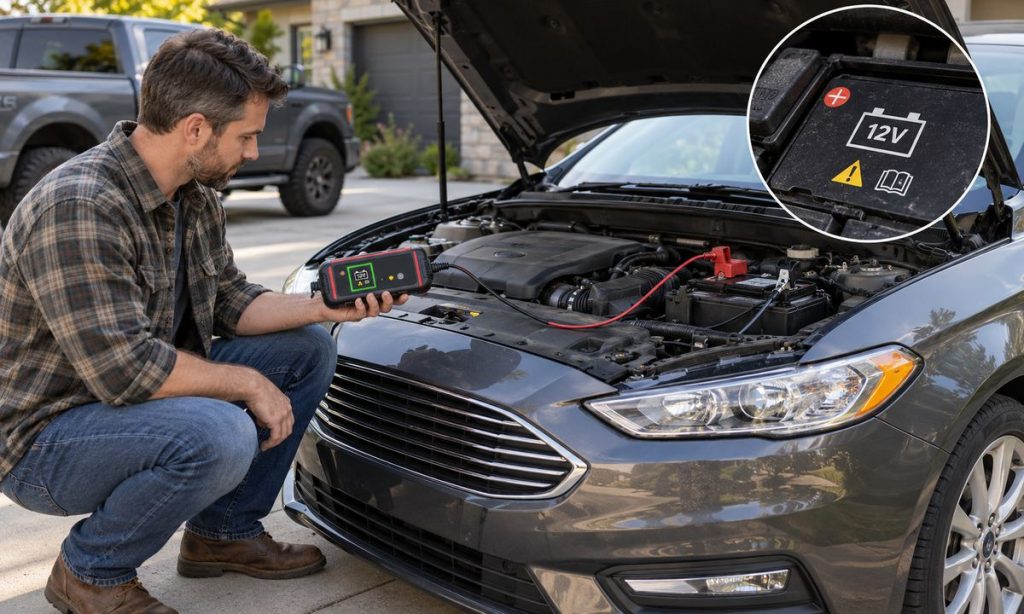
Check the 12-volt battery label for nominal voltage, chemistry, capacity or group information, and whether it is marked AGM or another type. Do not assume every Fusion uses the same battery because it has the same body style. A replacement battery may differ from the original if the vehicle has been changed, so confirm what is installed rather than relying on a generic online fitment listing.
Match charger chemistry and output
Buy a charger that explicitly supports the battery chemistry and voltage shown on the battery. Look for a regulated automatic charger or maintainer with the correct mode, reverse-polarity protection, overcharge safeguards, and a current rating suitable for the battery’s size and condition. Many smart chargers offer separate lead-acid, AGM, gel, or lithium modes; only select a mode if the actual battery label and vehicle documentation call for it. A device that claims to work with several chemistries still needs the correct setting.
For routine maintenance on a healthy 12-volt battery, a lower-current automatic charger may be appropriate, while a deeply discharged battery may require a controlled recovery procedure or professional testing. Do not choose solely by the largest amperage number or use a jump starter as a charger. Follow the charger maker’s instructions for ventilation, ambient temperature, connection points, and charging time. Never charge a damaged or frozen battery.
Follow the Fusion charging procedure
The owner’s manual explains whether the charger should connect at the battery terminals or at specified remote jump points. Modern vehicles may have a battery-monitoring sensor on a cable; attaching a charger to a point that bypasses the sensor can affect how the system estimates battery state of charge. Use the connection procedure for the exact model year and powertrain. Switch the charger off before attaching or removing clamps, keep leads clear of moving parts, and do not let clamps touch each other.
Hybrid or plug-in hybrid systems require extra caution. Do not touch orange high-voltage cables or remove high-voltage covers. If the 12-volt battery is inaccessible, the vehicle displays a charging fault, or a jump-start procedure is unclear, have a qualified technician handle it. After battery replacement or charging, some Ford battery-management systems may need a sleep period or reset procedure to relearn state of charge; follow the manual and service information that match the car.
Consider how the car is used
A Fusion driven mostly on short trips, stored for long periods, or used with accessories while parked may need battery testing or an approved maintainer. First diagnose why the battery is low. A charger will not correct a failing battery, parasitic draw, charging-system fault, loose terminal, or a drain caused by an accessory. If the battery repeatedly goes flat, record the timing and have the battery and charging system tested.
A maintainer is helpful only when its chemistry mode matches and the vehicle can safely remain connected as directed. Keep the car parked in a ventilated area and route cords so they cannot be pinched by doors or exposed to water. Do not leave an ordinary charger attached unattended unless the manufacturer identifies it as safe for that use.
A charger selection checklist
- Confirm whether the target is a 12-volt battery or a hybrid traction battery.
- Read the installed battery label for chemistry, voltage, and capacity.
- Verify the charger supports that chemistry and offers a proper automatic mode.
- Use a suitable output and protections for the battery size and condition.
- Check the Fusion model-year manual for connection points and battery-monitoring instructions.
- Stop and seek service if the battery is damaged or repeatedly discharges.
After identifying the battery, record its chemistry and capacity so you can compare charger specifications directly rather than selecting a charger by vehicle name alone.
Understand charger status and battery recovery
A smart charger may report charging, maintenance, fault, or recovery states, but indicator lights differ by brand. Read the supplied manual rather than assuming that a flashing light means a full battery. If the charger rejects the battery, repeatedly stops, or reports a fault, disconnect it as directed and have the battery tested. Do not use an aggressive repair or desulfation mode unless the charger maker and vehicle information allow it for that battery. After a successful charge, check whether the Fusion starts normally and whether battery warnings return. Recurring warnings call for a battery and charging-system diagnosis.
For general charger features and supported battery types, see the site’s car battery charger comparison. Use it only as a broad comparison resource; confirm the battery chemistry and charging procedure for your Fusion.
Frequently Asked Questions
Can I use an AGM setting on every Fusion battery?
No. Use AGM mode only if the installed battery and vehicle information specify AGM. Check the battery label before selecting a charger profile.
Can a 12-volt charger charge a Fusion Hybrid’s high-voltage battery?
No. A 12-volt charger is for the auxiliary battery only. The traction battery uses the vehicle’s designed high-voltage charging system.
Will a charger fix a battery that keeps going flat?
It may recharge a healthy discharged battery, but repeated discharge can point to battery wear, an accessory draw, loose connections, or a charging fault.
Can I leave a charger connected overnight?
Only if it is designed for unattended automatic charging and the battery maker’s and charger maker’s instructions permit it in the location and conditions.
Should I disconnect the battery before charging?
Follow the Fusion model-year manual and charger instructions. Some vehicles provide designated charge or jump points and battery-monitoring requirements.
Final Words
Choose a Ford Fusion battery charger only after identifying the exact 12-volt battery chemistry and the vehicle’s connection procedure. Match voltage, chemistry, current, and safety features, and keep hybrid high-voltage equipment separate from 12-volt service. Repeated discharge needs diagnosis, not just another charging cycle.
References
- Ford Owner Manuals (select the Fusion year and powertrain for battery and charging instructions).
- Ford 10-Amp Battery Charger/Maintainer (illustrates supported battery types; verify suitability for the installed battery).
- 2018 Ford Fusion Owner’s Manual (example manual; use the version for the vehicle’s year).