
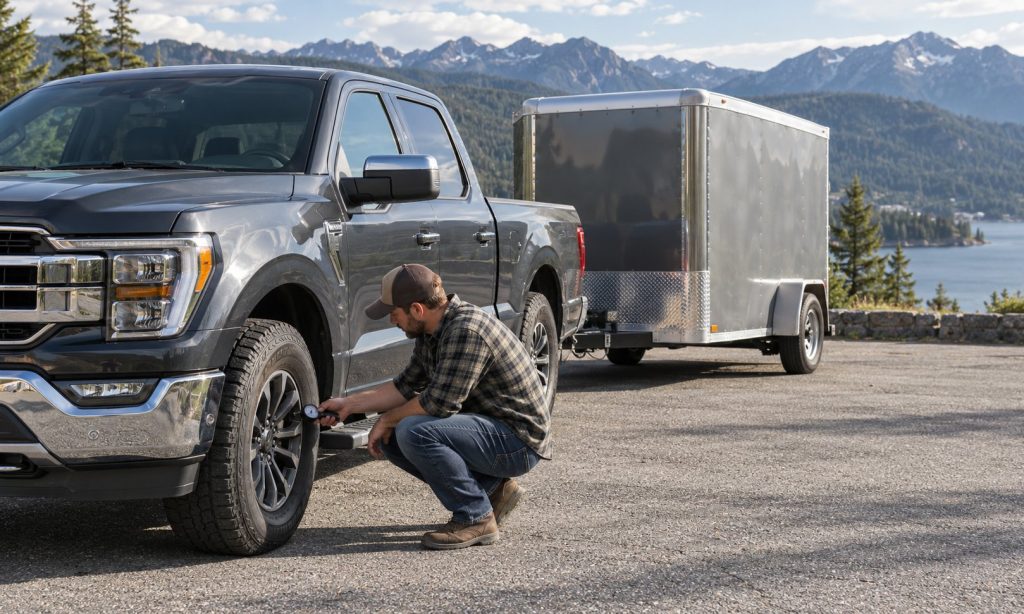
Winter tire sizing and fitment questions for Ford Ranger start with one rule: confirm the exact truck and its approved tire specification before choosing a winter setup. Ranger model year, trim, wheel package, drivetrain, engine, and market can change the correct size and load requirements. Read the tire placard on the driver-side door area and the owner’s manual for your specific model year; do not rely on a generic online size chart or another Ranger’s setup. Then compare the proposed winter tire’s full size, load index, speed rating, wheel compatibility, and clearance. If you are considering an all-terrain tire for Ford Ranger, remember that all-terrain labeling alone does not establish winter performance. This guide explains what to verify, what questions to ask, and when to get a tire professional involved.
Start with the vehicle’s exact specification
Record the model year, trim, cab, drivetrain, engine, and wheel size. Note whether the truck is stock or has a lift, leveling kit, aftermarket wheels, spacers, or other changes. The tire information label normally gives the original front and rear size and cold inflation pressure, while the owner’s manual can explain restrictions and alternate approved sizes. Use documentation for the truck’s model year and US market because a size listed for a different year or country may not apply.
Read the complete sidewall designation rather than only the diameter printed in a listing. Width, aspect ratio, rim diameter, load index, and speed symbol all matter. For example, two tires can share a nominal wheel diameter while differing in width, overall diameter, construction, load capacity, and clearance. A tire that mounts on a wheel is not automatically an appropriate fit for the truck.
NHTSA advises choosing the original size or another size recommended by the vehicle manufacturer and using the vehicle placard or owner’s manual to confirm it. The U.S. Tire Manufacturers Association likewise cautions against selecting a replacement tire with a smaller size or lower load capacity than specified. These principles are especially useful when winter shopping brings up many sizes that appear close.
Check winter capability separately from size
Winter use is not one condition. Wet pavement, slush, packed snow, deep snow, and ice ask different things of a tire. “All-season,” “all-terrain,” and “winter” describe broad categories, not a universal performance score. Look for the three-peak mountain snowflake symbol when severe-snow service is a concern, and verify that the exact tire model and size carries the marking. A model family may include variants with different ratings.
A winter tire can differ from the original tire in tread pattern, rubber compound, and sometimes construction or load rating. Confirm the candidate meets the Ranger’s required load and speed specifications and is approved for the wheel. If the manufacturer’s guidance calls for a matching set, do not mix winter and non-winter tires or different sizes to solve a fitment problem. Four-wheel drive can help the truck accelerate on slippery surfaces, but it does not remove the need for appropriate braking and cornering grip.
Compare the full fitment details
Before ordering, ask the installer or tire professional to confirm each item below against the Ranger’s placard and manual. Give them the full vehicle configuration and disclose modifications.
- Does the complete tire size match an original or manufacturer-approved option?
- Does the tire meet the required load index and speed rating for this truck?
- Is it compatible with the wheel width and diameter, including any aftermarket wheel?
- Will the tire clear the suspension, body, and steering at full lock and through suspension travel?
- Are front and rear fitments required to match, and does the spare remain usable?
- Does the proposed tire’s winter marking apply to the exact model and size?
- What cold inflation pressure and tire-pressure monitoring setup apply?
Do not use the maximum pressure molded on the sidewall as the normal target pressure. NHTSA says to use the vehicle’s recommended cold pressure on its tire label or in the manual. Check pressure when tires are cold and recheck as temperatures fall. The proper pressure is tied to the vehicle and its load; it is not a way to compensate for a tire that does not fit.
If the Ranger has a lift, larger wheels, or a changed suspension, the original label may not describe every consequence of the modification. Ask a qualified shop to assess the complete combination, including steering and suspension clearance, tire load capacity, speedometer effects, and the spare. Do not assume that a tire size used by another lifted truck is safe for yours. A professional should also check for rubbing after installation under the relevant steering and loading conditions.
Think through your winter driving
Describe the roads you actually use: plowed highways, steep neighborhood streets, rural roads, frequent slush, or unmaintained snow. Consider how often you drive in those conditions and whether you can avoid travel during severe weather. This helps you discuss the right tire category without treating one label as an answer to every winter problem.
If comparing user experiences, treat them as anecdotal. A driver’s report about snow traction can depend on tire age, tread depth, pressure, vehicle load, surface, temperature, and driving style. Public comments are most useful when they identify a question to investigate, such as road noise or wear, rather than as proof that the same setup will behave identically on your Ranger.
Common fitment mistakes to avoid
The first mistake is choosing a tire from a broad model-year range without checking the truck’s trim and wheel package. Another is comparing only the advertised width and diameter while overlooking the load index, speed symbol, or construction. Also avoid assuming that a larger tire provides more winter grip or that a more aggressive tread automatically performs better on ice. Those conclusions depend on the exact tire and conditions.
Do not set pressure by copying a number from another vehicle, a forum post, or the tire sidewall maximum. Do not mix tire types or sizes unless Ford’s instructions explicitly allow the arrangement. If a shop cannot confirm the proposed fitment, ask for the basis of the recommendation and pause the purchase until the question is resolved.
Frequently Asked Questions
Can I use a different tire size for winter on my Ford Ranger?
Only if the size is approved for the exact truck and wheel combination. Verify it in the owner’s manual or through Ford or a qualified tire professional, including load and speed ratings, clearance, and the spare.
Does four-wheel drive mean I do not need winter tires?
No. Four-wheel drive can aid acceleration, but tires still provide the grip needed for braking and cornering. Choose a tire suited to the conditions and follow safe winter-driving practices.
What does the three-peak mountain snowflake symbol mean?
It identifies a tire that meets a standardized severe-snow traction threshold. Check the exact tire variant and size; the symbol does not promise equal performance on every snow or ice surface.
Should I change tire pressure when winter temperatures drop?
Check pressures when the tires are cold and adjust to the Ranger’s placard or manual specification. Do not use a sidewall maximum or another vehicle’s pressure as the target.
Can I install winter tires on only two wheels?
Follow Ford’s guidance for your model year and drivetrain. A mismatched set can affect handling and vehicle systems, so have a tire professional confirm the required arrangement before installation.
Final Words
The safest answer to winter tire sizing and fitment questions for Ford Ranger comes from the exact truck’s placard, owner’s manual, and a verified tire application. Check the full size, ratings, wheel fit, clearance, winter marking, pressure, and spare before buying. Category labels and another Ranger owner’s experience are useful starting points, not proof of compatibility. If your truck is modified or the documentation leaves a question unanswered, ask a qualified tire professional to confirm the complete combination before installation.
Pingback: Best Tires for 2014 Hyundai Santa Fe Sport: 7 Picks