
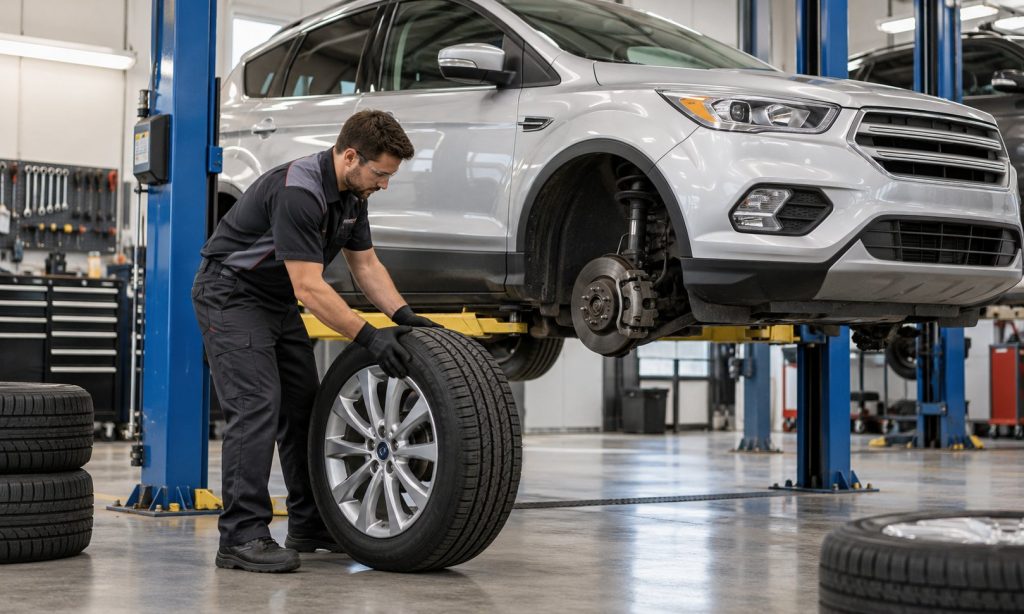
How tire rotation patterns affect tire life on Ford Explorer depends on more than the arrows in a diagram. The correct pattern has to match your Explorer’s model year, drivetrain, tire design, wheel setup, and any full-size spare included in the rotation. A rotation can help distribute normal differences in wear among positions, but it cannot repair a tire already damaged by misalignment, incorrect pressure, a worn suspension part, or a mechanical problem. Start with the maintenance schedule and tire instructions in the manual for your exact Explorer. Then confirm that the tires are eligible for the selected pattern and that the tire-pressure monitoring system is handled as required. If you are also comparing all-season tires for Ford Explorer, remember that tire choice and rotation schedule are separate decisions.
Why the rotation pattern matters
Tires can wear at different rates depending on axle position, steering, braking, vehicle load, inflation, road surface, alignment, and driving habits. Rotating eligible tires moves each one to another position so normal differences can be spread more evenly over time. Ford’s Explorer owner guides say following the recommended rotation interval can promote more even wear and longer tire life. Rotation is preventive maintenance, not a guarantee of a specific mileage or a fix for an underlying problem.
A pattern describes where each tire moves. A front-to-rear pattern keeps each tire on the same side. A cross pattern moves tires diagonally between axles. Some designs have a directional tread that must keep rolling in the marked direction. A staggered setup may use different front and rear sizes, which limits or prevents rotation. A full-size spare may or may not belong in the sequence, depending on the vehicle’s instructions and matching spare.
That is why a generic diagram is not enough. The correct pattern is the one permitted by Ford and the tire manufacturer for your specific configuration. For context, related pages discuss rotation patterns on a Ford Escape Titanium and a Ford Fusion; neither should replace the Explorer manual.
Use the Explorer’s schedule and tire setup
Find the maintenance schedule for the exact model year and use its interval or vehicle reminder. Do not substitute a universal mileage interval when Ford specifies another schedule or when a tire warranty has additional conditions. If the manual’s instructions are unclear, contact Ford or a qualified tire service professional with the vehicle identification number, tire sizes, and drivetrain details.
Before choosing a pattern, check the sidewalls and the vehicle’s configuration:
- Are all four road tires the same size and construction?
- Does any tire show a rotation arrow or inside/outside marking?
- Is the wheel setup staggered, or have the wheels been changed?
- Is the spare full-size and an approved match, or is it a temporary compact spare?
- Does the Explorer require a tire-pressure sensor position relearn after rotation?
- Are there signs of unusual wear, vibration, damage, or pressure loss?
A temporary spare should not be put into a rotation unless the vehicle manufacturer specifically instructs it. A full-size spare also needs to match the applicable size, construction, and condition requirements before it can be used in a five-tire rotation. Tire and wheel combinations differ between Explorer generations, so do not assume a procedure for a 2005, 2013, or 2024 model applies to yours.
Rotation can help, but it will not fix every wear pattern
Rotation may help even out ordinary front-to-rear or side-to-side differences. It cannot correct an alignment angle, wheel balance issue, incorrect cold pressure, dragging brake, bent wheel, or worn suspension component. Ford owner guidance for some Explorer years specifically says to have uneven wear checked for alignment, balance, or mechanical causes before rotating. If one tire is much more worn than the others, ask a technician to identify the cause instead of moving the problem to another axle.
Inspect tread across the inner, center, and outer sections, and compare tires on the same axle. Note feathering, scalloping, cupping, bald spots, cracks, bulges, or embedded objects. Do not attempt to diagnose a suspension issue from a single visual clue. If the vehicle pulls, vibrates, or makes a new rhythmic noise after service, return to the shop for inspection. A tire may need balancing or repair, and some tires cannot safely be rotated after damage or excessive wear.
Correct pressure matters too. Check cold inflation against the Explorer’s door placard, not the maximum pressure printed on the tire. The front and rear recommended pressures may differ. Recheck them after the tires move because the pressure requirement follows the vehicle position, not the tire that used to occupy it.
TPMS and service checks after rotation
The tire-pressure monitoring system may identify each tire by location. Depending on the Explorer’s model year and system, a rotation can require a sensor relearn or calibration. Follow the manual and use the right service procedure; do not assume the system will automatically display the new wheel positions. If a warning appears or the screen assigns pressure readings to the wrong corners, ask the shop to verify sensor operation.
Public Explorer owner discussions often raise two recurring questions: whether a spare is included and whether tire positions need to be relearned. Owners also report vibration or unexpected wear after rotation. Those reports are anecdotal and often involve different years, tire types, and modifications. They are useful prompts to check the manual, confirm wheel balance, and verify TPMS setup—not proof that every Explorer needs the same procedure.
After service, make sure lug nuts were tightened to the correct specification and that cold pressures match the placard. If you use a shop, ask it to record the rotation pattern and note any irregular wear it found. When load or towing use changes, review the Explorer’s tire-pressure instructions; our guide to Ford Explorer tire pressure under load covers why those conditions need attention.
What rotation can—and cannot—do for tire life
A consistent, correct rotation can help tires wear more uniformly, which may allow you to use their tread more evenly. It does not extend life by a fixed number of miles for every driver. Tire model, alignment, road conditions, pressure, climate, vehicle load, and driving style all affect wear. Record tread depth and service dates so you can see whether one position is wearing faster over time.
If your Explorer uses a different tire type or wheel arrangement, separate the fitment question from the maintenance question. Discussions of all-terrain versus highway tires for Explorer and tires for a 2016 Explorer XLT illustrate why exact size and setup matter. A separate review of all-season tires for a 2016 Ford Escape is not evidence of the right tire for an Explorer.
Frequently Asked Questions
How often should I rotate tires on a Ford Explorer?
Follow the maintenance schedule for your exact model year and tire setup. If you use a separate tire warranty interval, make sure it does not conflict with Ford’s instructions or the tire manufacturer’s requirements.
Which tire rotation pattern does an Explorer use?
The pattern can vary by model year, drivetrain, tire direction, wheel setup, and spare. Use the illustration in the correct owner’s manual and confirm it with a tire professional if your setup has been modified.
Can I rotate directional tires across the vehicle?
Directional tires generally must keep rolling in the marked direction. Their rotation options may be limited to front-to-rear on the same side unless a professional remounts them appropriately.
Should the spare tire be included?
Only when it is a matching full-size spare and the Explorer’s instructions allow it. A temporary spare is not a normal rotation tire.
What if the Explorer vibrates after a tire rotation?
Have the tires and wheels checked for balance, damage, correct mounting, and pressure. A new vibration should not be dismissed as a normal result of rotation.
Final Words
Tire rotation patterns affect tire life on Ford Explorer by changing where eligible tires run, helping distribute normal position-related wear. The pattern and interval still need to match your model year, drivetrain, tire direction, wheel sizes, and spare. Rotation will not correct an alignment, pressure, balance, or mechanical problem. Use Ford’s schedule, inspect unusual wear, and verify TPMS and pressure after service. If you are evaluating all-season tires for Ford Explorer, confirm the exact tire specification separately from the rotation plan.

Pingback: Uneven Tire Wear After F-150 4x4 Suspension Work: Checks
Pingback: Best All-Season Tires for 2011 Hyundai Sonata: 7 Picks
Pingback: Best All-Season Tires for Hyundai Tucson 2: 7 Picks