
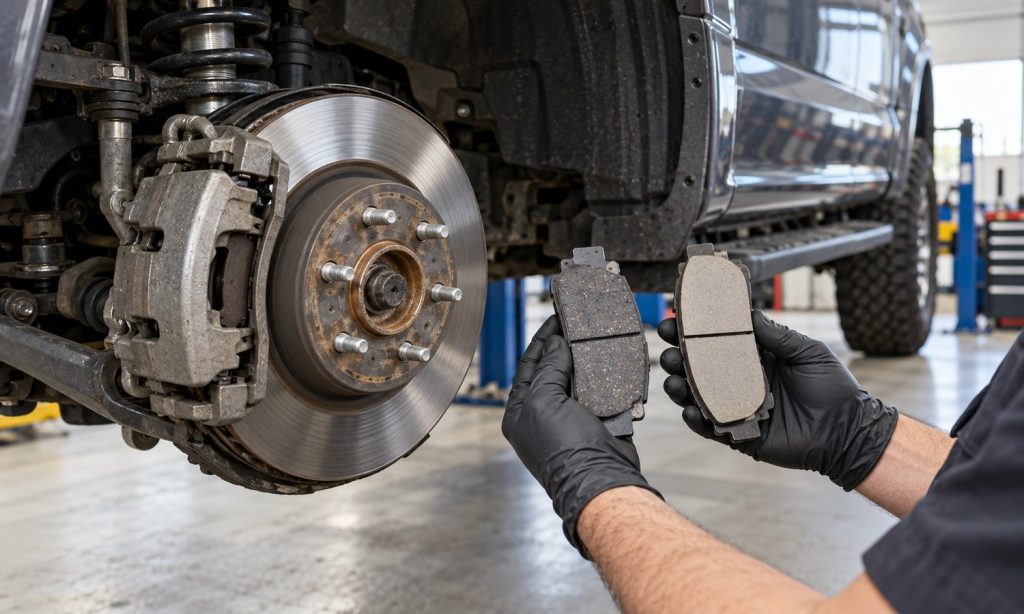
Ceramic vs. semi-metallic brake pads for Ford F-150 4×4 is not a universal winner-takes-all choice. Both labels cover a range of friction formulations, and the right pad must be approved for the truck’s exact model year, brake package, axle, rotor, and driving conditions. Ceramic pads are often selected for their quieter operation and lighter-colored, less visible dust; semi-metallic formulations are often designed for higher heat and demanding use. Those are broad tendencies, not guarantees for every pad. Start with Ford’s fitment and service guidance, then compare evidence for the exact application. If your maintenance list also includes shocks for 2014 Ford F-150 4×4, treat suspension fitment as a separate question from brake-pad material.
Fitment comes before friction material
F-150 brake hardware changes by model year, engine, trim, axle, wheel package, and brake option. The front and rear pads may differ, and a 4×4 badge does not identify the complete brake package. Use the owner’s manual, Ford parts information, and a qualified service source to match the vehicle. Confirm the pad shape, backing plate, friction specification, hardware, wear sensor if equipped, and compatibility with the rotor and caliper.
Do not assume that a pad listed for “F-150 4×4” fits every generation. Aftermarket wheels, towing packages, special editions, and prior brake changes can affect parts selection. If a parts lookup asks for the VIN or axle code, use it. A pad that physically installs is not automatically an approved friction match for the truck.
A 4×4 truck’s brake system still needs to meet its original design requirements. Pad material alone does not compensate for a worn rotor, seized caliper, damaged hose, poor installation, or an overloaded trailer. A professional should inspect the complete brake system when the pads are replaced.
What the two labels usually mean
Ceramic pads use ceramic-based friction materials with other ingredients; semi-metallic pads use a greater proportion of metal fibers and friction modifiers. Exact recipes are proprietary and vary. A 2021 SAE paper compared several ceramic formulations and a semi-metallic formulation on one brake setup, finding differences among the tested materials in friction, wear, noise, and vibration. That supports a practical point: the formulation and brake application matter more than the category name alone.
| Factor | Ceramic tendency | Semi-metallic tendency |
|---|---|---|
| Dust appearance | Often lighter and less visible on wheels | Often darker and more noticeable |
| Noise | Some formulations are tuned for lower noise | Some may produce more audible noise, depending on design and installation |
| Heat and repeated braking | Performance varies by formulation and application | Many designs are intended for higher heat or demanding use |
| Rotor interaction | Wear depends on the pad and rotor pairing | Wear also depends on formulation, rotor, and operating conditions |
This table describes common tendencies, not test results for a specific F-150. A premium ceramic pad may outperform a low-quality semi-metallic pad in one use and not another. Do not use material type alone to predict stopping distance, fade resistance, service life, noise, or rotor wear.
Match the pad to how you use the truck
For ordinary commuting, the exact original-equipment specification or an approved equivalent is a sensible baseline. If your F-150 frequently hauls or tows, ask the technician to confirm the replacement pad is intended for that application and meets Ford’s requirements. Repeated heavy braking generates heat, but towing weight, trailer brakes, driving technique, rotor condition, and the truck’s ratings all matter. A change in pad material does not raise the vehicle’s tow rating or replace correctly functioning trailer brakes.
If you prioritize clean-looking wheels or quiet stops, compare independent data and owner reports for the exact pad part number and truck application. If you regularly use the truck under heavier loads, compare data on the actual friction characteristics and temperature range with a qualified technician. Avoid assuming that “semi-metallic” always means stronger braking or that “ceramic” always means less dust. The actual friction compound and its approved use are decisive.
F-150 owner discussions about ceramic and semi-metallic pads often focus on dust, noise, towing, and rotor life. Reports vary, including among owners with similar trucks, because the pad brand, rotor, driving conditions, installation, and break-in differ. Treat those comments as prompts for questions rather than controlled evidence. Related context includes a published comparison of ceramic and semi-metallic pads on a Ford F-350, but that heavier truck’s use and brake parts are different.
Check rotors, hardware, and installation quality
New pads need a compatible rotor surface and correct installation. A technician should check rotor thickness, condition, runout as appropriate, caliper movement, hardware, and any electronic wear or parking-brake components. Resurfacing or replacing a rotor depends on its condition and the manufacturer’s limits; do not assume it must always be replaced with pads or that it can always be reused.
Noise after service can come from pad fit, hardware, rotor finish, contamination, bedding, or another brake component. It is not proof that ceramic or semi-metallic material is inherently defective. Ford service information for some vehicles specifically treats brake noise as a system diagnosis rather than a material label. If the pedal feels abnormal, the vehicle pulls, a warning appears, or braking performance changes, stop driving when safe and have the brakes inspected.
For related service context, see when to replace Ford F-150 4×4 rotors with pads and brake-pad bedding-in basics for F-150 4×4. Use the procedure for your specific pad and vehicle; bedding instructions are not interchangeable across products.
A practical comparison checklist
Before deciding between two compatible options, gather comparable details instead of relying on the category name. Check that tests or reviews identify the vehicle, brake package, pad part number, rotor, and conditions. Ask the installer to explain whether the candidate matches the original specification and the truck’s workload.
- Does the exact part number fit your F-150’s year, axle, and brake package?
- Does the manufacturer list the pad for towing or other heavy-use conditions relevant to you?
- Are noise, dust, wear, and friction claims backed by comparable testing?
- Will the pad work with the rotor type and condition on the truck?
- Are shims, clips, wear sensors, and parking-brake components included or specified?
- What break-in procedure applies to this exact pad and rotor combination?
- What symptoms after installation should prompt a return inspection?
Do not choose based only on price, a star rating, or a broad statement that one material “stops better.” If the truck is used for towing, consider the entire braking combination. Our overview of how towing weight affects F-150 brakes and suspension explains why load and setup matter alongside pad choice. Product listings such as brake pads for a 2016 F-150 or F-150 4×4 brake-pad options still require vehicle-specific compatibility checks.
Frequently Asked Questions
Are ceramic pads always quieter on an F-150?
No. Some ceramic formulations are designed for quiet operation, but noise also depends on the pad, rotor, hardware, installation, and vehicle condition.
Are semi-metallic pads better for towing?
Not automatically. Some semi-metallic formulations are intended for demanding heat conditions, but choose only a pad approved for your exact brake package and use.
Do ceramic pads always create less brake dust?
They often produce lighter-colored, less visible dust, but the amount varies by formulation and driving. No pad is dust-free.
Can I switch pad materials without changing rotors?
A technician must inspect the rotors and confirm they meet the applicable limits and are compatible with the new pads. The material label alone does not determine whether rotors need service.
Will a different pad material increase my F-150’s towing capacity?
No. Brake-pad selection does not change the truck’s rated towing, payload, or axle limits, and it does not replace the trailer’s required braking equipment.
Final Words
For a Ford F-150 4×4, choose ceramic or semi-metallic pads only after confirming exact fitment and the manufacturer’s approved application. The labels suggest broad material tendencies, but they do not guarantee a specific stopping distance, noise level, dust amount, or service life. Compare evidence for the exact pad and brake package, consider how the truck is driven, and have rotors and hardware inspected during service. If you also need shocks for a 2014 Ford F-150 4×4, verify that suspension fitment separately; it does not determine the right brake-pad compound.
Pingback: Best Brake Pads and Rotors for Nissan Altima: 7 Picks