
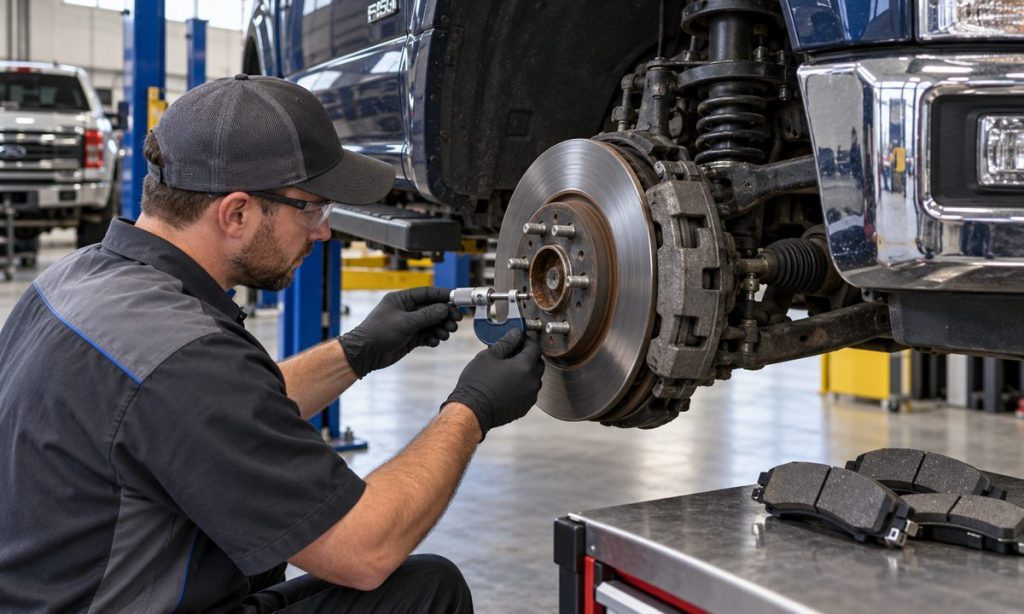
You do not have to replace the rotors every time you replace brake pads on a Ford F-150 4×4. Replace a rotor when it is below its stamped minimum thickness, cannot be machined within specification, is cracked or otherwise damaged, or a technician finds another condition that makes it unserviceable. A rotor that is still within the exact year-and-brake-package specification may be reused if its surface and runout are acceptable and the new pads can bed in correctly. F-150 brake hardware varies by model year, axle, trim, wheel, and package, so do not use a generic thickness number. If you are reviewing brake pads for a Ford F-150 4×4, verify the pads and rotors for the truck’s exact configuration. Brake work is safety-critical; use Ford service information or a qualified technician for inspection and repair.
When rotors should be replaced with pads
The rotor must be replaced if its thinnest measured point is at or below the “MIN THK” marking or the applicable service-manual limit. The minimum is not a suggestion to keep driving until the rotor looks thin; it marks a limit for safe heat capacity and braking operation. A rotor can also need replacement because of cracks, severe corrosion on the friction surface, deep scoring, heat damage, or a defect that cannot be corrected while preserving the required thickness and surface condition.
Replace or resurface rotors in pairs on the same axle when the applicable Ford procedure calls for it; do not replace only one rotor on an axle. Brake pads are also replaced as an axle set. The axle-pair rule helps keep braking response consistent from side to side. Do not mix a new rotor on one side with a worn, different rotor on the other unless a qualified technician has confirmed an approved procedure for that specific vehicle.
Rotors do not always have to be replaced simply because the pads are new. If the rotor is above minimum thickness, has no cracks or serious damage, meets runout and surface requirements, and the service procedure permits reuse, it may be serviceable. The mechanic should also inspect calipers, slide pins, hardware, hoses, and pad wear pattern to identify why replacement is needed and whether the rotor will work properly with the new pads.
How to check rotor condition
A visual check can identify obvious damage but cannot reliably establish remaining thickness. The minimum specification may be stamped on the rotor hat or found in the correct Ford service information. A technician measures the friction surface with a brake micrometer at several points around the disc, avoiding the outer rust lip. The lowest reading is compared with the exact minimum. Runout and thickness variation are separate measurements that may matter when the truck has brake pulsation or vibration.
Do not use a number found for a different F-150 year, 2WD model, axle, or brake package. For example, Ford’s later owner-manual inspection guidance includes axle-pair replacement and measuring procedures, but its numeric dimensions are specific to the covered vehicle. A 4×4 badge does not by itself identify rotor size. Confirm model year, VIN or brake option, front versus rear axle, and the part marking before deciding.
A brake pedal that pulses, steering-wheel shake, scraping, grinding, or pulling can come from several causes. Rotor thickness variation or runout may be involved, but so can deposits, a sticking caliper, a wheel or tire issue, a loose component, or a damaged bearing. A shiny rotor surface does not rule out a thickness problem, and grooves alone do not show the measurement. Have the cause diagnosed instead of replacing parts based only on one symptom.
Can rotors be resurfaced instead?
Resurfacing can be considered only when the rotor is otherwise serviceable and will remain above the specified minimum after machining. Some Ford procedures distinguish a “minimum thickness” from a thicker “minimum thickness to machine” value. The finished surface must also meet the required finish and dimensional tolerances. If machining would leave the rotor too thin, if the rotor is cracked, or if damage is too severe, replacement is the safer repair path.
A shop may recommend new rotors because machining equipment, labor, parts availability, or the condition of the old discs makes replacement the more practical option. Other shops may reuse a rotor that measures within limits. Public owner discussions reflect this same debate—some drivers describe reusing smooth rotors with sufficient thickness, while others replace both at each pad service. Those are individual experiences and shop choices, not a universal Ford interval. The correct decision comes from measurements and the procedure for your truck.
Why the truck’s 4×4 setup matters
Four-wheel drive does not establish a special blanket rule that every rotor must be changed with every pad set. But F-150 4×4 models can have different brake hardware across years and trims, and front or rear service may differ. Some newer vehicles also use electronic parking brakes or other systems that require a service mode or scan tool. Follow model-specific procedures; do not force a caliper piston or bypass a required electronic step.
Before ordering parts, match the year, cab, trim, engine, axle, wheel size, and brake package. Confirm front versus rear, rotor diameter and thickness, pad shape, caliper arrangement, and any sensor or hardware requirements. A parts listing that says “fits F-150 4×4” may still cover only certain configurations. Have the installer cross-check the VIN and the existing part numbers.
Questions to ask before approving brake work
- What is the rotor’s lowest measured thickness, and what is its exact minimum specification?
- Was runout or thickness variation measured if vibration was reported?
- Can the rotor be machined while remaining above the required post-machining limit?
- Are both rotors on the affected axle being replaced or machined consistently?
- Were caliper movement, pad wear pattern, brake hoses, and hardware inspected?
- Do the replacement parts match the truck’s VIN and brake package?
Do not drive the truck if the pedal sinks, braking is severely reduced, a rotor is cracked, or there is metal-on-metal grinding. Arrange a safe tow or professional inspection. When lifting the truck or removing brake components, use the correct lifting points and stands, procedures, torque specifications, and protective equipment; if you are unsure, leave the work to a qualified brake technician.
Frequently Asked Questions
Should I always replace rotors with brake pads?
No. Replace rotors when they fail the exact thickness or condition limits, cannot be machined to specification, or the service procedure otherwise requires replacement. A measured, serviceable rotor may be reused.
Can I replace just one rotor?
Ford guidance for covered models calls for replacing both discs on the same axle when replacement is necessary. Follow the procedure for your exact model year and brake package.
How do I find the minimum rotor thickness?
Look for the “MIN THK” marking on the rotor and confirm it in the correct Ford service information. Do not borrow a measurement from another model year or axle.
Does a brake pulsation mean the rotors are bad?
Not necessarily. Pulsation can have several causes. A technician should measure rotor thickness variation and runout and inspect the rest of the brake and wheel assembly.
Can a shop machine a rotor below its minimum thickness?
No. The rotor must remain within the required specification after machining. If it would be too thin or is cracked or badly damaged, it needs replacement.
Final Words
For an F-150 4×4, make rotor replacement a measurement-and-condition decision, not an automatic add-on to every pad job. Use the “MIN THK” value and service procedure for the exact year and brake configuration, and replace components as axle sets where Ford specifies. Ask the shop to explain its measurements and inspect related hardware. The Ford F-150 4×4 brake pads guide offers fitment context, but only your truck’s verified configuration can determine which parts fit.
References
- Ford Brake Disc Machining Job Aid.
- Ford F-150 Brake Disc Thickness Inspection guidance (procedure and numeric specifications are vehicle-specific; confirm your model year).

Pingback: Brake pad bedding-in basics after a replacement on Ford F150 4X4
Pingback: Ceramic vs. Semi-Metallic F-150 4×4 Brake Pads