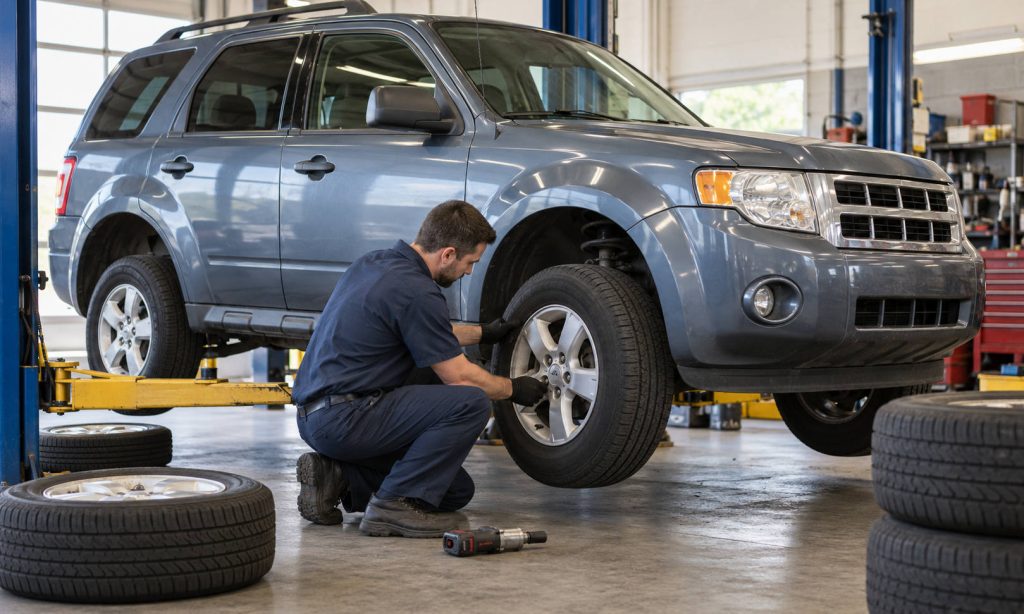
On a 2009 Ford Escape XLT, tire rotation affects how quickly the four tires reach their wear limits and how evenly the vehicle maintains grip. Rotation moves each tire to a different wheel position, sharing differences in steering, drive, braking, and cornering loads across the set. Ford’s 2009 owner’s guide says to rotate at the interval in the Scheduled Maintenance Guide and shows patterns by drivetrain. The exact diagram matters: the front-wheel-drive and four-wheel-drive versions do not necessarily use the same pattern. Start by checking whether your XLT is FWD or 4WD, then inspect the tire type and sizes before moving anything. If you are checking replacement fitment, see the site’s 2009 Ford Escape XLT tire overview; use the manual for the rotation sequence.
Why rotation changes tire life
The front tires steer and, on a FWD Escape, deliver engine torque as well. That combination can wear the front tread faster than the rear. Rear tires have their own loads and can develop a different wear pattern, particularly if alignment, suspension condition, pressure, or road crown is involved. Rotation gives each tire time at more than one position, which can reduce the gap between the most-worn and least-worn tires.
Even wear does not make tread last forever or repair a mechanical problem. Rotation can help the set wear more uniformly, but it cannot restore rubber already lost, correct toe or camber, balance a wheel, or cure a worn suspension joint. If one tire is visibly feathered, cupped, or worn on an edge, diagnose why before using a rotation to spread that pattern to another axle.
Use the 2009 Escape pattern that matches your drivetrain
Ford’s 2009 Escape Owner’s Guide includes a tire-rotation diagram for the 2009 Escape and directs owners to the scheduled maintenance information for timing. The guide’s FWD diagram uses a cross pattern: the front tires move to the opposite rear positions, while the rear tires move straight forward on their respective sides. Ford’s four-wheel-drive pattern differs. Confirm the exact illustration in the manual for your vehicle before asking a shop to rotate the tires.
Do not assume the drivetrain based on the XLT badge. The 2009 Escape was sold with different drivetrains, and used vehicles may also have replacement wheels or tires. Check the vehicle configuration, tire sizes, direction arrows, and any “outside” sidewall marking. Directional tires generally stay on the same side unless a tire shop dismounts and remounts them. A staggered setup with different front and rear sizes may limit rotation to side-to-side or make ordinary rotation impossible.
Follow the manual’s interval and check tread each time
The owner’s guide points to the vehicle’s Scheduled Maintenance Guide rather than establishing a universal interval in the rotation section. Use the maintenance schedule applicable to the Escape’s engine and use, and consider the tire maker’s guidance as a supplement. If the vehicle sees towing, frequent heavy loads, rough roads, or severe service, check the applicable maintenance schedule for special operating conditions. Do not apply an interval from a newer Escape without checking its manual.
At each rotation, measure tread depth at several points across every tire and note the readings by position. Compare inside, center, and outside tread, and look for cupping, scalloping, cracks, or embedded objects. A simple written record helps show whether the same corner continues to wear faster after rotation. Set cold pressure to the door-label specification after the tires change positions; front and rear pressure recommendations can differ on some vehicles.
When rotation will not solve uneven wear
Persistent inner-edge wear, one shoulder wearing faster, or repeated cupping calls for inspection. Ford notes that misalignment can cause rapid or uneven wear and that an impact with a curb or pothole can affect alignment or damage a tire. A tire that is out of balance can also wear irregularly. Have a technician inspect alignment, wheel balance, steering and suspension parts, and tire condition when the pattern is pronounced or returns quickly.
Public owner discussions about Escape tire wear commonly describe inner-edge wear and disagreements about whether alignment readings are acceptable. Those reports are anecdotes, not a diagnosis for every 2009 XLT. The useful takeaway is to measure and document the wear, then request an alignment and suspension inspection if the same pattern repeats. Do not rotate a badly damaged tire into a position where its condition is harder to notice.
Rotation limits and safe service
Do not include a temporary-use spare unless the manual identifies it as a matching full-size tire suitable for rotation. Ford warns that a dissimilar spare is for temporary use and should not be included. After service, confirm correct tire direction, wheel installation, and pressure. Ford’s guide also advises rechecking lug-nut torque after a wheel disturbance at the distance specified in the manual. A shop should use the correct torque specification rather than relying on an impact wrench alone.
If you rotate tires yourself, use a level surface, wheel chocks, the vehicle’s approved jacking points, and equipment rated for the vehicle. Never work beneath a vehicle supported only by a jack. If the pattern, tire construction, or wheel setup is unclear, let a qualified tire professional identify the allowed positions.
Frequently Asked Questions
Does a cross pattern always give a 2009 Escape XLT the best tire life?
No. Ford’s diagram varies by drivetrain, and directional or different-size tires can restrict the pattern. Match the manual to the actual vehicle and tire setup.
How often should I rotate the tires?
Follow the applicable 2009 Escape Scheduled Maintenance Guide and tire manufacturer instructions. Use the severe-service schedule if your driving conditions qualify.
Will rotation fix inside-edge wear?
It may distribute wear differently, but it does not correct the alignment or suspension cause. Have repeated edge wear inspected before it spreads.
Can directional tires be crossed to the opposite side?
Not while mounted in their current orientation. Keep the rotation arrow pointing forward at the top of the tire, or ask a tire shop about demounting and remounting.
Should the spare be part of the rotation?
Only if it is a matching full-size tire and the owner’s guide permits it. A dissimilar temporary spare should stay out of the rotation cycle.
Final Words
The right rotation pattern helps the tires on a 2009 Ford Escape XLT share their work and can reduce uneven wear across the set. Check the owner’s guide for the pattern that matches FWD or 4WD, confirm the tire construction and wheel sizes, and follow the applicable maintenance interval. Measure wear at each service; recurring edge or cupped wear deserves an alignment and suspension check. For replacement-size context, visit the published Escape XLT tire guide.