
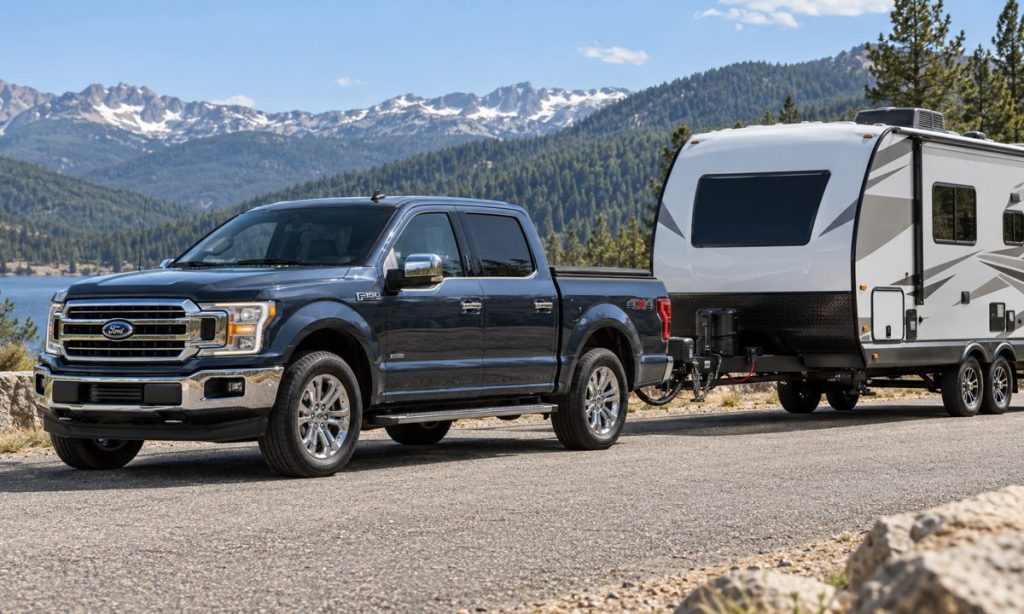
Towing weight changes what your Ford F-150’s brakes and suspension must manage, but it does not automatically mean you should install heavier-duty pads, springs, or shocks. The trailer’s actual weight, tongue load, truck payload, axle ratings, equipment package, and model year determine the limits. Start with the driver-door certification and tire labels, then check the owner’s manual and the towing guide for your exact F-150 configuration. Ford notes that towing adds load to the vehicle’s brakes, tires, axle, and suspension, and its 2016 manual requires separate functioning trailer brakes for loaded trailers over 1,500 pounds. If you are also comparing brake pads for a 2016 Ford F-150, confirm fitment by the truck’s year, trim, axle, and brake package; a product choice cannot increase the truck’s ratings.
Start with the actual weights and ratings
“Towing weight” is not one number. The trailer’s loaded weight affects the truck-trailer combination; tongue weight or fifth-wheel pin weight presses down on the truck and counts against payload and rear axle capacity. Add the driver, passengers, cargo, hitch, and installed accessories. The truck must remain within its GVWR and front and rear GAWR, and the combination must remain within GCWR and the specific maximum trailer weight for that engine, axle ratio, cab, bed, and towing package. The hitch receiver and tires have their own ratings.
Use the VIN-specific Ford towing guide and the labels on your truck, not a maximum headline figure for the model line. Weigh the loaded truck and trailer at a certified scale when approaching a limit. A truck can be under its advertised maximum trailer weight while over payload or rear-axle capacity because passengers, cargo, hitch hardware, and tongue load all consume capacity.
How weight affects braking
A heavier moving combination carries more momentum, so slowing and stopping demand more from the truck and trailer braking systems. On descents, repeated braking can add heat and increase the chance of fade. The trailer brakes, when required and properly adjusted, are meant to contribute to stopping; the truck’s service brakes still have to control the F-150 and help manage the combination. The 2016 F-150 owner’s manual says its braking system rating is based on the truck at GVWR rather than GCWR and requires separate working brakes on loaded trailers above 1,500 lb. Requirements differ by model year and jurisdiction, so check the applicable manual and local law.
A factory trailer brake controller, if equipped and compatible with the trailer’s brake type, can coordinate electric or electric-over-hydraulic trailer brakes according to the vehicle instructions. Follow Ford’s setup procedure and the trailer-brake maker’s guidance; test the system in a safe area before entering traffic. Do not rely on a brake controller to compensate for an overloaded truck, faulty trailer brakes, worn truck brakes, or poor loading. If the pedal feels soft, the truck pulls under braking, a warning light appears, or you smell overheated brakes, stop somewhere safe and have the system inspected.
How the load affects suspension and stability
Tongue or pin weight compresses the rear suspension and can reduce front-axle load. Too much rear squat may change headlamp aim, steering response, braking balance, and trailer control. A level stance alone does not prove the truck is within its ratings. Correct trailer loading and hitch adjustment matter: Ford’s guide explains that weight-distribution equipment may be required for some combinations and should be set according to the vehicle and hitch instructions. Never exceed the receiver’s rating or use a weight-distribution hitch where the vehicle or hitch maker prohibits it.
Suspension parts have different jobs. Springs support load; shocks or dampers control oscillation; sway bars influence body roll; helper devices can change how the suspension responds. A stiffer spring or air spring may reduce visible squat, but it does not increase GVWR, GAWR, payload, hitch, or tow ratings. An aftermarket part can also alter ride, handling, clearances, and warranty coverage. Ask a qualified installer to verify compatibility and describe exactly which behavior the part can address; do not treat it as added legal capacity.
Public F-150 towing discussions often describe rear squat, a firmer ride with suspension add-ons, or better stability after hitch setup and load changes. These are owner reports from different trucks and trailers, not controlled tests or proof that a modification is safe for your configuration. They reinforce a practical sequence: measure the load, set the hitch and trailer brakes correctly, and diagnose the vehicle before considering parts.
Choose maintenance by condition, not just trailer weight
Trailer mass by itself does not tell you which brake pads are appropriate. The factory brake package, rotor dimensions, calipers, wheel size, vehicle year, and intended use determine fitment. Inspect pad thickness and condition, rotor thickness and surface, caliper movement, hoses, fluid condition, and parking brake operation using the correct service information. Replace or machine rotors only within the specific minimum-thickness and service limits. A brake noise, vibration, or pull can have several causes; do not diagnose by sound alone.
Before a trip, check tires and cold pressures, wheel fasteners, suspension and hitch components, trailer coupler, safety chains, lights, breakaway system if fitted, and brake-controller connection. Ford recommends practicing stopping, turning, and backing in a low-traffic area. In hilly terrain, use the towing and grade-control features described for your model and avoid prolonged brake riding. Follow the maintenance schedule for severe or towing use in your exact owner’s manual.
Before changing brakes or suspension
- Confirm your exact F-150’s tow, payload, GVWR, GAWR, GCWR, tire, and hitch limits.
- Weigh the loaded truck and trailer when near a limit; include passengers, accessories, cargo, and tongue weight.
- Verify trailer brakes and controller compatibility, adjustment, and legal requirements.
- Inspect the truck’s brakes and suspension using model-specific service information.
- Match any replacement brake parts to the exact year, brake package, axle, and wheel configuration.
- Ask an installer to confirm that suspension equipment is approved for the truck and hitch setup.
If the truck exceeds any rating, reduce or redistribute the load or use a more suitable tow vehicle. Do not try to solve a weight-limit problem with stronger pads, helper springs, air bags, or tires. If the truck’s front end lifts noticeably, the combination sways, stopping changes, or a component is damaged, stop towing until the setup is checked by a qualified technician.
Frequently Asked Questions
Does a heavier trailer mean I need upgraded F-150 brake pads?
Not automatically. First confirm that the truck is within its ratings, the trailer brakes work, and the F-150’s factory brake system is in good condition. Replacement pads must match the exact brake configuration.
Will helper springs increase towing capacity?
No. They may change suspension sag or feel, but they do not raise the F-150’s certified payload, axle, hitch, or trailer ratings.
Does tongue weight count against payload?
Yes. Tongue or pin weight, hitch equipment, occupants, and cargo all use the truck’s available payload and affect axle loads.
When are trailer brakes required?
Requirements depend on the vehicle model year, trailer, and jurisdiction. The 2016 F-150 manual specifies separate functioning brakes for loaded trailers over 1,500 pounds; check your own manual and local rules.
Can I use a weight-distribution hitch to fix squat?
Only if the truck, receiver, trailer, and hitch makers permit and require that setup. Follow their instructions and ratings; do not use it to mask overloading.
Final Words
Towing weight affects F-150 braking demand, rear suspension compression, and stability, but the first step is verifying the exact truck-and-trailer weights against every rating. Maintain the factory brakes, use compatible and correctly adjusted trailer brakes, and set up the hitch by Ford’s instructions. Replace brake or suspension parts only after inspection and fitment confirmation. The related guide to brake pads for the 2016 Ford F-150 is relevant only if your truck matches that application; it does not establish a towing upgrade or capacity.
References
- 2016 Ford F-150 Owner’s Manual (vehicle-specific limits and trailer-brake instructions).
- Ford Towing Information.
- Ford 2024 RV & Trailer Towing Guide (general current towing guidance; verify your own model-year guide).

Pingback: Brake Pad Bedding-In Basics for Ford F150 4X4