
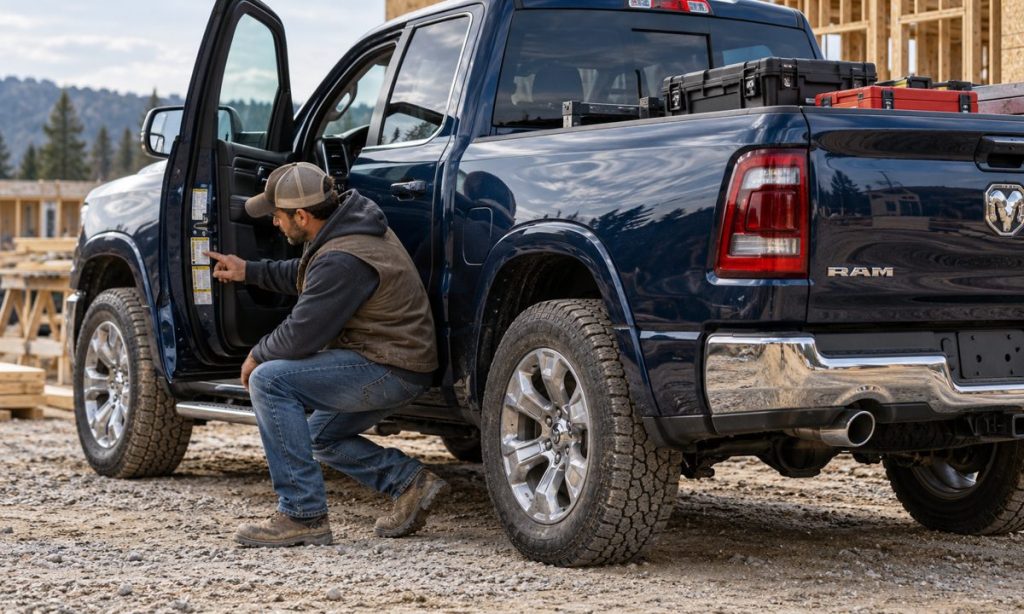
There is no single tire load range that every Dodge Ram 1500 needs. The correct replacement depends on the truck’s model year, cab, trim, wheel and tire package, and the specification on its driver-side Tire and Loading Information placard. Start there, then confirm the full tire size, service description, load index, cold pressure, and any owner-manual replacement requirements. A higher load range can offer more capacity at its specified pressure, but it does not raise the truck’s payload, GVWR, or axle ratings. For model-specific context on tires for a Dodge Ram 1500, use the buying guide in addition to the truck’s own labels and manual. Match your normal workload to the actual limits; do not choose by the “1500” badge alone.
Why the model name is not enough
Ram 1500 trucks have been sold across many generations and configurations. Two trucks with the same model name can leave the factory with different tire sizes, load indexes, wheel diameters, suspension packages, and payload ratings. A used truck may also have aftermarket wheels, a leveling kit, or a tire size that no longer matches its original setup. That means an online answer such as “all Ram 1500s need Load Range C” or “always use E” is too broad to apply safely.
Read the tire placard on the driver-side door or door pillar. Record the front and rear original tire sizes and recommended cold pressures. Read the vehicle certification label for GVWR and front and rear GAWR, and check the owner’s manual’s tire and loading sections. If the labels are missing or the installed wheels and tires differ from the listed equipment, ask a Ram dealer or qualified tire professional to identify the correct application from the VIN and inspect the modifications.
What the load range means
Load range is a tire category tied to the tire’s construction and its load-carrying capability at a specified inflation pressure. On light-truck tires, letters such as C, D, and E are commonly used. The letter is not a standalone weight rating: tire size and service description matter, and the tire maker’s load-and-inflation table explains how capacity varies with pressure. A load index is a separate numeric code that corresponds to a stated maximum load under specified conditions. Compare both the full tire designation and its rated capacity rather than relying on one letter.
The 2024 Ram 1500 owner’s manual directs owners to follow the placard’s tire size, loading conditions, and cold inflation pressures to stay within tire capacity. Its replacement-tire guidance calls for an equivalent tire and cautions against using a lower load index than the original. Check the manual for your specific model year because equipment and recommendations vary. A tire with a higher maximum capacity may still be unsuitable if its size, wheel fit, pressure, speed rating, clearance, or construction is wrong.
Match the tires to your usual workload
Write down what the truck routinely carries: occupants, child seats, tools, bed cargo, accessories, and any trailer tongue weight. The payload figure on the label is the combined allowance for people and cargo; it is not a separate cargo allowance. Add-ons such as a cap, rack, step, winch, or toolbox use part of that payload before you load the bed. Trailer tongue weight also presses down on the truck and counts against payload and axle capacity.
If you regularly carry substantial or uneven cargo, weigh the loaded truck at a certified scale and obtain separate front and rear axle weights where possible. Each axle must remain at or below its GAWR, and the entire truck must remain below GVWR. The weight on each tire is not necessarily one quarter of the truck’s total: front/rear distribution, passengers, bed placement, and side-to-side loading all matter. Use the tire maker’s capacity table for the exact tire at the correct pressure and have a qualified tire professional assess any borderline setup.
Owners discussing Ram 1500 tire changes often describe a real tradeoff: some report firmer ride with heavier-duty tires when the truck is lightly loaded, while others value the added tire capacity for their specific towing or hauling setup. Those posts refer to different generations, tire sizes, pressures, and vehicles, so they are anecdotal—not a pressure chart or fitment approval. The useful lesson is to compare load needs and ride expectations without assuming a heavier letter solves an overloaded-truck problem.
Pressure is part of the load rating
Set cold tire pressure to the value on the vehicle placard for the approved tire fitment. Check pressure when the tires have not been driven recently, preferably before the day’s trip. Pressure rises as tires warm, so do not bleed a warm tire down to the cold specification. Inspect all four tires and the spare if equipped; a TPMS warning does not replace routine gauge checks.
Do not inflate to the maximum number molded into the sidewall simply because the tire is marked Load Range E. That number is the tire’s maximum pressure under the stated condition, not automatically the truck’s everyday setting. Do not reduce pressure to improve ride comfort based on a forum post either. Any load-based pressure change must follow vehicle and tire manufacturer guidance for the exact combination and actual load. If the truck has aftermarket tires or wheels, have the installer verify pressure, capacity, clearance, speed rating, and TPMS compatibility.
Before buying a replacement set
- Match the exact year, cab, trim, drive configuration, wheel size, and placard tire size.
- Confirm the service description and load index meet the original requirement.
- Compare actual front and rear loading with each axle’s GAWR and the truck’s GVWR.
- Ask whether the tire maker approves the tire for the wheel and intended towing or hauling use.
- Check speed rating, clearance, spare fit, and TPMS compatibility.
- Have a qualified shop mount and balance the tires and set verified cold pressure.
If a tire professional suggests a different load range, ask what exact load table, tire size, pressure, and vehicle configuration support that choice. A stronger tire does not increase the truck’s certified ratings, make a suspension modification legal, or correct poor weight distribution. Stop if a label conflicts with the current hardware or if you find a bulge, exposed cords, repeated pressure loss, or unusual handling; have the truck inspected before carrying a heavy load.
Frequently Asked Questions
Does every Ram 1500 need Load Range E?
No. Use the placard and manual for the exact truck. Load Range E may be appropriate for some approved tire setups and uses, but the letter alone does not prove fitment or capacity at the truck’s required pressure.
Can I use a higher load index than the factory tire?
Potentially, but confirm the complete tire size, wheel compatibility, pressure, clearance, speed rating, and manufacturer approval. A higher index does not raise GVWR, GAWR, or payload.
Should the rear tires have more pressure when I haul cargo?
Follow the placard and the model-year manual unless the vehicle and tire manufacturers provide verified load-specific instructions for your exact setup. Do not guess at a higher pressure.
How do I know if the truck is overloaded?
Compare the actual loaded weight with GVWR and front and rear axle weights with their GAWRs. A certified scale can help, especially when cargo or tongue weight is substantial.
Can E-rated tires increase my towing capacity?
No. Tires do not change the truck’s certified payload, axle, hitch, or towing limits. Use the exact truck’s towing information and stay within all ratings.
Final Words
Choose a Ram 1500 tire load range from the exact truck’s placard and manual, then verify capacity against its real axle loads and normal use. Match the complete size and service description, keep pressure within manufacturer guidance, and remain below GVWR, both GAWRs, and payload limits. If the truck has been modified or the label does not match the installed tires, get the combination checked before hauling. The related guide to tires for Dodge Ram 1500 models can help with product context after you establish the required specifications.
References
- 2024 Ram 1500 Owner’s Manual (use the manual for the truck’s own year).
- NHTSA Tire Safety Ratings and Awareness.
Pingback: Dodge Ram 1500 Tire Pressure When Towing or Hauling
Pingback: Compare Ram 1500 Tire Noise and Wet Grip