Choose a battery charger for a Ford Explorer by matching the charger to the installed 12-volt battery’s chemistry, voltage, capacity, and the vehicle’s charging instructions. “Explorer” covers many model years and gasoline and hybrid configurations, and the battery type can change with trim or a previous replacement. Read the label on the battery and the owner’s manual before selecting a charger mode; do not assume every Explorer uses the same flooded lead-acid or AGM battery. Ford’s 2026 manual directs owners to use the vehicle’s designated ground point when connecting an external charger and to keep the ignition off while charging. A standard 12-volt charger is for the low-voltage battery, not the Explorer Hybrid’s high-voltage traction battery.
Identify the battery you are charging
With the vehicle off, check the battery label for chemistry, nominal voltage, capacity or rating, and any charging warnings. Common 12-volt automotive types include flooded lead-acid and absorbed glass mat (AGM). Some batteries have a maintenance-free case but still require the charger’s lead-acid mode; “sealed” alone does not identify the correct profile. If the label is unreadable, use the VIN and Ford parts information or ask a qualified service department to identify the installed battery.
Do not rely on an online battery-size lookup alone. A previous owner may have installed a different approved replacement, and the vehicle’s battery-management system (BMS) may require a specific battery type or a reset after replacement. If your Explorer is a hybrid, it may also have auxiliary low-voltage components in addition to a high-voltage traction pack. Follow the exact owner’s manual and do not touch orange high-voltage cables or components.
Match charger voltage and chemistry
The Explorer’s 12-volt battery needs a charger designed for 12-volt automotive batteries. Confirm that its selectable chemistry mode matches the battery label—such as conventional flooded lead-acid or AGM—and that the charger maker explicitly supports that battery type. Do not use a lithium-only charger on a lead-acid vehicle battery or choose a reconditioning/desulfation mode unless the charger and battery manufacturers permit it for the installed battery and connected vehicle.
Check the charger’s output current against the battery capacity and the charger maker’s instructions. A low-current maintainer is intended to keep a healthy battery topped up during storage; it may be too slow to recover a deeply discharged battery. A higher-output charger is not automatically better for every battery or for charging while it remains connected to the vehicle. If the battery is very low, damaged, frozen, hot, or repeatedly loses charge, have it tested rather than trying increasingly aggressive modes.
Use the vehicle’s approved connection points
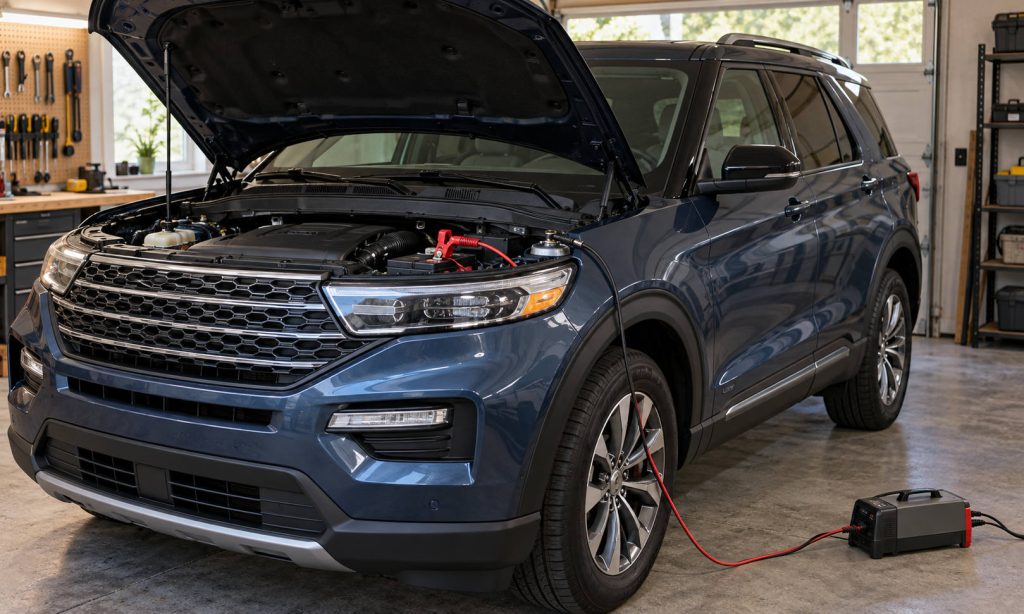
Read the Explorer manual’s charging section before connecting clamps. Ford’s 2026 manual says to use the designated vehicle ground point for the negative charger connection and to keep the ignition off during charging. The correct procedure can vary by model year and engine, so confirm the instructions for your vehicle rather than applying a generic cable order. Keep clamps from touching each other or moving engine parts, and connect the charger to household power only as its manual directs.
Charge in a dry, well-ventilated area away from flames, sparks, and smoking materials. Wear eye protection, remove metal jewelry, and never charge a frozen or visibly damaged battery. Stop if the battery becomes hot, swells, vents heavily, or smells unusual. If you are uncertain about access or connection points, have a technician charge it.
Consider battery management and hybrids
Many newer Explorers monitor battery state and manage charging electronically. Connecting a charger directly to the negative battery post can bypass the vehicle’s current sensor on some configurations, so Ford may specify a chassis ground point instead. Follow the manual’s connection method. Do not disconnect sensors, reset the BMS, or turn on the ignition during charging unless Ford’s procedure specifically requires it.
Some Explorer hybrid manuals describe energy transfer that helps maintain the 12-volt battery from the high-voltage system under certain conditions. That does not make the high-voltage traction battery a user-serviceable charging target, and it does not eliminate the possibility of a low 12-volt battery. Use only the approved external-charge procedure for the low-voltage battery. If a hybrid warning appears or the vehicle will not enter its ready state, contact Ford service instead of probing high-voltage components.
Choose between a charger and a maintainer
If the battery is only slightly low, a compatible smart charger can restore charge and switch to maintenance mode when its instructions allow. For long-term storage, a maintainer designed for the battery chemistry can help preserve charge, but confirm the vehicle can remain connected to it and whether periodic sleep or wake cycles affect charging. Public Explorer owner discussions often mention AGM replacements, maintainers, and BMS behavior; those reports vary by year and battery, so use them as prompts to verify the label and manual rather than as universal recommendations.
A charger cannot fix a worn-out battery, a faulty alternator, a key-off electrical drain, or a BMS problem. If the charger repeatedly reports a fault, the battery will not hold a charge, or a charging warning returns, request a battery and charging-system test. Tell the technician the battery type, charger mode, connection points, and how long the battery was charged.
Charger selection checklist
- Confirm the Explorer’s model year, powertrain, and exact installed 12-volt battery.
- Match a 12-volt charger mode to the battery chemistry shown on its label.
- Check charger output and battery capacity against the charger maker’s instructions.
- Use Ford’s designated ground point and the vehicle-specific procedure.
- Keep the ignition off and follow battery and charger safety warnings.
- Use a maintainer only when its manual permits the storage setup.
- Get the battery and vehicle charging system tested if the battery repeatedly discharges.
Frequently Asked Questions
Can I use an AGM charger on every Ford Explorer?
Only if the installed battery is AGM and the charger is compatible with it. Check the battery label and the vehicle’s manual first.
Can I charge an Explorer Hybrid’s high-voltage battery with a 12-volt charger?
No. A 12-volt automotive charger is for the low-voltage battery. Follow Ford’s hybrid charging instructions and do not service high-voltage components.
Can I leave a charger connected overnight?
Only if the charger is designed for unattended charging and its instructions permit that battery type and vehicle connection. Do not leave a damaged or frozen battery charging.
Why does Ford specify a chassis ground point?
Some vehicles monitor current through a battery sensor. The specified ground point helps the vehicle’s battery-management system account for charging current.
Will a charger fix a battery that keeps going flat?
It may restore charge temporarily, but repeat discharge can indicate a worn battery, charging-system fault, or electrical draw that needs diagnosis.
Final Words
For a Ford Explorer, choose a charger only after checking the installed battery’s type, capacity, and the manual’s connection instructions. Match the charger mode to the battery label, use the specified ground point, and keep a standard charger on the 12-volt system only. If the battery repeatedly goes low, find the cause instead of relying on a maintainer to hide it.
References
- 2026 Ford Explorer Owner’s Manual — 12V battery charging and designated ground point.
- 2024 Ford Explorer Owner’s Manual — hybrid low-voltage battery guidance.
- Interstate Batteries Guardian Charger Manual — charger and lead-acid battery safety instructions.