
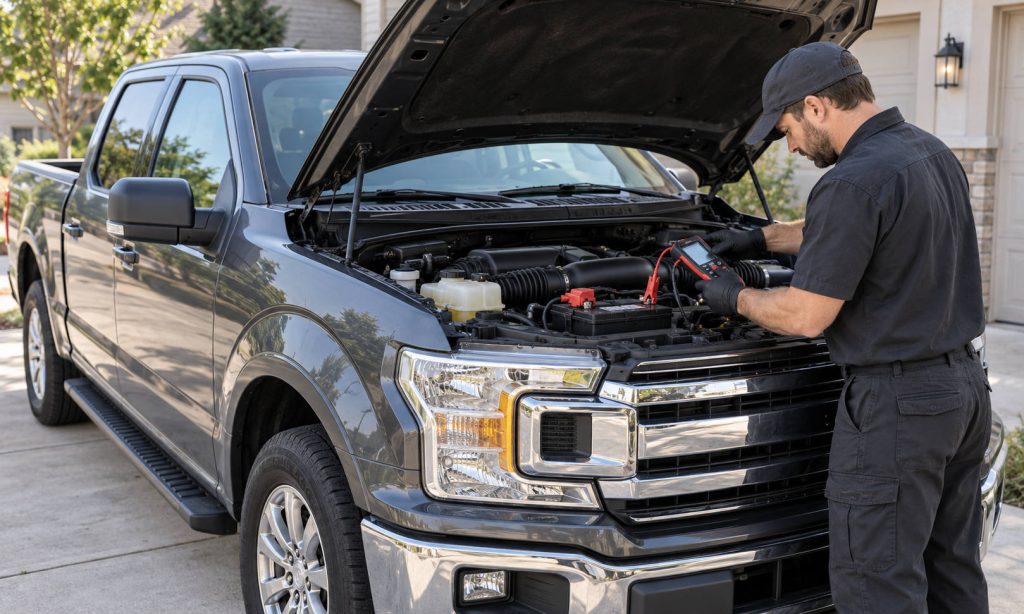
A slow-cranking Ford F-150 5.0 and a long crank are different symptoms. If the starter turns the engine unusually slowly, begin with the 12-volt battery’s state of charge and condition, then inspect the terminals, cables, grounds, and starter circuit. If the engine spins at normal speed but takes extra time to fire, the battery may not be the cause; fuel, ignition, air, sensor, or security-system issues may need diagnosis. “F-150 5.0” spans many model years and electrical configurations, so use the owner’s manual and battery label for the exact truck. Record the battery age and the exact starting symptom before testing or replacing parts. If the engine cranks normally but will not start, the separate F-150 5.0 spark-plug guide covers one ignition maintenance question, not battery diagnosis.
First distinguish slow crank from long crank
Listen and observe during one normal start attempt. A slow crank sounds labored or turns at a visibly lower speed than usual; rapid clicking or dimming lights can accompany low voltage or a poor connection. A single click or silence can also involve the starter control circuit, interlocks, or connections. A normal-speed crank followed by delayed firing is a different path and should not be “fixed” by replacing the battery without testing.
Stop repeated attempts if the starter becomes hot, wiring smells burnt, the battery case is swollen or leaking, or the truck behaves unpredictably. Do not bridge starter terminals with a tool. If the vehicle is in gear, on an incline, or in an unsafe location, secure it and call for help.
Check the battery safely
With the engine off and key removed, look for a loose hold-down, damaged case, wetness, or corrosion around the terminals. Keep flames, cigarettes, and sparks away from a battery. Wear eye protection and avoid touching both terminals or bridging a terminal to metal with a tool. If the battery is cracked, swollen, leaking, frozen, or hot, do not attempt to charge or jump it; arrange professional service.
Check the battery’s date code, type, rated cold-cranking amps (CCA), and label. A battery can show voltage yet fail under the high current needed to crank a large V8. A professional conductance or load test can measure starting capability; ask for the test result and whether the battery was fully charged before the test. Do not choose a replacement based only on outside dimensions. Verify the correct group size, CCA, terminal layout, battery chemistry, and any battery-monitoring reset procedure for the truck’s year.
Inspect the connections before blaming the starter
Battery posts and cable clamps need clean, tight contact. Corrosion can hide under a cable’s insulation or at an engine or frame ground, so a connection that looks clean from above may still have high resistance. Look for frayed cables, loose clamps, damaged insulation, or heat discoloration, but do not pull or probe high-current cables with the battery connected. Have a technician perform voltage-drop tests across the positive and ground paths while cranking if the visual check is inconclusive.
Owner discussions about F-150 slow-crank complaints often mention cable or ground issues even after a battery or starter tested “good.” That is anecdotal, but it supports a useful diagnostic sequence: test the battery under load and verify the current path before replacing parts. A generic parts-store test may not reproduce a heat-related or intermittent problem, so record whether it happens cold, hot, after sitting, or after short trips.
Check the charging system and recent changes
If the battery repeatedly becomes discharged, a new battery may only mask the cause. The alternator, charging control, belt, wiring, battery sensor, or a parasitic electrical load may be involved. Ask for a charging-system test that checks output under different conditions and confirms the battery is being charged as the truck’s manual specifies. Modern F-150 charging voltage can vary with temperature and battery-management strategy, so one universal running-voltage number is not a diagnosis.
Note recent battery replacement, jump starts, add-on electronics, trailer-module activity, or wiring work. Ford has issued a recent service message for some 2021–2025 F-150s describing a discharged battery/no-crank or clicking condition related to trailer-module software. That message applies only to the listed years and conditions; a Ford dealer can check whether your VIN and software are affected. It does not explain every slow-start concern.
What a shop should test next
If the battery passes but the crank is still slow, a technician can check voltage drop, starter current draw, starter operation, engine grounds, and mechanical drag. If the starter spins normally but the engine does not fire, diagnostic trouble codes and live data may direct checks of fuel pressure, ignition, crank/cam signals, or anti-theft authorization. A stored code is a clue, not proof that a particular part has failed.
Bring a short symptom log: engine temperature, outside temperature, time parked, whether the starter turns slowly or at normal speed, dashboard messages, and any recent repairs. Avoid replacing the starter, alternator, or sensors based solely on a forum post or a one-time parts-counter test. If the truck loses power while driving, shows a charging warning, or stalls in traffic, stop in a safe place and arrange assistance.
Frequently Asked Questions
Can a weak battery cause a slow crank on an F-150 5.0?
Yes, but poor cable connections, grounds, a failing starter, or other electrical or mechanical issues can create similar symptoms. Test the battery and circuit before replacing parts.
Does a new battery guarantee that the starting problem is fixed?
No. If a charging fault or key-off electrical drain remains, the replacement battery can discharge again. Test the charging system and investigate repeated discharge.
What if the F-150 cranks at normal speed but starts late?
That is a long-crank symptom rather than a slow-crank symptom. A technician may need to check fuel, ignition, sensor, or security-system data.
Can I test the battery with a basic voltage reading?
A voltage reading can show state of charge, but it does not establish the battery’s cranking capacity. A proper load or conductance test is more informative.
When should I stop trying to start the truck?
Stop if the battery is damaged, cables heat up, there is a burning smell, the starter keeps clicking without turning the engine, or the truck is in an unsafe location.
Final Words
For a slow-start concern on a Ford F-150 5.0, first identify whether the engine cranks slowly or cranks normally but takes time to fire. Test battery condition under load, inspect connections and grounds, and check the charging system before replacing parts. Use the year-specific Ford manual and a qualified technician when high-current testing or starter-circuit work is needed. If you mean spark-plug maintenance rather than slow cranking, see the separate Ford F-150 5.0 spark-plug page.
References
- 2025 Ford F-150 Owner’s Manual — battery, charging-system, and jump-start guidance.
- Ford SSM 54503 — specified model years with a trailer-module-related discharged-battery/no-crank condition.
- Interstate Batteries IB Pulse Manual — battery and starting/charging system tests.
Pingback: Diagnosing Slow Starts and Weak Batteries on Ford 5.4 Triton