Choosing universal vs. vehicle-specific accessories for a Ford F-150 depends on what the accessory must fit, the truck’s exact configuration, and whether a loose or obstructive fit could affect safe use. A universal item may work when it is adjustable, non-structural, and does not block controls or safety systems. A vehicle-specific part is usually the better starting point when it attaches to a particular seat, bed, roof, floor, wiring connector, or mounting point. Before ordering, identify the model year, cab, bed length, trim, and options, then check the maker’s application details. For example, seat covers for a 2005 Ford F-150 must match that truck’s actual seat layout rather than the F-150 name alone. Here is a practical way to compare the two fit types.
What “universal” and “vehicle-specific” mean
A universal accessory is designed to adjust across a range of vehicles. Its fit may rely on straps, elastic, clamps, telescoping parts, or a broad size range. “Universal” does not mean it fits every truck or every configuration. A vehicle-specific accessory is listed for a defined make, model, year range, and sometimes a cab, bed, trim, or option package. Some products sit between those descriptions: a manufacturer may offer a few size families, then ask you to select the right application.
The label alone does not prove quality or compatibility. Compare the installation method, measurements, clearance requirements, and limitations. Check whether the manufacturer names your F-150 generation and configuration, and whether it distinguishes SuperCab from SuperCrew, short from long bed, or a particular console, seat, or factory package.
When a universal accessory may be suitable
Universal accessories can be convenient for items whose position or size can be adjusted without affecting vehicle operation. Examples may include some organizers, removable cargo nets, or non-electrical storage items, provided the attachment points are approved and the item stays secure. Before use, check that it cannot slide into the pedals, cover a switch, obscure a mirror or camera, interfere with a seat belt, or become a loose object during hard braking.
A universal cover or mat deserves more scrutiny than a simple organizer. Excess fabric can bunch around seat controls, belt buckles, or seat-mounted airbags; a floor liner that shifts can interfere with pedal travel. Do not install an item over an airbag deployment area or use a seat cover whose compatibility with the seat-mounted side airbag is unclear. NHTSA warns against attaching accessories on or near side airbags and advises consulting a dealer before covering or replacing front seat-back covers. Check the owner’s manual for your truck’s model year and do not treat a seller’s “airbag compatible” claim as a substitute for the vehicle instructions.
When vehicle-specific fit is the safer starting point
Choose a vehicle-specific application when the accessory depends on precise contours, fastener locations, electrical connectors, or load-bearing mounts. Seat covers, molded floor liners, bed covers, roof-rack components, lighting assemblies, and wiring harnesses often depend on configuration details. A listing for “F-150” may not cover every year, cab, bed, or trim. Verify the part number and application range with the manufacturer and compare it with your truck’s labels or build information.
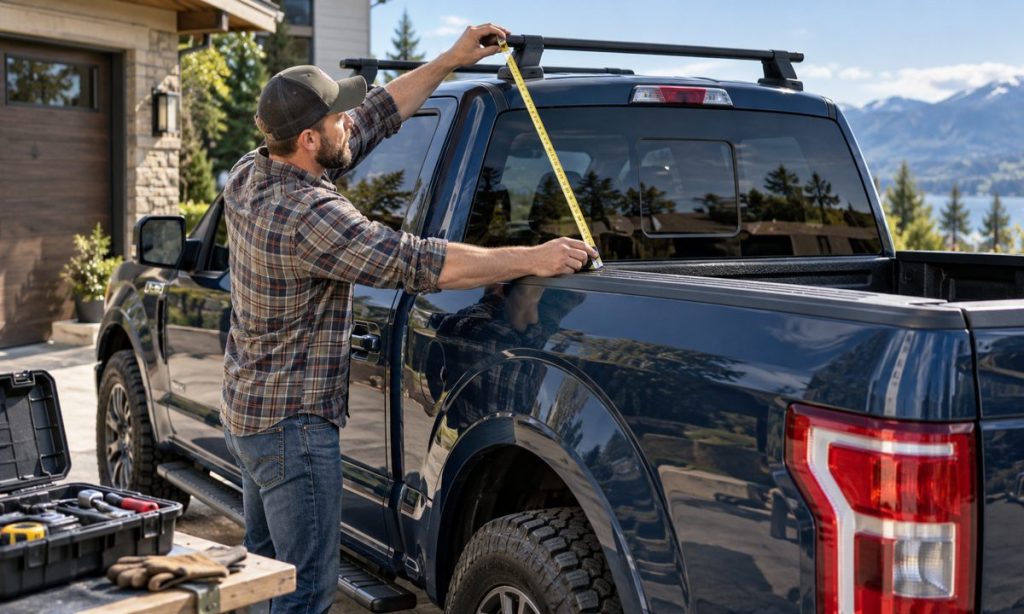
For cargo or roof equipment, match the accessory to the correct bed length, cab, factory rails, and mounting arrangement. A useful example is checking bed and roof accessory fitment on an F-150. Then confirm the truck’s own payload and load limits; the accessory’s capacity does not increase the vehicle’s rating. Installation should not require drilling or modifying a structural area unless the manufacturer’s approved procedure specifically calls for it.
Compare the trade-offs before you buy
| Check | Universal option | Vehicle-specific option |
|---|---|---|
| Fit range | Adjusts across a broad range; measure carefully | Lists a defined vehicle application; confirm options |
| Installation | May use straps or adjustable clamps | May use shaped panels or named mounting points |
| Clearance | Check for gaps, bunching, or movement | Still inspect controls and clearances after fitting |
| Best use case | Simple, adjustable, removable accessories | Contoured, structural, electrical, or load-related parts |
Also compare the installation instructions, return conditions, stated exclusions, and the tools or modifications required. If you consult owner reviews, treat them as individual experience rather than proof of compatibility. Check any reported fit issue against the product’s application list and installation instructions.
Verify fitment by accessory type
For seat covers, confirm cab and seat configuration, head restraints, armrests, fold-down center sections, and airbag provisions. For floor mats, check the row, cab, floor shape, and factory retention points; comparing all-weather and carpet protection for an F-150 is a separate decision from checking whether a liner physically fits. For bed covers, measure the bed and identify rail or cargo-management equipment. A product guide to tonneau covers for a 2018 F-150 illustrates why model-year and bed details matter. A broader Ford F-150 tonneau-cover overview offers another fitment example.
For accessories near occupants, look at airbags, seat belts, visibility, controls, and restraint-system labels. If you carry a dog, a dog seat cover for an F-150 still needs to leave the belt buckle and seating position usable and must not obstruct a side airbag. For exterior items, check whether the accessory affects lights, license plates, sensors, doors, or the driver’s view. Even a vehicle-specific wiper application should be confirmed against the exact truck configuration before installation.
Installation checks for either type
- Match the part number to the model year, cab, bed, trim, and relevant factory options.
- Inspect mounting points and nearby wiring before attaching or routing anything.
- Follow the vehicle and accessory manufacturers’ instructions; do not force a part or substitute hardware.
- Keep accessories clear of pedals, seat belts, airbags, lights, cameras, sensors, and control surfaces.
- After installation, operate affected controls while parked and check for movement or warning lights.
- Stop if a safety warning appears, a restraint component is disturbed, or a structural modification is unclear.
If a product listing is vague, ask the accessory manufacturer to confirm the exact application in writing. Provide the model year and configuration rather than relying on a generic “fits F-150” statement. When installation involves airbags, structural drilling, vehicle wiring, or uncertain load limits, use a qualified installer.
Frequently Asked Questions
Are universal accessories always cheaper?
Not necessarily. Price varies by material, design, and included hardware. Compare the full kit and installation requirements rather than assuming that a universal label means lower overall cost.
Can a vehicle-specific accessory still fail to fit?
Yes. A model-year range can include multiple cab, bed, trim, or option configurations. Confirm the product’s exclusions and the truck’s exact equipment.
How can I find my F-150 cab and bed configuration?
Check the vehicle identification information, door labels, owner documents, and measurements. If the accessory maker needs a specific measurement, follow its method rather than estimating from a photo.
Should I use a universal seat cover on an F-150 with side airbags?
Only if the cover maker clearly identifies compatibility with the specific seat and airbag arrangement and the vehicle instructions allow it. Otherwise, do not cover the deployment area.
What if the accessory fits but blocks a control?
Remove it or correct the installation according to the manufacturer’s directions. A part that blocks a pedal, belt buckle, seat adjustment, light, or sensor is not properly fitted for your use.
Final Words
For an F-150, choose the fit type based on the accessory’s job and the truck’s exact configuration. Universal accessories can work for simple, adjustable uses when they remain secure and clear of controls and safety systems. Vehicle-specific applications are the better place to start for shaped, mounted, wired, or load-related parts, but they still require a year, cab, bed, and option check. If you are comparing seat covers for a 2005 Ford F-150, verify the seat layout and airbag provisions before installing. When fitment instructions are incomplete or the work touches safety equipment, get confirmation from the manufacturer or a qualified technician.