To check oil filter compatibility before servicing a Ford F-250 6.7L diesel, identify the truck’s model year and exact engine configuration, then confirm the replacement through a current Ford or filter-maker application catalog. The phrase “6.7 diesel” alone is not enough: model-year changes, engine variants, production updates, and previous repairs can affect the correct service part. Compare the catalog result with the filter type and part number already installed, and confirm any supersession with the manufacturer. A filter that looks similar or is advertised for a Super Duty is not proof of fit.
Start with the exact truck details
Record the model year, F-250 trim, engine, and VIN before searching a parts catalog. If the truck has had an engine replacement, modified oil system, or non-original filter housing, note that too. Use the VIN with a Ford dealer or the parts maker’s official lookup when the catalog requests it. A fitment result for a different Super Duty year, F-350, or 6.7L application should not be assumed to transfer to the F-250.
Find the owner’s manual and diesel supplement for the same model year through Ford’s owner-manual portal. Those documents help verify the specified service procedure, oil requirements, and maintenance schedule. The Ford diesel maintenance information also separates intervals by engine and operating conditions, so do not copy an interval from a different year or duty cycle.
Verify the filter specification in a current catalog
Search the vehicle in Ford Parts or the filter manufacturer’s current application guide, then record the exact catalog number and any listed replacement or supersession number. If two sources disagree, pause and ask the manufacturer or dealer to resolve the difference using the VIN. Do not choose the filter based only on a marketplace listing, an informal cross-reference chart, a previous owner’s receipt, or a part number from another 6.7L truck.
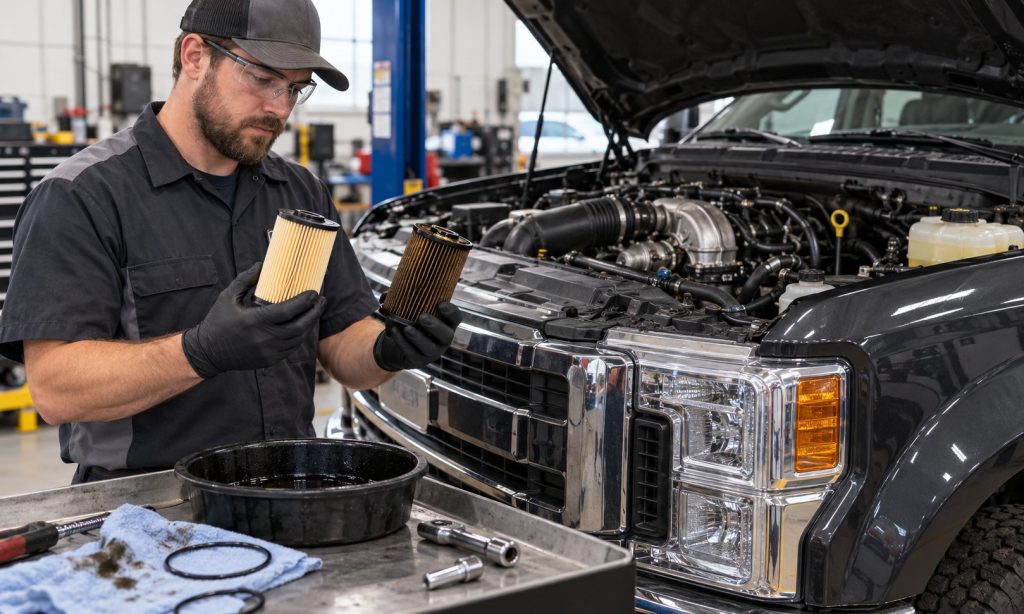
Check that the catalog describes the correct engine oil filter rather than a fuel filter, air filter, transmission filter, or a kit for another service. Filters can share similar names or packaging. If the catalog lists a cartridge, housing seal, drain plug seal, or other included service parts, confirm the set matches the engine’s housing and the service instructions. Do not substitute a spin-on or cartridge design based on appearance alone.
The printed number on the removed filter can be useful for cross-checking, but it is only one clue. A prior service may have used an incorrect part, and a legitimate supersession may carry a different current number. Compare the old and new parts only after the official application has been confirmed. If a filter is visibly different, the seal arrangement does not match, or it does not seat as instructed, do not force it into place.
Check the fit and service details before opening the package
- Part number and application: Match the filter to the exact year and engine in a current manufacturer catalog, and verify supersessions.
- Filter design: Confirm the specified cartridge or other filter style and any included seals or service components.
- Engine and housing condition: Tell the shop if the engine, filter housing, or oil system has been changed or repaired.
- Packaging and condition: Check that the part is sealed, undamaged, and has a readable manufacturer label and part number.
- Service procedure: Use the correct model-year owner’s manual or service information for installation, torque, sealing surfaces, and oil refill checks.
Never use a filter that requires force, has a damaged seal, or does not match the listed design. A leak or incorrect seal can cause oil loss. After service, follow the vehicle procedure to confirm the oil level and inspect for leaks. If the oil-pressure warning remains on, the engine makes unusual noise, or a leak appears, shut the engine off when safe and have the cause checked promptly.
Keep compatibility separate from the maintenance schedule
Finding the correct filter does not establish the right oil grade or change interval. Follow the owner’s manual and diesel supplement for the truck’s year, engine, ambient conditions, and use. Towing, extended idling, dusty roads, and severe operating conditions may affect maintenance timing. Our guides to F-250 6.7 diesel maintenance in towing and dusty use and Ford 6.7 diesel oil viscosity provide related context; the exact manual remains the source for the individual truck.
For broader engine-service context, compare the owner-manual guidance for an F-250 7.3 diesel, but do not carry its specifications over to a 6.7L. Filter service also differs from intake service: see the Ford 6.7 diesel air-filter application overview for a separate system. A battery for Ford F-250 6.7 diesel is another fitment question altogether; battery group, terminal layout, and electrical requirements do not establish oil-filter compatibility. Our F-250 6.7 diesel battery fitment overview covers that separate part category. For wider diesel-truck context, see this F-250 diesel battery comparison.
If you want to compare a filter review after confirming the application, see the Ford 6.7 diesel oil-filter guide. Use it as a starting point for checking catalog fitment, not as a substitute for the exact vehicle lookup. For older F-250 maintenance context, our cold-weather oil guide for a 7.3 diesel is relevant only to its stated engine.
Frequently asked questions
Does every Ford 6.7L diesel use the same oil filter?
Do not assume so. Verify the exact model year and configuration in a current Ford or filter-maker catalog. Production updates or a changed engine or housing may affect the application.
Can I use the number printed on the old filter?
Use it as a cross-check, not the only source. The old filter could be incorrect or superseded. Confirm the current application with the VIN and manufacturer catalog.
Is an oil filter the same as a fuel filter on the 6.7 diesel?
No. They serve different systems and have different applications. Confirm that the catalog result specifically says engine oil filter before buying or beginning service.
Can I rely on an online fitment listing?
Use current manufacturer catalogs where possible. If a marketplace listing conflicts with Ford or filter-maker information, resolve the discrepancy with the manufacturer or dealer before installing the part.
What should I do if the replacement does not fit the housing?
Stop and recheck the part number and application. Do not force the filter or seal. Verify the VIN, engine, housing, and any previous modifications with a qualified service professional.
Final Words
For a Ford F-250 6.7L diesel, verify an oil filter by exact year and engine in a current Ford or filter-maker catalog, then cross-check the part number, filter design, and required service components. Treat an old filter and marketplace listing as clues rather than final confirmation. Use the matching owner’s manual or diesel supplement for the service procedure and interval, and resolve any catalog conflict before installing the part.