
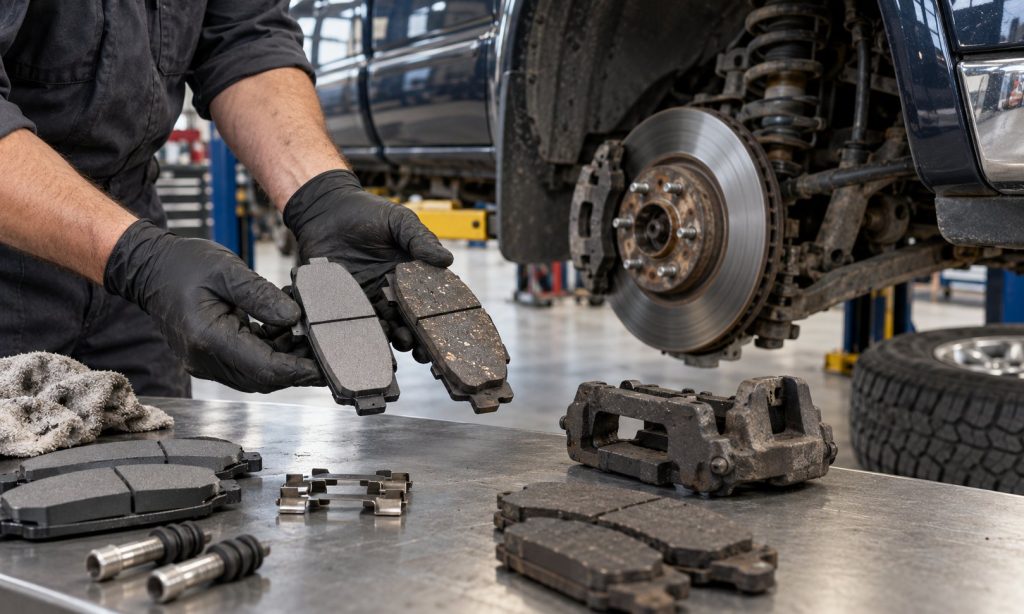
Comparing ceramic vs. semi-metallic brake pads for a Dodge Dakota 4×4 starts with confirming the exact year, engine, axle, and brake package. “Ceramic” and “semi-metallic” describe broad friction-material families, not a guarantee of stopping distance, service life, noise, or rotor wear. One formulation may be quieter and produce less visible dust in ordinary driving, while another may tolerate repeated higher-temperature use differently. The pad maker’s vehicle-specific application, the Dakota’s condition, and the way the truck is used matter more than the label alone. This guide explains the tradeoffs and what to verify before a brake service.
What the material names mean
Ceramic pads use ceramic fibers and other ingredients in a formulated friction compound. Many are designed to produce less visible dust and lower noise for everyday use, but actual performance varies by formulation and vehicle. Semi-metallic pads include a substantial metal component mixed with other friction materials. Their composition can influence heat transfer, bite, noise, dust, and wear, but there is no single semi-metallic behavior that applies to every pad.
SAE researchers have tested particular ceramic and semi-metallic formulations and found differences in friction, pad and rotor wear, noise, and vibration. Those results describe the samples and test conditions in that study; they do not establish that every ceramic pad is quieter or that every semi-metallic pad is better for a Dakota. A manufacturer’s application-specific testing and published fitment information are more useful for choosing among actual replacement parts.
Compare the factors that matter on a Dakota
- Vehicle fitment: Confirm that the pad set matches the exact model year, front or rear position, axle, and brake option. A 4×4 designation by itself does not identify every brake package.
- Driving duty: Stop-and-go commuting, steep roads, hauling, and repeated hard braking create different demands. Use the pad maker’s stated application and operating limits for the Dakota’s actual use.
- Noise and dust: Ask about the specific compound’s noise-control features and expected dust. Pad shape, shims, clips, caliper condition, rotor finish, and installation can affect noise as well.
- Rotor compatibility: Inspect the rotor for scoring, cracking, heat damage, thickness below specification, and uneven wear. A new pad material cannot correct a damaged rotor or sticking caliper.
- Complete hardware: Confirm whether the service includes the correct clips, abutment hardware, and any required lubrication at specified contact points. Never apply grease to the friction surface.
- Break-in requirements: Follow the pad manufacturer’s bedding procedure and the Dakota service information. Avoid inventing a generic break-in routine when instructions differ by product.
How use changes the comparison
For routine neighborhood and highway driving, a quiet, low-dust ceramic formulation may be attractive if it is approved for the exact truck and duty. For sustained high heat or demanding use, some semi-metallic applications may be designed with those conditions in mind. That does not make either material automatically safer or more durable. A mismatched pad, glazed rotor, seized slide, contaminated friction surface, or incomplete bedding can undermine braking regardless of compound.
If the Dakota regularly carries weight or tows, tell the brake technician how it is used and ask which applications the pad maker approves for that duty. Brake condition, tires, load, trailer setup, and maintenance all contribute to stopping behavior. Replacing shocks for 2001 Dodge Dakota 4×4 can address a ride-control concern, but shocks are separate from the brake friction system and do not determine which brake pad fits. Keep suspension and brake part selection tied to their own exact vehicle applications. For related ride-control context, see how to recognize worn shocks on a Ford F-150 4×4; for a separate tire-wear issue after suspension service, see the F-150 post-repair tire wear guide.
For context, compare this Dakota-specific discussion with our ceramic vs. semi-metallic brake pad guide for Ford F-350 and Toyota Pickup 4×4 pad material comparison. Vehicle-specific brake hardware can change what matters, so those articles are background rather than Dakota fitment references.
What to verify before buying or installing
Use the VIN or a reliable vehicle lookup along with year, engine, axle, and front/rear position to confirm fitment. Compare the pad’s shape and hardware against the removed parts, but do not rely on appearance alone. Check the pad maker’s catalog and the official Mopar parts listing for the 2001 Dakota’s front brakes; if the vehicle has non-original calipers, rotors, or axle components, provide those details to the shop before ordering.
Before fitting new pads, have the calipers, slide pins, flexible hoses, rotors, and related hardware inspected. Brake fluid leaks, a soft or sinking pedal, pulling, grinding, smoke, or a brake warning light call for prompt professional attention. Do not keep driving to “test” a severe brake symptom. The Dakota owner or service manual should guide inspection, service limits, torque procedures, and brake-fluid requirements for the actual configuration.
Our guide to replacing rotors with pads explains the inspection questions that apply broadly, while this F-150 brake-pad guide shows why fitment and stated use matter when reading a parts listing. For the 2001 Dakota 4×4 suspension context, see the 2001 Dakota shock fitment guide; it addresses a separate system.
After service, follow the installer’s break-in instructions and allow the pads to seat before judging noise or pedal feel. If the truck vibrates, pulls, makes persistent grinding noises, or the pedal changes, return for inspection. Brake maintenance is not complete until the technician verifies correct assembly and a normal, firm pedal response.
Frequently asked questions
Are ceramic pads always quieter on a Dodge Dakota?
No. Ceramic formulations are often marketed for quieter operation, but noise also depends on the particular compound, shims, hardware, rotor condition, caliper movement, and installation. Ask about the specific application rather than assuming from the material name.
Do semi-metallic pads stop a 4×4 Dakota better?
There is no universal answer. Stopping behavior depends on the complete brake system, vehicle condition, tires, load, temperature, and the pad formulation. Use a pad approved for the exact truck and intended duty.
Should I replace the rotors whenever I install new pads?
Not automatically. A technician should measure rotor thickness and inspect surface condition against the service limits for that Dakota. Rotors that are damaged, below minimum thickness, or otherwise out of specification may require replacement or an approved service procedure.
Does 4×4 identify the correct pad set?
No. Model year, axle, brake option, and front or rear position may affect fitment. Confirm the application using the VIN and the parts maker’s catalog or a qualified shop.
Can new pads fix a soft brake pedal or pulling?
Those symptoms can have causes beyond pad material, including hydraulic faults, uneven caliper operation, damaged components, or contaminated friction surfaces. Have the system inspected instead of assuming that a different compound will solve the symptom.
Final Words
Choose Dakota 4×4 brake pads by exact application and use, then compare the specific compound’s noise, dust, heat, and maintenance information. Ceramic and semi-metallic are broad material categories, not guarantees of performance. Ask for rotor and caliper inspection, confirm the correct hardware, and follow the vehicle and pad maker’s service and break-in instructions. Persistent noise, pulling, grinding, or a changed pedal needs prompt inspection.
Pingback: Best Brake Pads and Rotors for Nissan Frontier: 7 Picks