Choosing tire pressure for Ford Explorer when towing or carrying a heavy load starts with the vehicle’s Tire and Loading Information label and the correct owner’s manual. Do not add an arbitrary amount of air because a trailer is attached, and do not use the tire sidewall maximum as your everyday target. Follow any specific loading or towing instructions Ford supplies for your exact model year and equipment. Pressure is only one part of the check: the Explorer, its axles, tires, hitch, and trailer must also remain within their applicable ratings. This guide explains how to find the right information, take a useful cold reading, and recognize situations that need professional assessment. If you are considering replacement all-season tires for Ford Explorer, verify the complete size and service specification before applying any pressure advice.
Find the vehicle-specific starting point
Ford directs owners to the recommended cold inflation pressure on the tire information label, usually at the driver’s door edge or B-pillar. Read both front and rear entries; do not assume they must be identical. Check that the tire size shown agrees with the installed approved setup. Photograph the label so you can refer to it without relying on memory at an air station.
The owner’s manual is the next source for load and towing instructions. Use the US manual for the actual year and powertrain, including any supplement. An Explorer forum post, another owner’s dashboard photo, or a generic pressure chart may refer to a different vehicle configuration. When the label is missing or unreadable, ask Ford or a qualified service provider to identify the correct specification from the vehicle details.
Understand what “cold” means
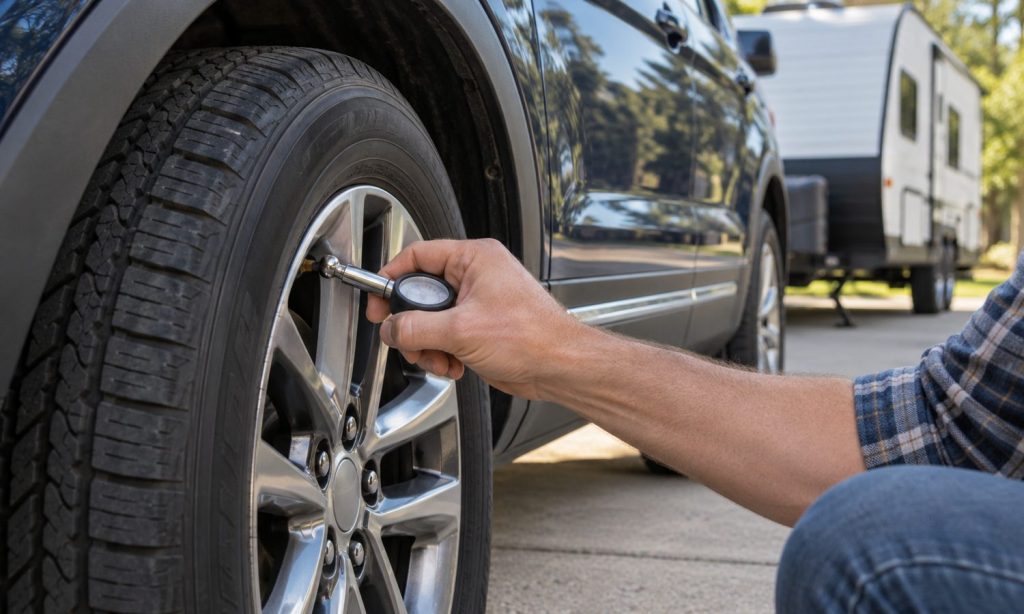
A cold reading is taken before driving has warmed the tire. NHTSA uses at least three hours parked as its general cold-check guidance. Plan the check before leaving for a trip rather than after reaching a distant fuel stop. Use a reliable gauge, press it squarely onto the valve, and repeat an uncertain reading. Replace the valve cap afterward.
Driving normally raises tire temperature and pressure. Do not release air from a warmed tire simply to make it match the cold number on the label. If you find a tire unexpectedly low while traveling, prioritize a safe location and the owner-manual guidance; have the cause evaluated and recheck cold. An air compressor’s display and the vehicle screen are useful tools, but neither makes the correct reference pressure optional.
More load does not justify guessing at pressure
A common temptation is to increase rear pressure until the vehicle looks level or feels firmer. That is not a valid way to establish a safe setting. Use an explicit loaded-pressure instruction when the correct Ford documentation provides one. Otherwise, do not invent a towing adjustment or borrow one from a different Explorer generation.
If the vehicle sits unusually low, steers differently, or feels unstable after loading, stop and reassess the load and equipment. Added inflation cannot increase the Explorer’s rated payload or correct an unsuitable hitch setup. Nor should you lower pressure to soften the ride of a heavily loaded vehicle. The problem may require unloading, redistributing permitted cargo, or professional inspection.
Account for everything the Explorer carries
Passengers, luggage, installed accessories, and the trailer’s tongue load all matter to the tow vehicle. The trailer’s entire weight is not carried on the Explorer, but its downward load at the hitch is part of the vehicle load. Ford’s 2020 Explorer manual explicitly includes tongue weight when calculating total vehicle weight; confirm the applicable method and limits for your year.
Use actual loaded weights when you are near a limit or uncertain. A suitable scale and a knowledgeable towing professional can help establish axle and combination weights. Compare the results with the vehicle’s labels and year-specific towing documentation. Being below a broad advertised trailer-weight figure does not prove that the loaded rear axle or payload is within its limit.
Separate the SUV’s tires from the trailer’s tires
The Explorer label governs the Explorer’s approved tires, not the trailer tires. Check the trailer’s own labels, manual, tire specifications, and load guidance. Do not copy an SUV pressure onto a trailer merely because the wheel sizes look similar. Include any trailer spare in the preparation checklist and confirm the correct temporary-use rules for the Explorer’s spare.
Inspect both sets of tires before departure. Look for visible damage, abnormal wear, and evidence of pressure loss. A trailer that has been stored for a long period needs condition checks even when its tread looks substantial. Pressure alone does not establish that an aging or damaged tire is suitable for travel.
What if the Explorer has replacement wheels or tires?
A different tire size or construction can change the assessment. Ford’s tire-pressure monitoring guidance notes that a vehicle with tires different from its placard requires the proper inflation pressure to be determined for those tires. That does not authorize a driver to calculate a setting from the sidewall maximum or imitate another owner’s choice.
Have a qualified tire professional review the complete specification, vehicle load requirements, wheel ratings, and applicable manufacturer information. Ask for the resulting approved guidance in writing. If the change is not supported, return to a compliant setup rather than attempting to compensate through pressure. The words all-season, touring, or reinforced are not a substitute for the full specification.
Use a repeatable pre-trip check
A short written record makes it easier to spot changes. Record the date, whether the tires were cold, the prescribed values, and the actual readings. Check every road tire rather than only the one easiest to reach. A tire that repeatedly needs air deserves investigation even if the warning light stays off.
- Confirm the vehicle label and correct towing instructions.
- Check the loaded vehicle and trailer against all applicable limits.
- Inspect tire condition and measure cold pressure with a gauge.
- Follow the correct specification for each vehicle and its spare.
- Resolve unexplained pressure loss or handling changes before departure.
Do not wait for a tire-pressure warning to perform these checks. The monitoring system warns about certain pressure conditions; it does not approve your cargo weight, tire fitment, or trailer setup. If a warning remains after the tires are correctly checked, consult the manual and arrange diagnosis instead of simply resetting or ignoring it.
Related guidance: a related Ford Escape tire-pressure discussion for towing.
Frequently Asked Questions
These answers address situations that often arise when preparing an Explorer for a loaded trip.
Should I always add five psi for towing?
No. There is no universal five-psi rule for every Explorer. Follow the exact label and any applicable Ford loading instructions. Ask for qualified confirmation when the guidance is unclear.
Can stronger tires increase the Explorer’s payload?
No. A tire change does not raise the vehicle’s rated payload, axle, hitch, or towing limits. Every relevant limit still applies to the loaded combination.
Is the sidewall pressure the correct setting?
It is not a replacement for the vehicle’s prescribed cold inflation guidance. Read the full sidewall information in context and have nonstandard applications assessed professionally.
Why are readings different after a highway drive?
Tire temperature changes during use. Compare readings under consistent cold conditions and avoid bleeding a warm tire down to the cold target merely because its pressure has risen.
What if only one tire keeps losing air?
Have that tire, valve, and wheel inspected. Repeated topping-up can conceal a problem, and the absence of a warning light does not establish that the tire is sound.
Final Words
Choose Explorer tire pressure from the correct Ford label and documentation, then verify loading separately. Do not use added air to compensate for excess weight or an uncertain tire conversion. For replacement planning, the Explorer tire guide provides related fitment context, but your vehicle’s requirements remain controlling. Cold checks, complete weight accounting, and timely inspection of pressure loss are useful preparation for every loaded trip.
References
Consult the year-specific manual for your Explorer; the 2020 manual below illustrates loading principles rather than universal specifications.