
When to replace tires on Ford F250 depends on tread, age, damage, and the conditions in which the truck works. A tire can need replacement even when its tread looks deep, and an older spare is not automatically sound because it has never touched the road. Begin with a safe visual inspection, measure tread in several places, and locate the manufacturing date. Then apply the correct Ford and tire-manufacturer guidance to your truck’s configuration. Do not use extra pressure or a rotation to disguise a damaged tire. This guide separates checks you can make while parked from conditions that need a tire professional’s assessment. If you are researching an all-terrain tire for Ford F250, first establish why replacement is needed and what specifications the truck requires.
Use three separate replacement checks
Tread depth, age, and condition answer different questions. Tread indicates remaining groove depth; the date code establishes manufacturing age; inspection identifies visible damage and possible hidden problems. Passing one check does not cancel a failure in another. A nearly new tire with a bulge may need immediate attention, while a low-mileage tire can still reach the manufacturer’s age limit.
Write down the F-250’s model year, trim, drivetrain, tire size, and modifications before arranging service. Describe towing, payload, off-road use, and any recent impacts. Those details help the shop assess suitability and investigate wear. They do not allow anyone to guarantee the tire’s condition without inspection.
Measure tread rather than judging its appearance
NHTSA identifies 2/32 inch as the point at which tires are unsafe and should be replaced. That is not a promise of adequate performance until the final fraction of an inch. Weather, intended use, and manufacturer guidance may justify replacement earlier. Do not wait for the legal minimum to become the only factor in a tire decision.
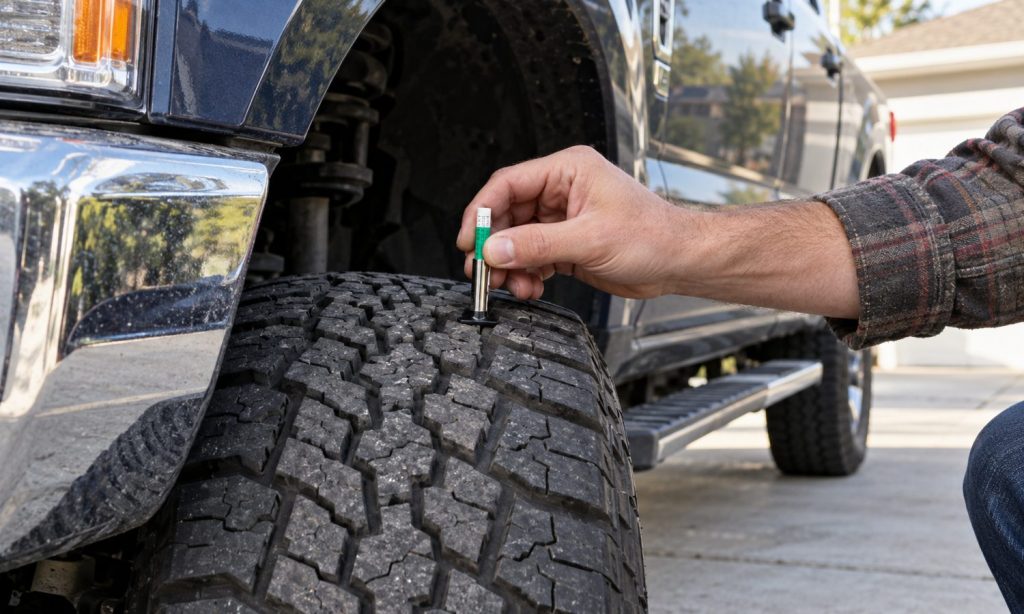
Use a tread-depth gauge in the main grooves, avoiding the raised wear indicators themselves. Measure across the usable tread and at several points around each tire. Record the lowest reading rather than averaging it with deeper areas. If the inner shoulder is difficult to see, have it inspected instead of assuming it matches the outer edge.
Built-in wear bars offer another visual clue. When the adjacent tread is level with them, replacement is due. A penny check can indicate very low tread, but a gauge and professional assessment provide better detail when wear varies. Never crawl under the truck or reach into an unsafe position merely to finish the measurement.
Uneven wear needs a cause check
One shoulder wearing faster, repeated scalloped patches, or a strip that looks unusually smooth calls for inspection. Pressure, alignment, balance, loading, and worn vehicle components may all contribute. Do not diagnose a suspension failure from a tread photograph alone. Ask the shop to identify the likely cause before a new set develops the same pattern.
Rotation can help manage normal wear when performed according to the vehicle and tire instructions. It does not restore missing tread or repair structural damage. If the tire is already unsuitable, moving it to another wheel position does not make it serviceable.
Read the date and include the spare
On modern tires, the last four digits of the DOT identification number give the manufacturing week and year. For example, 2321 means the twenty-third week of 2021. The full code may be on the inward-facing sidewall. If you cannot read it safely, ask a tire professional to check it. The purchase receipt and the manufacture date answer different questions.
Ford’s tire-care guidance generally calls for replacement after six years regardless of tread, with heat and frequent heavy loading potentially requiring earlier replacement. Confirm the instructions for your F-250 and the tire maker; follow the more restrictive applicable guidance. Do not turn a general age limit into a guarantee that every younger tire is safe.
The spare belongs in the same review. Its age, pressure, size, condition, and use restrictions matter. A spare stored under a truck may be hard to inspect properly without the correct procedure. Have it checked during tire service, and do not assume it is a permanent replacement simply because it holds air.
Damage that should change your plans
Bulges, exposed cords, tread separation, deep cuts, and significant sidewall damage require prompt professional attention. If a tire appears structurally compromised, avoid continuing the trip and arrange assistance. An outside inspection may not reveal damage caused by an impact or driving while seriously underinflated.
Repeated pressure loss also deserves investigation. The source could involve the tire, valve, bead area, or wheel, and simply adding air does not establish the cause. Tell the technician whether the tire was driven low or flat. Do not try to reinflate a tire that has been run flat or severely underinflated without the required professional inspection.
After a pothole strike, curb contact, or rough off-road trip, check for new vibration, pressure loss, or visible changes. Symptoms can involve the wheel or suspension as well as the tire. If the truck pulls, shakes, or handles differently, arrange inspection rather than assuming the tire merely needs more time to settle.
A safe inspection routine for a working truck
Park on firm, level ground, secure the vehicle, and let hot components cool. Inspect from accessible positions with good lighting. Keep hands clear of sharp debris and avoid removing an embedded object that may be sealing a puncture. Tire removal, mounting, and internal examination belong with suitably trained personnel and equipment.
- Compare tread readings at multiple locations on every road tire.
- Look at accessible sidewalls for cuts, bulges, and cracking.
- Record date codes and include the spare.
- Note cold-pressure changes and recent impacts.
- Share towing and loading history with the technician.
Check regularly and before demanding travel. NHTSA recommends monthly tire checks, and an unusual event can justify an earlier inspection. Keep a simple record with the truck’s service paperwork. Changes between readings can be more informative than trying to remember how the tire looked several months ago.
Plan replacement around verified fitment
Use the truck’s label and owner documentation to establish the required size, load index, speed rating, and tire type. An aggressive tread or a heavy-duty description is not proof of compatibility. Ask the installer to review the complete set, wheel condition, and any matching requirements, particularly when the truck is modified.
Have the shop explain whether one tire, an axle pair, or the complete set needs attention and why. Existing wear and drivetrain requirements influence that decision. Do not raise payload expectations after fitting different tires: the vehicle and axle ratings still apply. Request an inspection of related causes when the old tires wore abnormally.
Related guidance: a parallel tread, age, and damage checklist for a Ford Transit.
Frequently Asked Questions
These questions help distinguish a replacement decision from a maintenance or diagnostic question.
Can deep tread make an old tire safe?
No. Tread depth cannot establish internal condition or cancel age guidance. Check manufacturing age, history, damage, and the applicable manufacturer limits separately.
Does a small sidewall crack always mean immediate replacement?
A description alone cannot establish severity. Have cracking assessed, especially when it is spreading, deep, or accompanied by pressure loss. Do not assume cosmetic appearance proves safety.
Can a puncture always be repaired?
No. Location, size, tire history, and internal condition affect repairability. Have the tire removed and assessed under the appropriate repair standards rather than relying on an external plug alone.
Should I replace tires at a fixed mileage?
Mileage is useful service history, but it is not a universal replacement threshold. Tread, age, damage, operating conditions, and inspection findings control the decision.
Will new tires cure every vibration?
No. Wheel damage, balance, alignment, and other vehicle faults can cause vibration. Explain the symptoms and have the underlying problem investigated before assuming replacement will solve it.
Final Words
Replace F-250 tires when tread, age guidance, or damage makes continued service unsuitable. Inspect all tires and the spare, record uneven wear, and get qualified help for suspected structural problems. The F-250 all-terrain tire guide offers related fitment context, but the truck’s exact specifications and a condition assessment should guide the next step.
References
These official resources support the inspection principles. Confirm year-specific instructions in your truck’s owner documentation.
Pingback: Compare Ford Escape XLT Tire Noise and Wet Grip
Pingback: Ford F-250 Tire Load Range for Your Workload