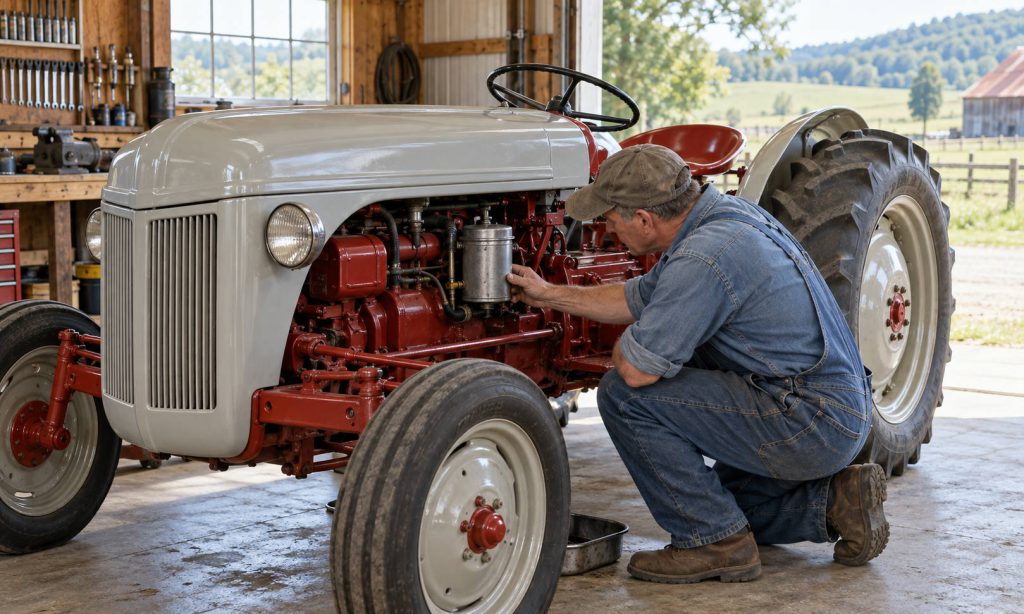
Before servicing an 8N Ford tractor, check oil-filter compatibility by identifying the filter housing that is actually installed, then matching the replacement element and seals to that housing. The model name alone is not enough: these tractors are old, parts may have been changed, and some have been converted from the original canister-style cartridge to a spin-on filter. Ford’s period parts catalog lists the oil-filter assembly, cartridge, cover, and gaskets as separate pieces, which is why a filter element number by itself may not confirm a complete fit. Compare the part number, dimensions, center opening, end seals, and housing style with a reliable parts catalog or tractor-parts specialist. For filter fitment, match the element, seals, and canister to the installed housing and a reliable parts catalog.
Identify the installed filter system
Park the tractor on level ground, shut it off, let the engine cool, and clean dirt from around the filter assembly before opening it. Locate the oil-filter housing and note whether it has a removable canister cover held by a center bolt or a threaded spin-on filter mounted to an adapter. Do not order a cartridge based only on a picture of a similar tractor: conversions and replacement housings can change what fits.
Record any stamped or printed part numbers on the filter, cover, base, and conversion adapter. Take clear photographs of the housing, the filter element, and its top and bottom ends. If the old element is swollen, distorted, or damaged, measure only after it has been removed carefully; use the housing and catalog application as the main reference, not a deformed old part.
Confirm tractor and engine details
Verify that the tractor is an 8N rather than a 9N, 2N, or later Ford model. Check the serial number and engine identification where accessible, and note whether the block or filter assembly appears to have been replaced. Many similar N-series parts look alike, but their part references and assemblies can differ by production period or previous repairs.
A 1949 Ford tractor parts catalog, for example, lists the filter assembly, cartridge, cover, inlet adapter, outlet elbow, and cover gasket as related but separate components. That historic listing helps show what to identify; it is not a guarantee that every surviving tractor still has that original combination. A replacement base or conversion may use a different element and sealing arrangement.
Match the cartridge and seals as a set
For a canister system, match the filter element’s outside diameter, length, center hole, end-cap design, and supplied seals to the housing and service documentation. Check whether the canister uses a top gasket, a center-bolt seal, or additional seals at the inlet and outlet interfaces. Some replacement kits include multiple gaskets for different housings; use only the correct pieces and place them where the parts diagram specifies.
For a spin-on conversion, identify the adapter or base and select a filter using its thread, gasket diameter, bypass characteristics, and application data. A canister cartridge is not interchangeable with a spin-on filter merely because both are described as “8N oil filters.” Do not rely on a cross-reference that lists the tractor model without identifying the conversion base.
Check dimensions and catalog application before buying
Compare the candidate filter’s published dimensions and cross-reference with the identified housing. Verify the product is intended for the Ford N-series tractor and the exact system installed. Ask the parts supplier to confirm the filter number against the housing or adapter number if the catalog gives multiple alternatives. Keep the package and old element until the new element is seated correctly and the housing closes without binding.
Public tractor-owner discussions commonly describe confusion between original canister cartridges and spin-on conversion kits, as well as uncertainty about older cross-reference numbers. Those reports are useful prompts to inspect the actual hardware, but not proof that a particular automotive filter is suitable. A filter’s thread or dimensions alone do not establish filtration, bypass-valve, or oil-flow compatibility.
Service carefully and check for leaks
Use the tractor’s service manual for oil grade, capacity, filter installation, and tightening instructions. Avoid overtightening the cover bolt or spin-on filter. Before starting, confirm that the correct gasket is in place, the drain plug and lines are secure, and the filter housing is clean. After startup, check for leaks and verify oil pressure according to the tractor manual. Shut the engine down immediately if pressure is absent or a significant leak appears.
Do not start or run the engine with the filter missing, the wrong seal installed, or an open oil line. If the housing is cracked, the cover bolt bottoms before clamping, or a conversion adapter’s routing is unclear, stop and have a tractor mechanic identify the assembly. A simple part-number check is less costly than risking oil loss or engine damage.
Common compatibility mistakes
- Assuming every 8N still has its original canister housing.
- Confusing an 8N with a 9N, 2N, or later Ford tractor when searching catalogs.
- Choosing by length alone and overlooking center-hole or end-seal design.
- Using a spin-on cross-reference without checking the conversion adapter.
- Reusing a hardened gasket or stacking multiple seals.
- Assuming a filter with matching threads has the correct internal bypass or flow design.
Frequently Asked Questions
Did the Ford 8N originally use a spin-on oil filter?
Period parts catalogs show an oil-filter canister and cartridge assembly. A tractor may now have a spin-on conversion, so inspect the installed hardware.
Can a 9N or 2N filter fit an 8N?
Some parts catalogs group related N-series assemblies, but the exact filter and seals still depend on the housing and production details. Confirm by part number and dimensions.
Is a matching thread enough to prove a spin-on filter is compatible?
No. Also verify gasket dimensions, bypass behavior, application, and compatibility with the adapter or base.
Should I replace the canister gasket every time?
Follow the service instructions and the filter kit requirements. Replace hardened, damaged, or flattened seals, and use the correct gasket in each specified location.
What if my old filter has no readable number?
Identify the housing and adapter, measure the element and openings, and ask a tractor-parts specialist to verify the application before installation.
Final Words
To check oil-filter compatibility on an 8N Ford tractor, identify the canister or spin-on system in front of you, confirm the tractor and housing details, and match the element and seals using a catalog that covers that exact assembly. Treat historic part numbers and owner reports as clues, then verify dimensions and application with a specialist when anything differs. The 8N spark-plug article covers a separate service item and does not substitute for this filter check.