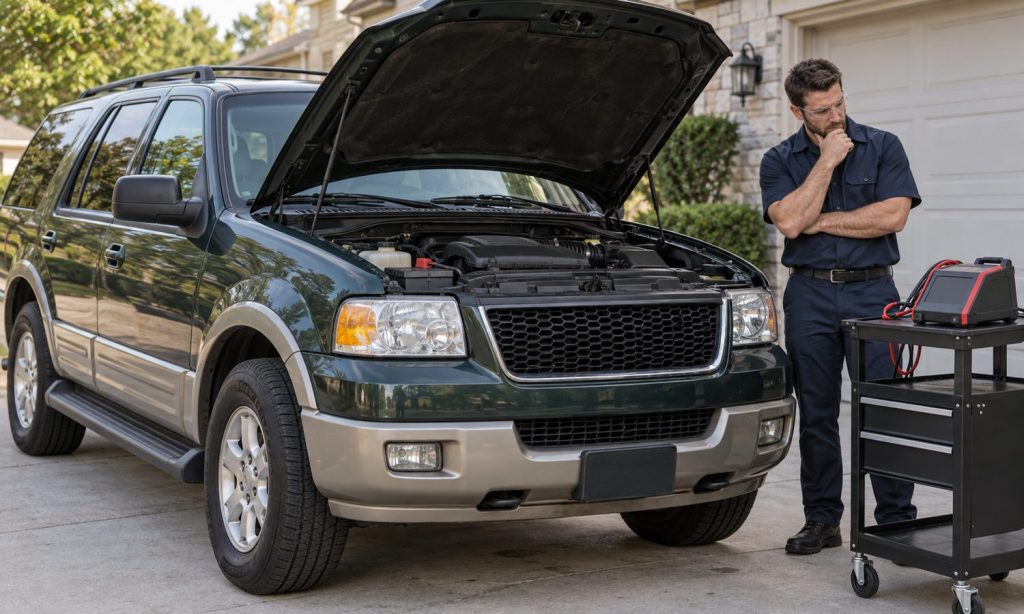
Learning how to diagnose a slow-start or weak-battery problem on a Ford Expedition begins with describing what the engine actually does. Does it turn unusually slowly, click without turning, or crank at normal speed for several seconds before firing? Those symptoms lead to different checks. A discharged or deteriorated battery is one possibility, but cable resistance, a starter fault, charging problems, or an electrical drain can produce similar complaints. Normal-speed cranking that takes too long to become a running engine belongs on a different diagnostic path. Start with safe observations and a properly performed battery test, then investigate the circuits indicated by the results. The Expedition’s model year and engine matter, so this guide avoids one universal battery specification, voltage threshold, or jump-start connection sequence.
Sort the symptom before replacing anything
Slow cranking means the starter turns the engine more sluggishly than usual. No cranking means the engine does not turn, whether or not you hear a click. Extended cranking means it turns at its usual pace but takes longer to start. Record which one occurs. Saying only that the Expedition starts slowly can send the diagnosis toward the wrong system.
Also note whether the problem appears after sitting overnight, only in cold weather, after a hot engine is shut down, or after several days parked. Record recent service, accessory installations, battery age if known, and warning messages. A short recording made safely while parked can help a technician understand an intermittent sound without repeated starting attempts.
Begin with a safe visual check
Park securely, turn the engine off, and keep keys away from the vehicle while inspecting accessible areas. Look for a damaged battery case, wetness that could be electrolyte, loose-looking cables, corrosion, or damaged insulation. Do not manipulate a leaking, swollen, hot, or possibly frozen battery. Have a qualified professional handle it.
Lead-acid batteries contain corrosive acid and can release explosive gas. Keep flames and sparks away, use appropriate eye protection, and avoid placing metal tools across terminals. Do not reach around moving belts or fans. If safe access requires removing parts or working underneath the vehicle, let the technician perform the inspection with proper support and service information.
Test battery charge and battery health separately
A battery can be healthy but discharged, or charged yet unable to deliver the required starting current. A resting voltage measurement is useful context, but it does not settle both questions. Recent charging, temperature, battery construction, and test conditions affect interpretation. Avoid condemning the battery from one number or assuming normal-looking voltage proves it will crank the engine properly.
Ask for a battery test appropriate to its technology and rated specification. If the result calls for charging and retesting, complete that sequence before accepting a replacement diagnosis. Use compatible charging equipment and the vehicle’s designated connection points. The printed test result should identify the battery type and rating entered, since incorrect settings can undermine the conclusion.
Check the current path when the battery passes
The starter depends on both the positive supply path and the return path through the ground connections. Corrosion or a poor connection can restrict current even when the battery itself tests well. A technician can use voltage-drop testing under starting load to locate excessive resistance. Looking at the outside of a cable cannot reveal every problem inside a terminal or cable assembly.
If the battery and cables meet the correct specifications, the technician can evaluate starter current draw, control operation, and possible mechanical causes. A click alone does not identify a failed starter. Do not bridge starter terminals or bypass the starting controls as a driveway shortcut; unexpected movement, short circuits, and high-current arcing are serious hazards.
Find out why a battery keeps losing charge
A successful recharge answers whether starting improves with more available energy, not why the battery was low. Review lights left on, short trips, long parking periods, and recent electrical additions. If the battery repeatedly goes flat, arrange charging-system and key-off electrical-draw checks. Replacing the battery without investigating the pattern can leave the original problem unresolved.
Charging-system interpretation varies across Expedition generations. Do not apply a single engine-running voltage rule to every model or disconnect a battery cable while the engine runs to test the alternator. A technician should check operation under the specified conditions, including relevant control information. For a drain test, modules may need time to enter their normal parked state; pulling random fuses can disturb that state and obscure the cause.
Use the normal-cranking branch when appropriate
If the engine cranks normally but takes too long to fire, investigate the starting conditions and stored diagnostic information before buying battery or ignition parts. Fuel delivery, ignition, engine-management inputs, and other faults may be involved. A trouble code identifies an area needing diagnosis rather than automatically naming the part to replace.
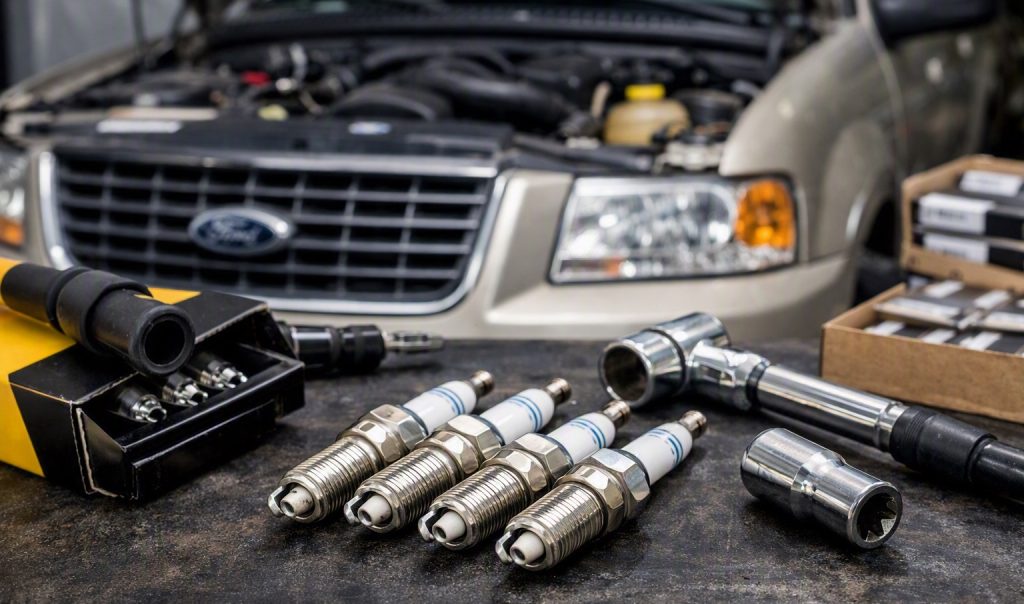
Spark plugs are relevant only when testing or the maintenance schedule points toward ignition service. For a matching 2003 vehicle, the existing 2003 Ford Expedition spark-plug fitment guide provides application questions to verify. It is not a solution to sluggish starter rotation, and a plug listed for another engine or production year should not be assumed suitable.
Related guidance: a related slow-start and battery diagnostic guide; battery fitment context for a different Ford truck.
Frequently Asked Questions
Does a successful jump-start prove the battery is bad?
No. It shows that the additional electrical support helped under those conditions. A discharged battery, poor connection, or other issue may still need investigation. Follow the exact owner’s manual if assistance is necessary, then have the system tested.
Can bright headlights rule out a battery problem?
No. Lighting and starter demands differ. A battery or connection may support lights while failing under the starting load. Use the observations to describe the event, but rely on appropriate testing for a conclusion.
Should I keep cranking until the engine starts?
No. Follow the model-specific limits on starting attempts and rest periods. Repeated attempts can discharge the battery and overheat components. Stop for smoke, hot wiring, a burning smell, or abnormal mechanical sounds.
Why does the problem happen only after the engine is hot?
Temperature-dependent faults can involve several systems. Have the shop reproduce the condition and measure the relevant circuits while it occurs. A cold test that passes does not necessarily resolve a complaint that appears only after a hot shutdown.
Does a new battery need any vehicle setup?
Requirements vary by model year and equipment. Confirm the specified battery technology, physical fit, connections, and any battery-monitoring reset or relearn procedure in the correct service information. Do not assume an older Expedition’s process applies to a newer one.
Final Words
Diagnose an Expedition starting complaint by separating slow rotation from delayed firing, testing battery charge and health, and checking the current path before replacing parts. Repeated discharge calls for charging and drain diagnosis. Keep a clear symptom record, use year-specific instructions, and leave high-current or unsafe testing to a qualified technician.
Reference
Canadian Centre for Occupational Health and Safety: vehicle lead-acid battery precautions — general battery hazards, not Expedition-specific repair instructions.