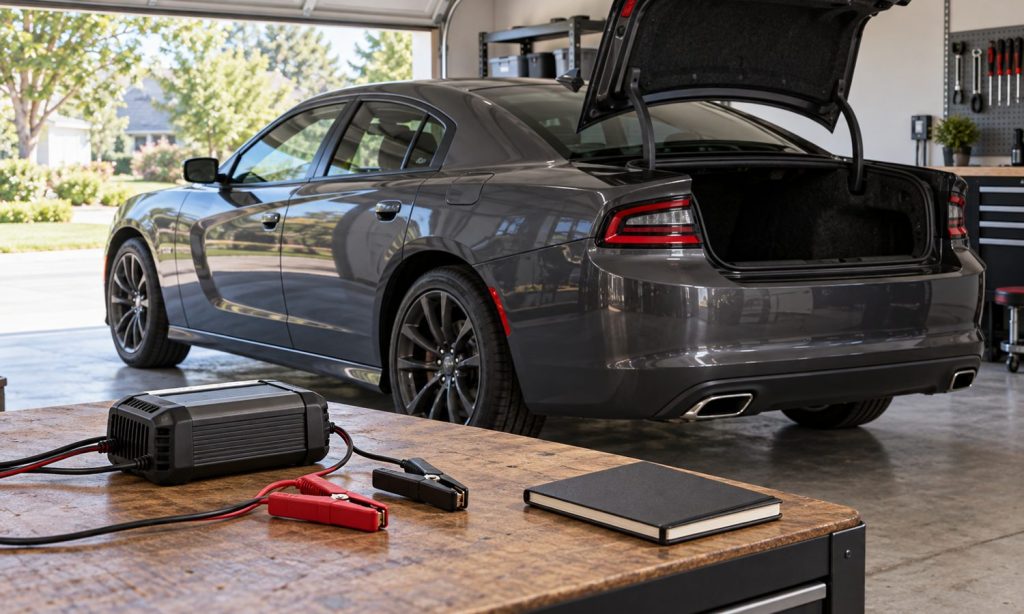
Understanding how to verify charging equipment compatibility with Dodge Charger V6 models starts with the installed battery, not the engine badge. For a conventional gasoline Charger, this means checking a 12-volt battery charger or maintainer against the battery label, the vehicle manual, and the equipment instructions. A phone charger and an electric-vehicle charging station serve different purposes. Even among automotive battery chargers, matching voltage alone does not establish compatibility. Battery chemistry, supported capacity, operating mode, connection method, and installation conditions also matter. This guide explains how to collect that information before connecting anything, distinguish routine charging from emergency starting, and recognize questions that require a technician. Because model years and replacement batteries differ, it provides a verification process rather than one charging setting for every V6 Charger on the road.
Identify the vehicle and the battery separately
Record the model year, engine, and any electrical modifications. Obtain the owner’s manual for that year and market. Then photograph the installed battery label without disturbing its cables. A previous owner may have installed a replacement with different construction, so an online original-equipment listing is not enough.
Look for nominal voltage, battery type, part number, and capacity information. AGM means absorbed glass mat; it is a lead-acid battery construction, not lithium. A label describing a battery as maintenance-free does not by itself identify every charging requirement. If the chemistry is unclear, resolve the part number with the battery manufacturer before choosing a mode.
Cold-cranking amps and amp-hours describe different properties. Do not enter a CCA number into a charger’s battery-capacity field. When the equipment manual specifies an amp-hour range and the battery label omits that rating, obtain the battery’s documentation instead of inventing a conversion.
Match the equipment to the intended job
A charger replenishes charge; a maintainer is intended to manage charge during storage within its stated limits. A jump starter supplies a brief starting assist. A power supply supports an electrical load. One device may offer several functions, but each function has separate instructions and limitations.
Write down whether you need occasional recharging, seasonal maintenance, or professional diagnostic support. A device’s maintenance capacity may differ from its charging capacity. A small maintainer that can support a charged battery may take impractically long to restore a heavily discharged one. Compatibility includes the task, not just the connector.
Do not use a repair, desulfation, force, lithium, or supply setting simply because the ordinary mode reports an error. Those modes can change how the unit controls output or applies protections. Their suitability must be established for the battery and for use while connected to the vehicle.
Build a compatibility checklist before connecting
Compare the battery instructions and charger manual side by side. Confirm supported nominal voltage, chemistry, capacity range, permitted charging current, and temperature limits. Also check whether the instructions allow charging with the battery installed and connected. Any unresolved conflict is a reason to stop and obtain clarification.
A charger’s maximum output current is not automatically the right setting for your battery. Likewise, the word automatic does not remove the need to select the correct mode. If charging current is adjustable, use the battery manufacturer’s specified limits and the equipment procedure rather than a universal rule based on engine displacement.
Check the supplied leads and connectors too. They must be approved for the equipment and appropriate for the intended installation. Matching connector shapes do not prove matching polarity or current ratings. Avoid improvised extensions, damaged clamps, or an accessory lead whose wiring and protection are unknown.
Verify connection points in the correct manual
Battery location and charging connection points are separate questions. The 2018 Charger owner’s manual locates its maintenance-free battery beneath a trunk access cover and identifies remote engine-compartment terminals for jump-starting. That jump-start information should not be treated as blanket approval for every charging mode or accessory connection.
The same manual gives a specific warning concerning fast chargers: vehicle battery cables must be disconnected before that operation, and a fast charger must not supply starting voltage. Battery disconnection is not a casual workaround; it requires the correct procedure. If your equipment instructions conflict with the vehicle instructions, have a qualified technician resolve the setup.
For another model year, consult its own documentation. Identify the approved positive and negative connection locations and any battery-monitoring requirements before work begins. Do not choose a ground point because it is convenient or copy a photograph from an unidentified Charger. This article does not replace a model-specific connection procedure.
Check the space and equipment condition
Inspect the battery and leads before charging. Do not charge a frozen, cracked, leaking, or otherwise damaged battery. Use a ventilated area, keep ignition sources away, and follow the required eye and skin protection precautions. Lead-acid batteries can release flammable gas, including during normal operation.
Keep the charger switched off or unplugged while attaching or removing connections, following its prescribed sequence. Route cords clear of sharp edges and moving parts, and prevent a hood or trunk lid from pinching them. Follow the equipment’s limits for moisture, temperature, placement, and electrical supply. Stop if insulation, plugs, or terminals are damaged.
Confirm the result instead of assuming success
Before starting the session, record the selected mode and any initial warning. Observe the unit as directed by its manual and understand what its indicator actually means. A charging-complete light is not an independent test of battery starting capacity, and an error code is not a complete vehicle diagnosis.
If the battery repeatedly goes flat, record the parking duration, accessory use, and starting symptoms. Battery condition, charging-system operation, cable connections, and excessive parked electrical draw may need testing. Repeatedly recharging without investigating the cause can leave the original problem unresolved.
Parking accessories deserve particular attention. Our explanation of dash-camera power during parked recording helps distinguish accessory demand from charging equipment. A charger compatibility check cannot establish how long an individual camera installation will run without affecting starting reserve.
Related guidance: battery chemistry and charger mode checks in a Ford Explorer; parked accessory power and battery drain context.
Frequently Asked Questions
Does the V6 engine determine the charger setting?
No. Engine identification helps locate vehicle documentation, but the installed battery and charging equipment determine the applicable settings. Two V6 cars can have different replacement batteries. Record the actual battery type and part number instead of treating engine size as a charging specification.
Can a USB phone adapter recharge the starting battery?
A normal phone adapter draws power from the vehicle to charge a device. It does not function as an automotive battery charger. Do not attempt to feed power backward through a USB port or ordinary accessory adapter to charge the car.
Can I leave a maintainer attached throughout storage?
Only when the equipment, battery, and vehicle instructions permit the arrangement. Follow the specified monitoring and environmental requirements. Long-term maintenance capability does not mean every lead installation or unattended location is acceptable, and it does not eliminate periodic battery and cable checks.
What if an automatic charger will not recognize the battery?
Do not bypass its detection safeguards by guessing at a force mode. Check the manual’s troubleshooting guidance and have the battery assessed when needed. Incorrect connections, voltage outside the detection range, and battery faults require different responses; the symptom alone does not distinguish them.
Should I buy charging equipment before identifying a replacement battery?
Establish both specifications first if replacement is already planned. A charger compatible with the current battery may not suit a later change in chemistry or capacity. Keep the battery specification and equipment manual together so future servicing does not rely on a remembered setting.
Final Words
Verify charging equipment compatibility with your Dodge Charger V6 by matching the installed battery, intended task, vehicle instructions, and equipment limits. Confirm every setting and connection before applying power. When documentation conflicts or the battery repeatedly loses charge, seek a qualified diagnosis instead of escalating to a more aggressive mode. A documented match is more useful than a broad claim that a charger works with all cars.
Reference
2018 Dodge Charger Owner’s Manual: battery location and charging precautions.
Canadian Centre for Occupational Health and Safety: Garages—Lead-acid Batteries.