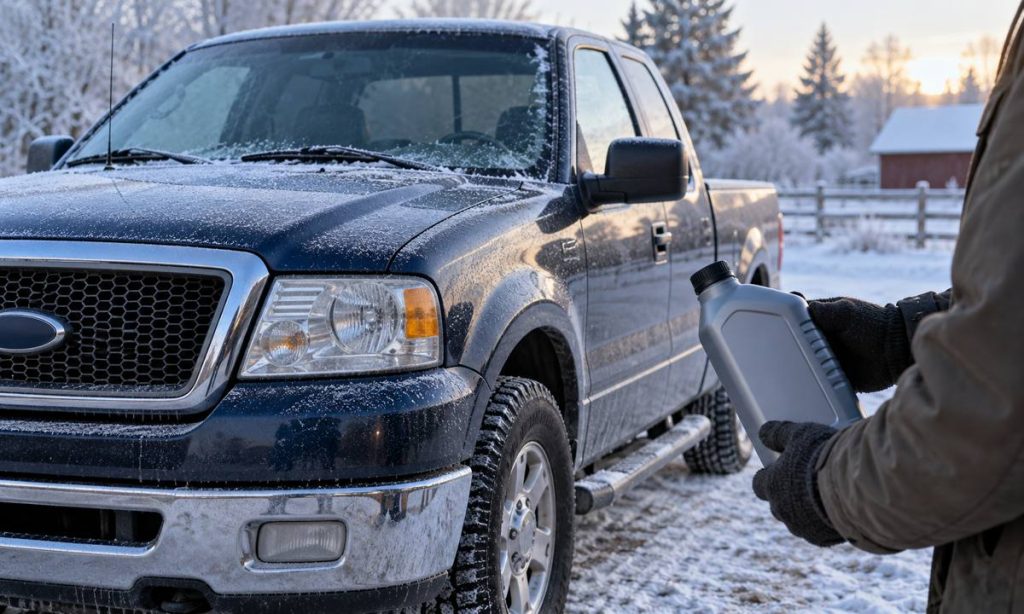
Cold weather makes oil choice feel urgent, but the right viscosity for a Ford F-150 4.6L must come from the owner’s manual for the exact model year, engine version, and market. “F-150 4.6” spans multiple years and engine configurations, and the manual may specify a grade, performance standard, and temperature guidance. Do not switch to a thinner oil based only on a cold forecast or choose a thicker grade to compensate for wear without qualified advice. Ford’s oil recommendations vary by year and engine. As one dated example, the official 2009 F-150 guide specifies SAE 5W-20 for its 4.6L engine and identifies a Ford oil specification. That example does not automatically apply to every 4.6L truck. If you are also planning a tune-up, the separate spark plug guide for a Ford F-150 4.6 covers a different service item.
Start with the exact owner’s manual
Confirm the truck’s model year, engine size, and engine version from the VIN-specific records, under-hood label, or vehicle paperwork. A 4.6L V8 may be described with additional details such as 2-valve or 3-valve, depending on year. Use Ford’s owner-manual lookup to find the correct guide. Then check the engine oil section and the capacities and specifications table. Record the SAE viscosity grade, Ford specification, API or other certification language, and any temperature chart or permitted alternatives.
Ford’s general oil lookup also asks for model year and engine because recommendations change across vehicles. Do not use a manual for a different year, a generic “Ford 4.6L” chart, or the grade printed in a forum post as the final authority. If the engine has been replaced or modified, confirm which specification applies with a Ford service source or qualified technician.
What the viscosity label tells you
A multigrade label such as 5W-20 contains two ratings. The “W” refers to cold-temperature performance in standardized viscosity tests; the second number describes viscosity at operating temperature under the relevant test method. In broad terms, a lower winter rating is associated with better flow in colder conditions than a higher winter rating within the same oil category. The label alone, however, does not establish that an oil is approved for a particular engine. The Ford specification and required certification matter too.
The owner’s manual may show a viscosity chart tied to ambient temperatures or list one recommended grade with a technical specification. Follow that chart exactly. Do not decide that 0W oil is automatically better for every cold climate, or that 10W oil is unacceptable in every situation. The engine was designed and validated for specified oil grades and approvals; a substitute needs to meet the vehicle’s requirements, not just appear in a search result as suitable for cold weather.
A dated F-150 4.6L example
Ford’s 2009 F-150 Owner’s Guide distinguishes the 4.6L engine from the 5.4L engine and specifies SAE 5W-20 oil for the 4.6L application. It also lists Ford specification WSS-M2C930-A and an API Certification Mark in its recommendation. This is a useful illustration of why the engine and year matter: the same manual lists a different oil quantity and details for the 5.4L engine. Use the example only if your truck’s exact year and engine match the manual; check the current correct manual for every other model year.
The manual also discusses oil capacity and service intervals separately from viscosity. When refilling, capacity is a starting reference, not a substitute for checking the dipstick or electronic level procedure. Overfilling can be harmful. For an oil change, use the specified filter and service procedure along with the required oil. This article does not establish a universal grade, fill quantity, or change interval for all F-150 4.6L trucks.
How cold weather affects your decision
If winter temperatures fall below the range shown in your manual, use the manual’s chart or contact Ford with the VIN before changing grades. Look for any footnotes about engine type, oil certification, or restricted alternatives. The temperature chart should be interpreted for expected ambient conditions and the exact engine, not as a general recommendation for every F-150.
Cold starts can make oil appear slow to circulate, and the engine may sound different briefly, but a noise is not proof that the viscosity is wrong. Check oil level on level ground using the manual’s waiting period and method. If the oil pressure warning appears, stop safely and follow the owner’s manual. A persistent warning, loud knocking, leak, or repeated hard-start issue needs diagnosis; do not attempt to silence it by changing oil grade without verifying the cause.
Common mistakes to avoid
- Using a viscosity chart from another model year or a different 4.6L engine version.
- Choosing oil by the first viscosity number alone and ignoring Ford’s specification.
- Assuming synthetic oil changes the required grade or approval.
- Using a thicker oil to mask engine wear or a thinner oil based only on cold weather.
- Guessing capacity instead of checking the manual and level procedure.
- Confusing oil guidance with spark-plug or other service specifications.
Frequently Asked Questions
What oil viscosity does a Ford F-150 4.6L use?
It depends on the model year and engine version. Use the owner’s manual for the exact truck. Ford’s 2009 guide specifies 5W-20 for its 4.6L application, but that does not establish the grade for every year.
Can I use a lower winter viscosity for very cold weather?
Only if the exact owner’s manual permits that grade and the oil meets the required Ford specification and certifications. Do not choose by cold rating alone.
Does synthetic oil let me ignore the manual’s viscosity?
No. The oil still needs to meet the specified viscosity and performance requirements unless Ford’s manual explicitly allows an alternative.
How do I know whether my F-150 has a 4.6L 2-valve or 3-valve engine?
Check the VIN-specific vehicle records and engine information for your model year. Do not assume from the badge or a generic listing; ask a Ford service source if the configuration is unclear.
What if the oil-pressure warning appears in cold weather?
Follow the owner’s manual warning procedure and stop the engine when directed. Check oil level only when safe, and arrange service if the warning persists. Do not treat a warning as a reason to change viscosity without diagnosis.
Final Words
For Ford F-150 4.6L oil viscosity in cold weather, the owner’s manual is the deciding reference. Verify year, engine version, approved SAE grade, Ford specification, certification, and any temperature chart before buying oil or topping up. The 2009 manual’s 5W-20 example applies to that manual’s 4.6L specification, not automatically to every truck. Keep oil level and filter requirements separate from viscosity, and have warning lights or persistent engine noises diagnosed instead of changing grades by guesswork. For related 4.6L maintenance, consult the Ford F-150 4.6 spark plug guide separately.