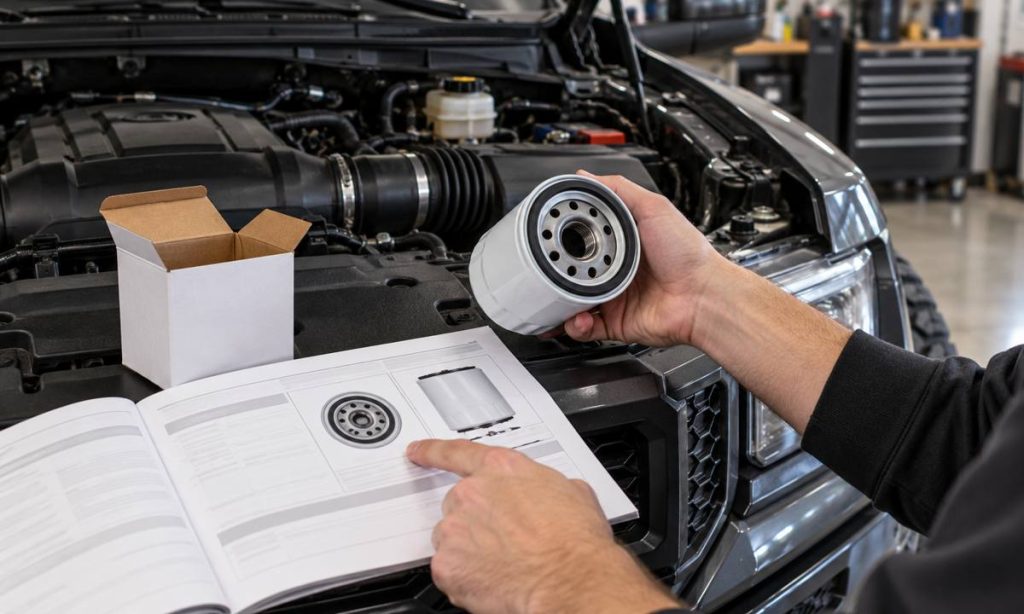
Before servicing a Ford Raptor, verify the oil filter by the vehicle’s exact model, year, engine, and VIN-specific parts application. “Raptor” can refer to more than one Ford vehicle and powertrain, and filter fitment may change across generations. A filter that threads onto the mount can still have the wrong gasket, internal bypass behavior, anti-drainback design, dimensions, or performance specification. Start with the owner’s manual and a Ford or filter-manufacturer application catalog, then compare the listed part number and required specification. Do not select a filter by appearance, engine family alone, or a marketplace title. Ford’s Raptor supplements include model-specific filter guidance; for example, the 2018 F-150 Raptor supplement calls for a Motorcraft filter or an alternative meeting SAE/USCAR-36. For a separate maintenance item on a 2014 F-150 Raptor, see the site’s Ford Raptor spark-plug guide.
Identify the exact Raptor
Record the model year, vehicle line, engine, and production details. Confirm whether the vehicle is an F-150 Raptor, Ranger Raptor, Bronco Raptor, or another market-specific model. Engine size and oil-filter design may differ between them and between years. Use the VIN in Ford’s parts or service system when available. If the engine has been replaced, modified, or fitted with an aftermarket oil-cooling system, disclose that before ordering parts.
Ford’s owner-manual lookup helps identify the correct maintenance document. For filter selection, use a Ford parts catalog or a filter-maker catalog that asks for the same vehicle details. If two catalogs disagree, check the VIN with a Ford parts department or qualified technician rather than guessing.
Verify the part number and specification
Find the specified oil-filter part number in the owner’s manual, service information, or official parts catalog. Confirm whether Ford has superseded that number with a newer one and whether the change applies to the exact engine and build date. A current listing may show multiple replacement numbers, but a supersession chain should be supported by a trusted catalog, not inferred from similar packaging.
Read the filter’s technical specification, not only the brand name. Ford Raptor supplements may provide an industry performance standard for a non-Motorcraft alternative. The 2018 F-150 Raptor supplement, for instance, states that if a Motorcraft oil filter is unavailable, use one meeting SAE/USCAR-36. That statement is specific to the supplement and vehicle application; it does not establish a universal filter rule for every Raptor year or model. Use the applicable supplement for your truck.
Why physical fit alone is not enough
Oil filters can look similar while differing internally. Thread size and gasket diameter are only part of the match. The filter also needs the correct sealing surface, height and clearance, flow capacity, bypass-valve behavior, anti-drainback design where applicable, and filtration performance for the engine’s oiling system. A mismatch can cause leaks, poor oil circulation, start-up noise, or inadequate filtration. Do not assume that a filter is suitable because it fits by hand or shares a thread with another Ford engine.
Check that the replacement clears nearby components and can be installed and removed with the intended access. On some engines, a cartridge-style element and housing seal are used rather than a spin-on canister. Confirm whether the catalog includes the correct element, cap seal, drain-plug gasket, or other service parts. Do not reuse a distorted seal or substitute a generic O-ring without a documented application.
Check related service requirements
Oil-filter compatibility is only one part of an oil service. Verify the engine oil grade and Ford specification, fill capacity, filter change procedure, and service interval for the same model year and engine. Some Raptor engines have special procedures or more than one oil-circuit component; follow the manual and service information. Do not use an oil filter chosen for a related engine if the exact application is absent.
Before installation, compare the new filter and supplied seals with the specified part. Inspect the mounting surface for the old gasket, dirt, or damage. Follow the filter maker’s installation instructions and Ford’s service procedure for lubrication, tightening, and refill. After starting the engine, check for leaks and confirm the oil level according to the manual. If an oil-pressure warning appears, shut the engine off as instructed and investigate before operating the vehicle.
What to record before ordering
Save the VIN, model year, engine description, and production date if the catalog requests it. Record the specified filter number and any documented replacement number. If an old filter is still installed, note its number but do not treat it as proof; a previous service may have used the wrong part. Compare the catalog result with the owner’s manual or supplement, and keep the packaging until the new filter is installed and checked. If a listing omits engine or year details, ask the manufacturer for a written application confirmation. A generic “fits Raptor” description does not resolve a catalog conflict.
Common compatibility mistakes
- Searching only “Ford Raptor oil filter” without choosing the vehicle year and engine.
- Assuming an F-150, Ranger, and Bronco Raptor use the same filter.
- Matching the thread but ignoring the gasket, bypass valve, or performance specification.
- Using an older part number without checking for an official supersession.
- Confusing an engine oil filter with a transmission or fuel filter listing.
- Installing a filter when the catalog application or service instructions are unclear.
Frequently Asked Questions
How do I find the correct oil filter for my Ford Raptor?
Use the VIN, model year, vehicle line, and engine in Ford’s parts catalog or a trusted filter-maker catalog. Confirm the specified part number and any approved supersession.
Can I use any oil filter that fits the threads?
No. Thread fit does not verify gasket dimensions, clearance, bypass function, anti-drainback design, or required performance standard.
Does SAE/USCAR-36 apply to every Ford Raptor?
Do not assume that. The 2018 F-150 Raptor supplement names that standard for an alternative filter in its application. Check the current guidance for your exact Raptor.
What if two parts catalogs list different filters?
Pause and verify the VIN, engine, and production details with Ford or a qualified parts professional. Do not choose based on appearance or a generic cross-reference alone.
Should I replace the oil-filter seal during service?
Follow the exact filter and vehicle instructions. Cartridge systems often require a new specified seal; spin-on designs have different requirements. Do not reuse a damaged or distorted seal.
Final Words
To check oil-filter compatibility before servicing a Ford Raptor, identify the exact vehicle and engine, verify the part number through a VIN-aware catalog, and confirm any required performance specification in the applicable Ford manual or supplement. Physical fit is not enough. When the application is unclear, pause and confirm with Ford or a qualified parts professional before installing the filter. Keep oil grade, capacity, and filter requirements tied to the same model-year service information. For related service planning on a 2014 F-150 Raptor, use the separate spark-plug guide as a distinct maintenance reference.