
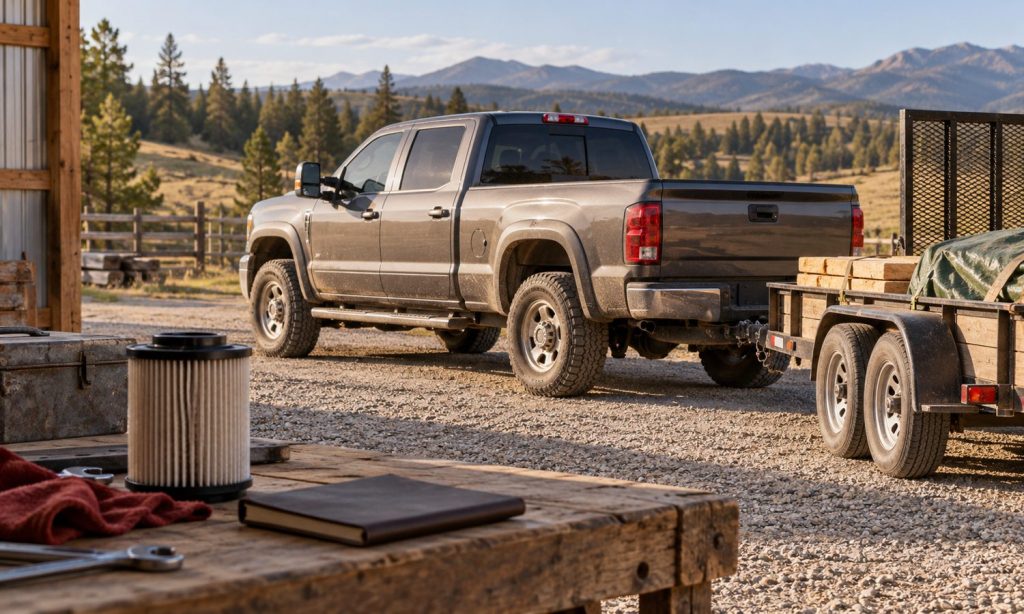
How towing and dusty driving change maintenance needs for a Ford F250 6.7L diesel depends on the truck’s model year and how it works. Frequent trailer use, low-speed operation, extended idling, and unpaved roads can place the truck under special operating-condition schedules instead of ordinary-use assumptions. The answer is not simply to change every fluid sooner or replace the air filter whenever it looks dirty. Use the correct Ford owner’s manual and diesel supplement, identify the conditions that apply, and track mileage, time, and engine hours where specified. Then combine scheduled service with inspections prompted by actual conditions. This approach keeps oil, filtration, cooling, chassis, and electrical maintenance connected to the work the truck performs without borrowing an interval from a different Power Stroke generation.
Build the schedule around actual use
Start with the VIN and model year. Locate both the normal maintenance schedule and the special operating-condition tables. Read their descriptions and footnotes rather than assuming that any trailer trip triggers the same requirements. List recurring conditions: towing frequency, typical loaded weight, dusty road exposure, stop-and-go work, and time spent idling.
Where Ford specifies more than one trigger, record each applicable measure. A work truck can accumulate operating hours without traveling far. Keep the service date, odometer reading, and engine-hour reading when available. If several special conditions overlap, have the service adviser explain which requirements apply to each component; do not average two intervals or use the longest one by default.
Give oil service the correct priority
Towing and prolonged low-speed work can change oil-service needs. Follow the oil-life monitoring instructions together with the limits and special-condition requirements for your exact truck. The display does not replace checking oil level or responding to a warning. Reset the monitor only after the corresponding oil service has actually been completed.
Confirm the required Ford oil specification and permitted viscosity for the engine and operating conditions. Do not select a heavier oil solely because the truck tows, or add an unapproved treatment to compensate for hard use. Record the specification and filter used on the invoice. A useful service record identifies what went into the engine, not just that an oil change occurred.
Treat dust as an intake-system concern
Use the air-filter inspection method specified for the installed system. The 2016 diesel supplement describes a restriction gauge and more frequent checks in extremely dusty conditions. It also warns against judging the filter by appearance alone or cleaning the paper element with compressed air. Those instructions are a model-year example; verify the equipment and guidance on your truck.
Ask the technician to check the housing, sealing surfaces, clips, and intake connections when service is due. A replacement element must fit and seal correctly. Do not run the engine with the filter removed to see whether performance improves. Dust exposure is a reason to inspect the complete air path and follow the prescribed service method, not an invitation to modify filtration.
Keep fuel and exhaust maintenance distinct
Road dust and diesel-fuel contamination are different issues. Follow the specified fuel-filter schedule and water-separator checks, and respond promptly to water-in-fuel or fuel-pressure messages according to the manual. The 2016 6.7L supplement describes both frame-mounted and engine-mounted filtration. Confirm the arrangement for your year before assuming that replacing one filter completes the service.
Diesel exhaust fluid and diesel fuel also have separate fill points and purposes. Keep filling equipment clean and use the specified fluid. If the wrong substance enters either tank, stop and obtain professional advice rather than trying to dilute it. Exhaust-system messages need the response described for the truck; do not treat towing as a guaranteed cure for a particulate-filter warning.
Include cooling and the running gear
Before demanding use, have leaks, abnormal temperatures, and cooling-system concerns resolved. Inspect accessible fluid levels only under the conditions specified in the manual, and never open a hot pressurized cooling system. Coolant type, testing requirements, and service schedules vary. Do not add a universal additive because another owner uses it in a different model year.
Dusty-road service also warrants attention to brake condition, tire wear, steering joints, suspension components, and applicable lubrication points. Ford’s special-condition guidance includes such inspections; an air-filter replacement alone is not a complete dusty-use service. Report new vibration, wandering, uneven tire wear, or pulling under braking. These observations call for diagnosis rather than simply shortening the next oil-change interval.
Check electrical readiness without assuming battery failure
Include battery security, connections, and charging concerns in the inspection, especially before remote work or a long towing trip. If starting becomes sluggish, have the battery system tested and distinguish slow rotation from normal-speed cranking with delayed firing. Our Ford 6.7L diesel starting-diagnosis guide explains that distinction.
A dusty route or heavy trailer does not automatically mean the batteries need replacement. If testing establishes that replacement is needed, verify the technology, rating, dimensions, and any required setup. The F250 6.7 diesel battery fitment overview provides application questions, but the truck’s exact requirements and test results remain decisive.
Make the next service easy to verify
Give the shop your usage record and ask for a written list of the applicable schedule items. Separate inspections from replacements: a component checked and found serviceable is different from one renewed. Record any deferred concern, the reason, and the next due trigger. Review the plan when work patterns change, such as a move from paved commuting to daily construction-site travel.
Related guidance: Ford 6.7 diesel air-filter maintenance context; Ford 6.7 diesel owner-manual maintenance context.
Frequently Asked Questions
Does one dusty trip require a full severe-use service?
Not automatically. Inspect for immediate concerns and apply the manual’s condition descriptions. An unusual exposure can justify an inspection without making every fluid due. Persistent dusty operation needs an ongoing maintenance plan.
Should I replace the air filter whenever it looks brown?
Appearance alone may be misleading. Use the specified restriction or condition checks and inspect the seal and housing. Replace a damaged or unsuitable element as directed; do not invent a universal visual threshold.
Can engine hours matter more than mileage?
They can become the earlier service trigger where Ford specifies an hour limit. Idling and slow work accumulate hours with few road miles. Record both measurements and follow the applicable schedule.
Does towing increase the truck’s permitted load after servicing?
No. Maintenance does not raise GVWR, axle, tire, hitch, or trailer ratings. Weigh and configure the combination correctly; better service cannot make an overloaded setup acceptable.
Should fuel additives replace scheduled filter changes?
No. Follow Ford’s fuel guidance and prescribed filtration service. An additive does not remove a filter’s accumulated contamination or replace a water-separator procedure. Obtain advice for an actual fuel-quality problem.
Final Words
For an F250 6.7L diesel, towing and dusty driving call for a documented, year-specific service plan. Track operating conditions and due triggers, inspect filtration and the running gear, and address warnings promptly. Use measurements and condition checks to support replacement decisions rather than adopting another truck’s schedule.
Reference
2016 Ford 6.7L Diesel Supplement — special operating conditions, air-filter inspection, and fuel-system maintenance; confirm the schedule for your own model year.
Pingback: How to Choose Spark Plugs for a Ford 5.4 Triton
Pingback: Check Oil Filter Compatibility for Ford F-250 6.7 Diesel