If an accessory may be draining a Dodge Ram 2500 battery, first identify what stays powered when the truck is parked and whether the battery and charging system are healthy. Common areas to inspect include added lights, audio equipment, alarms, remote-start systems, dash cameras, inverters, trailer wiring, and outlets. A weak or undercharged battery can mimic a parasitic draw, and a charging fault can leave the battery low even when no accessory is at fault. Record the truck’s exact year and equipment before checking circuits because wiring and battery-management features vary.
Start with the pattern of the discharge
Note when the truck fails to start, how long it was parked, recent short-trip or towing use, and any recent electrical work. Check whether the problem began after installing or adjusting an accessory. Look for lights that remain on, a charger left in a powered outlet, a radio or inverter that does not shut off, or a device wired directly to constant battery power. If the truck has a Battery Saver or low-voltage message, record it and consult the manual for that exact model year.
Do not assume the accessory is the only possible cause. A battery that has aged, been deeply discharged, or is not fully charged can lose reserve capacity. Loose or corroded terminals, a charging-system problem, or an internal electrical fault can also lead to a no-start. Have the battery and charging system tested before an extended parasitic-draw diagnosis so the technician is measuring against a known condition.
Inspect accessory wiring and how it is powered
- Determine the power source: Find whether the accessory uses constant battery power, ignition-switched power, or a vehicle outlet that remains live after shutdown.
- Check the shutoff behavior: Confirm that the accessory enters its intended sleep mode and that timers, parking modes, or remote-start settings are configured correctly.
- Look at recent installation work: Inspect for pinched insulation, loose grounds, poor splices, exposed conductors, incorrect fuse taps, or a relay wired to stay energized.
- Review total load: Additional lights, amplifiers, alarms, and inverters draw current when operating; multiple accessories may exceed what the truck can replenish during short trips.
- Check trailer and outlet connections: Unplug the trailer or device when parked and inspect connector condition if the discharge began after towing or using a powered outlet.
- Read the accessory instructions: Compare its ignition-off draw, shutdown delay, and installation diagram with the vehicle’s electrical design.
Do not bypass fuses, increase fuse ratings, or connect an accessory directly to the battery without the required circuit protection and installation procedure. If the accessory’s wiring is unclear, have an automotive electrician trace it. Improper wiring can create heat, damage vehicle electronics, or cause a fire.
Use a proper draw test when the cause is not obvious
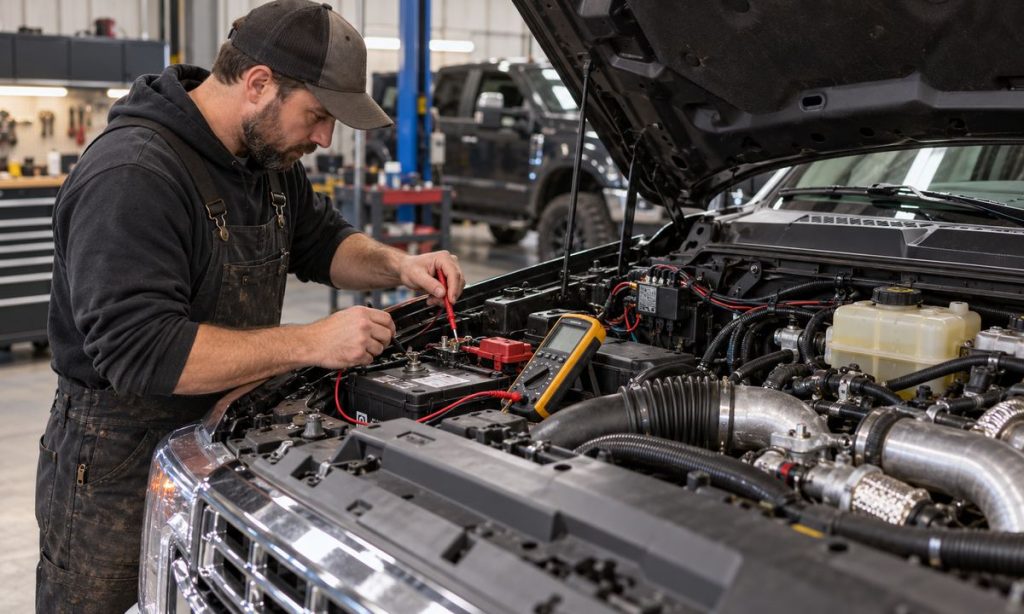
A parasitic-draw test is more than touching a meter to the battery immediately after shutdown. Modern vehicles may keep modules awake for a period, and opening a door or reconnecting a device can change the reading. The vehicle-specific service procedure should specify how to prepare the truck, allow modules to sleep, and isolate circuits without waking them. Some Rams use battery monitoring or load-reduction features that change electrical behavior; follow the manual for the actual year and configuration.
A qualified technician can compare current draw with the applicable specification, then isolate the circuit or accessory responsible. If the drain appears only intermittently, a current clamp, data logger, or controlled overnight test may be needed. Do not disconnect safety-related systems or pull fuses at random; that can erase diagnostic evidence, create new faults, or affect security and module settings.
For later Ram models, the owner manual describes load-reduction messages and lists added lights, upfitter accessories, audio equipment, alarms, and unusual driving cycles as possible contributors to a low battery condition. That information is specific to equipped vehicles and is not a universal specification for every Ram 2500. If you’re researching headlights for a 2001 Dodge Ram 2500, verify the year-specific lamp wiring and the added load separately from the battery diagnosis.
Related troubleshooting examples include an accessory-related battery drain on a Ford 6.7 diesel and slow-start diagnosis on a Ford Raptor. They provide general questions to ask, while the Ram 2500 wiring diagram and service information control the test procedure.
After the repair, verify both the cause and the fix
Once an accessory or circuit has been repaired, confirm the battery is charged and test the truck after it has sat for the same amount of time that previously triggered the problem. Verify the accessory’s intended shutdown behavior and check for warning messages. If the battery continues to discharge, reassess battery condition and charging output rather than installing another accessory or replacing parts by guesswork.
If the truck is slow to crank, these related guides show how symptoms can have different causes: Ford 5.4 Triton battery and slow-start checks, Ford 6.7 diesel starting-system diagnosis, and Ford F-150 5.0 slow-start checks. For an OBD-II tool question on this truck, see the Dodge Ram 2500 scanner compatibility guide; a code reader does not replace a battery draw test.
Frequently asked questions
Can an aftermarket accessory drain a Ram 2500 while it is off?
Yes, if it remains powered, fails to sleep, or is wired to an always-hot circuit. Check its installation and shutdown behavior, then confirm the truck’s battery and charging system are healthy.
Could a weak battery look like an accessory drain?
Yes. A battery with reduced capacity may lose enough charge during ordinary parking to cause a no-start. Test the battery and charging system before concluding that an accessory is the cause.
Do added headlights drain the battery when parked?
They can if a switch, relay, or wiring fault leaves them powered, or if the installation draws current when off. Verify the exact lighting circuit and installation rather than assuming all aftermarket lamps behave the same.
Can I use a multimeter to find the parasitic draw myself?
Only if you understand the correct procedure and the vehicle’s sleep-cycle requirements. An incorrect connection can damage the meter or disturb vehicle electronics. When unsure, have a qualified technician perform the test.
What if the battery warning or low-voltage message returns?
Record the message and have the charging system, battery, and accessory circuits checked using the service information for your truck’s year. Repeated warnings need diagnosis.
Final Words
When an accessory may be draining a Dodge Ram 2500 battery, document when the discharge happens, inspect added equipment and its power source, and verify battery and charging-system health. If the cause is not clear, use the correct sleep-cycle and current-draw procedure for the truck’s exact year. Repair the circuit with proper protection, then confirm the battery holds charge after the same parking period that previously caused trouble.