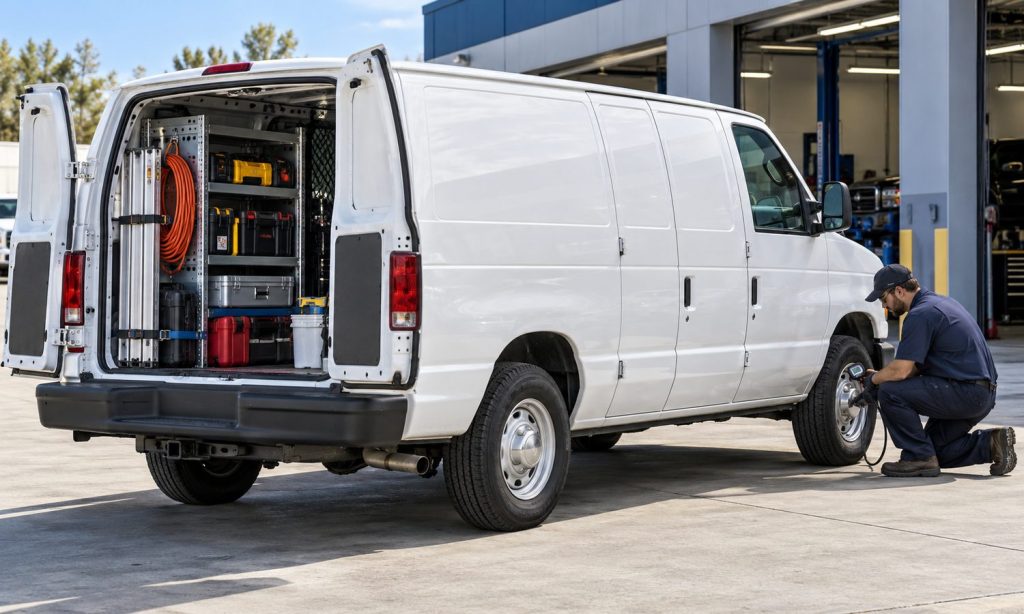
Choosing tire pressure for a Ford E-250 van when towing or carrying a heavy load starts with the tire-and-loading label on that exact van, not a guess or the maximum number molded into the tire sidewall. E-250 vans vary by model year, tire package, axle ratings, body configuration, and modifications. The label and the matching owner’s manual account for those details. Before a workday or trip, check the tires cold, confirm cargo and trailer tongue load stay within the van’s ratings, and inspect the tires. If your van has replacement wheels, a different tire size, or an upfitted body, ask a qualified tire professional to verify the setup before carrying a heavy load.
Start with your van’s tire label
Open the driver’s door and locate the Tire and Loading Information label or Safety Compliance Certification label. Record the original tire size and recommended cold pressure for the front and rear axles. Use the label for your van’s specific model year and configuration; pressures from another E-250, an online forum, or a generic chart may not apply. Ford owner manuals define cold pressure and explain that the vehicle’s recommended value is tied to its tires and load requirements.
The tire sidewall lists that tire’s maximum pressure and load information. It does not replace the vehicle label as the everyday setting. Nor does a tire with a higher load range automatically need to be inflated to its sidewall maximum. A replacement tire may require a load-and-inflation check and confirmation that the wheel, axle, and vehicle remain compatible. Consult the manual and a tire professional before changing tire size or pressure strategy.
Count the complete load
Payload includes occupants, tools, shelving, aftermarket equipment, and cargo. When towing, trailer tongue weight also presses down on the van and consumes payload. Heavy cargo can concentrate weight at the rear axle, so staying under the van’s total payload number does not guarantee that each axle is within limits. Ford’s loading guidance tells owners to include tongue load in payload and check the vehicle’s ratings. Do not exceed the gross vehicle weight rating (GVWR) or either gross axle weight rating (GAWR) listed for your van.
If you regularly carry dense equipment or tow near rated limits, weigh the loaded van at a certified scale. An axle-by-axle reading can uncover a rear-axle overload that is difficult to judge by sight. Secure cargo and distribute it as the vehicle or upfitter directs. Do not place heavy items high or far behind the rear axle without checking the effect on loading and handling. If the van exceeds any rating, reduce the load. Adding air cannot make an overloaded vehicle safe.
Check pressure the right way
Measure pressure before driving, ideally after the van has been parked for several hours and the tires are out of direct sun. Use a reliable gauge on each tire; include the spare as part of routine maintenance. Compare the readings with the front or rear specification on the label. Add air in small increments, recheck, and replace valve caps. If tires are warm from driving, their pressure will be higher. Do not bleed air merely to bring a warm reading down to the cold-label number; recheck once cold.
A tire-pressure monitoring system may warn of significant pressure loss, but it does not replace a gauge check or verify that a tire is suitable for your load. Follow the owner’s manual for the system’s limits and reset procedure. A tire that repeatedly loses pressure, has a bulge, cut, exposed cord, or causes vibration needs inspection. Avoid driving on a visibly damaged or severely underinflated tire, especially when loaded.
What changes when towing?
Towing adds load and changes acceleration, turning, and stopping. It does not create one universal towing pressure for all E-250s. Follow your model-year manual and tire label. If Ford specifies a different setting for a stated loading condition, follow that exact instruction. If the manual does not specify one, do not invent an increase or substitute the tire sidewall maximum. Trailer sway, sag, or poor handling should lead you to check load distribution, hitch setup, trailer brakes, and compatibility against the manual, not to inflate beyond approved guidance.
When evaluating tires for a Ford E-250 van, confirm size, load index or range, speed rating, wheel fit, and suitability for axle loads. The site search did not surface a verified published guide for this exact application, so this phrase is not linked to a specific existing article. A qualified tire shop can confirm that a replacement matches the van’s placard and intended service.
Pressure mistakes to avoid
- Using the sidewall maximum as the normal setting without a vehicle-specific instruction.
- Copying a pressure from another year, tire size, or axle configuration.
- Checking warm tires and lowering them to match a cold specification.
- Ignoring the manufacturer’s requirements for dual rear tires, if equipped.
- Assuming extra pressure compensates for excess payload, worn tires, poor alignment, or incompatible tires.
- Forgetting occupants, upfits, tools, and trailer tongue load all use payload capacity.
Before-trip checklist
- Confirm tire size and front/rear cold pressures on your van’s label.
- Inspect tread, sidewalls, valve stems, and wheels.
- Check cold pressure with a gauge and include the spare where appropriate.
- Account for passengers, equipment, cargo, and trailer tongue load.
- Confirm GVWR, front and rear GAWR, tire, wheel, hitch, and trailer ratings are respected.
- Recheck after tire service, seasonal temperature changes, or changes to the tire, wheel, or upfit.
For general loading principles, NHTSA explains the tire and loading information placard; Ford’s E-Series manual gives model-specific instructions. These sources support the checks above but cannot replace the label on your individual van.
Tire pressure and tire capacity work together: inflation must follow the vehicle’s placard and manual, while the tire’s load rating must suit the van’s axle and operating load. For a related Ford E-250-specific load-range discussion, see how to choose a tire load range for a Ford E-250 van. Use it to check capacity and fitment; do not substitute another vehicle’s pressure values.
Frequently Asked Questions
Should I raise pressure when the van is fully loaded?
Use the pressure stated on your vehicle label and follow any load-specific procedure in its manual. Do not raise pressure beyond Ford’s guidance simply because the cargo area is full.
Can I use the maximum PSI on the tire sidewall?
That marking describes a limit for the tire under specified conditions; it is not automatically the correct cold pressure for the van. Use the vehicle label and verify replacement tires professionally.
Does trailer tongue weight count as cargo?
It adds load to the tow vehicle and counts against payload. Include it when checking payload and axle ratings, and use the specific vehicle and hitch instructions.
How often should I check pressure?
Check at least monthly and before long trips or heavy-load duty. Also inspect tires when one looks low or the monitoring system warns you. Cold readings are comparable to the label.
What if my van has non-original tires or wheels?
Do not assume the original pressure information covers a modified setup. Have a qualified tire professional confirm tire capacity, wheel limits, axle loads, and pressure before towing or carrying heavy cargo.
Final Words
For a Ford E-250, start with the cold pressure on that van’s own label and the correct tire size and axle. Keep the loaded vehicle within GVWR and GAWR, include trailer tongue weight in payload, and check pressure before heavy-duty use. If a modified tire, wheel, or upfit makes the correct setting uncertain, have the complete combination checked before carrying the load.
References
- Ford 2016 E-Series Owner’s Manual (consult the manual matching your van).
- NHTSA, Tire and Loading Information Labeling.
- NHTSA Tire Safety.