Choosing tire pressure for a Dodge Ram 1500 when towing or carrying a heavy load depends on the exact truck, its tires, and the load at each axle. Ram 1500 model years differ in cab, bed, drivetrain, engine, wheel package, and payload rating; replacement tires or suspension modifications add more variables. Start with the cold-pressure values on the driver-door tire and loading label and the instructions in the owner’s manual for your model year. Then confirm the truck, tires, wheels, hitch, and trailer remain within their individual ratings. There is no single extra pressure that applies to every Ram 1500 under load. If you cannot verify a modified tire setup, ask a qualified tire professional before towing.
Use the label on your truck
Find the Tire and Loading Information label on the driver-side door area. It lists the original tire size and recommended cold inflation pressure, usually by axle. The information is specific to the vehicle as built. Do not copy a setting from a different Ram, even one with the same year and trim name, because its wheels, tires, axles, or payload package may differ.
NHTSA directs drivers to the vehicle tire placard or owner’s manual for the recommended pressure. The number molded on a tire sidewall is a maximum for that tire under stated conditions, not automatically the vehicle’s everyday setting. A replacement tire’s load range or size can change the pressure needed to carry a given load. Confirm replacement tire fitment, wheel limits, and load capacity rather than inflating to the sidewall maximum by default.
Understand what “under load” means
The truck’s payload is shared by people, cargo, accessories, and trailer tongue weight. A tool box, bed cover, racks, bed cargo, passengers, and a trailer all contribute. Tongue weight presses down on the tow vehicle and uses payload even though the trailer has its own wheels. The amount of load on the front and rear axles may be uneven, especially when cargo is concentrated near the tailgate or a heavy hitch is installed.
Check the truck’s GVWR, front and rear GAWR, tire ratings, wheel ratings, hitch rating, and trailer limits. These values depend on the specific truck and equipment. Do not exceed any one rating just because the combined weight seems within another. If you routinely tow or carry dense cargo, a certified scale can help you check axle weights with the truck loaded as it will travel. Reduce or redistribute cargo if a rating is exceeded; raising tire pressure cannot increase the truck’s payload or axle rating.
A safe cold-pressure check
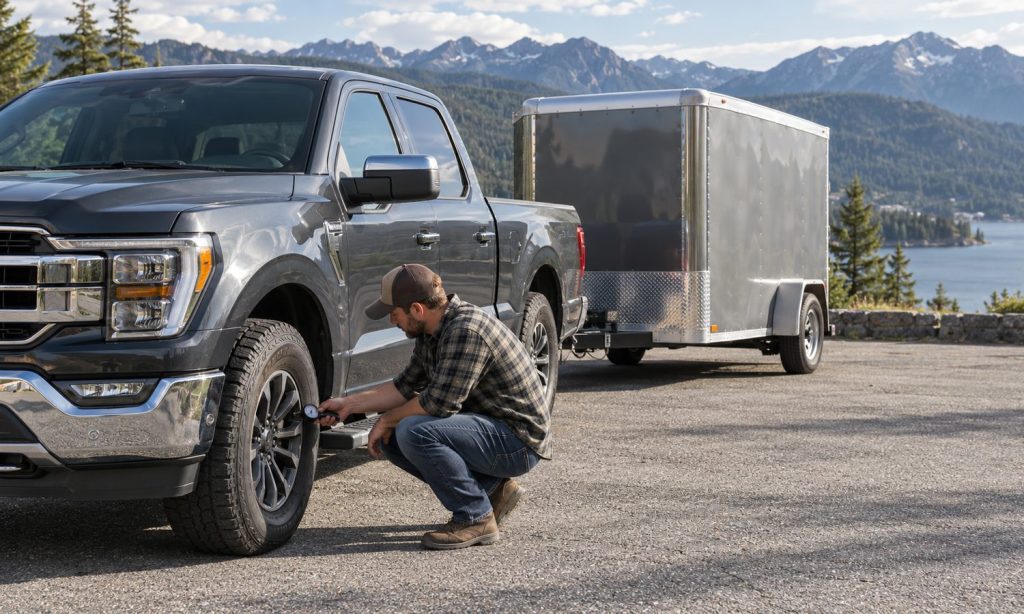
Check the tires before driving, when they have been parked for several hours and are not heated by direct sun. Use an accurate gauge on all four tires and compare each axle with the value on the truck’s label. Inflate in small increments and recheck. Replace valve caps and inspect for uneven wear, cuts, bulges, embedded objects, or damaged valve stems. If a pressure reading is repeatedly low, have the tire and wheel inspected for a leak.
After driving, tire pressure naturally rises as the air warms. Do not release air from a warm tire just to make its reading match the cold placard value. Check it again when cold. A tire-pressure monitoring system is helpful for warnings, but it is not a substitute for routine gauge checks or a load-capacity assessment. Follow the specific owner’s manual for TPMS limits, warnings, and any reset instructions after service.
Does towing call for more pressure?
Only follow a load-specific pressure adjustment if the owner’s manual or tire-and-wheel specifications for your exact truck and tire combination say to do so. Do not assume towing always requires more pressure, and do not apply a generic online chart across different model years or replacement tires. Ram’s towing information emphasizes that towing capability depends on vehicle configuration and ratings. That capacity information is not itself a tire-pressure instruction.
Trailer sway, excessive rear sag, steering changes, or a harsh ride should not be “corrected” by guessing at tire pressure. Check whether the load is within limits, cargo and trailer are distributed correctly, the hitch is appropriate, and the trailer brakes and tires are in good condition. If the Ram has aftermarket wheels, a lift, leveling kit, larger tires, or air springs, get the complete setup assessed. Suspension aids do not raise the original vehicle, axle, tire, or wheel ratings.
Choosing tires for a Dodge Ram 1500
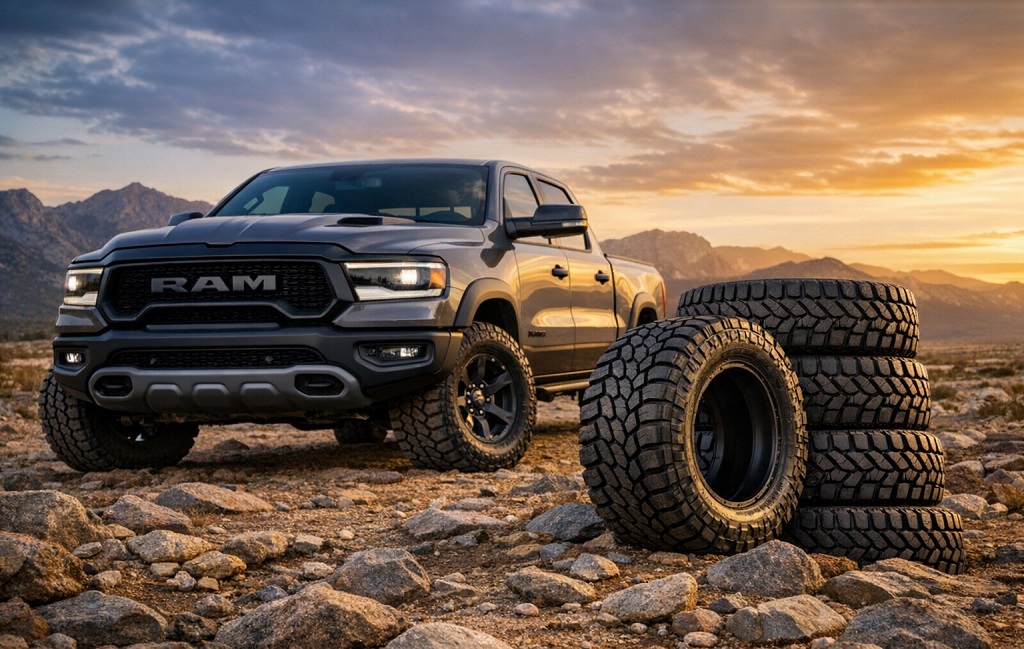
The supplied supporting phrase, tires for Dodge Ram 1500, is relevant to this topic, but the site search did not return a verified published page for a suitable internal link. Before choosing replacement tires, match the tire size and load capacity to the truck’s placard and intended use. Confirm the tire’s load index or range, speed rating, wheel compatibility, and clearance through the full steering and suspension travel. A tire that physically fits may still be unsuitable for the truck’s axle load or towing use. Ask a tire professional to verify non-original sizes and pressure requirements.
Common mistakes to avoid
- Using the tire’s sidewall maximum as the routine pressure without a vehicle-specific instruction.
- Following another Ram owner’s pressure setting without matching year, tire, wheel, and load configuration.
- Adjusting pressure based on a hot reading rather than checking cold.
- Ignoring tongue weight, installed accessories, or passengers when calculating payload.
- Assuming an air spring, lift, or higher-load tire lets you exceed vehicle or axle ratings.
- Relying on the dashboard TPMS as the only tire inspection.
Before towing or hauling checklist
- Read the door label and verify tire size and cold front/rear pressures.
- Inspect tires, wheels, and valve stems; gauge each cold tire.
- Count occupants, cargo, accessories, and trailer tongue weight toward payload.
- Check GVWR, both GAWRs, tire and wheel limits, hitch rating, and trailer limits.
- Secure cargo and confirm hitch setup, trailer brakes, and trailer tire condition.
- Get professional confirmation if the wheels, tire size, suspension, or load pattern has been changed.
Use the owner’s manual for your specific Dodge Ram 1500 and the instructions on its tire label. NHTSA’s tire-safety guidance explains where to find recommended inflation pressure and why checking tires matters. Ram’s towing pages describe configuration-dependent towing ratings; consult the manual and truck-specific labels for the controlling limits.
Pressure is only one part of tire setup for a loaded Ram. Check the vehicle’s load placard and manual, confirm the tire’s capacity, and inspect tread and age. The site’s guides to Dodge Ram 1500 tire load range, Ram 1500 tire rotation patterns, and tire replacement checks for a Ram 1500 cover related maintenance decisions. Keep each recommendation specific to the truck’s year and installed tires.
Frequently Asked Questions
What pressure should I use when my Ram 1500 bed is full?
Start with the cold pressure on the driver-door label. Use a different load-specific pressure only if the owner’s manual or tire documentation for your exact setup provides one.
Should towing pressure be higher than normal?
Not automatically. Follow the truck manual and tire specifications; do not substitute a generic towing rule or the tire sidewall maximum.
Does trailer tongue weight use payload?
Yes. Tongue weight is supported by the Ram and counts against its payload, while also affecting rear-axle load. Check the ratings for your particular truck and hitch.
Can I lower pressure for a smoother ride when unloaded?
Do not go below the vehicle maker’s recommended pressure unless an applicable manufacturer procedure explicitly calls for it. Low pressure can affect handling and tire heat.
What if my Ram has oversized tires?
Have a tire professional verify pressure and load capacity against actual axle weights, wheel limits, clearance, and the tire maker’s load-inflation data. Do not guess from appearance.
Final Words
For a Dodge Ram 1500, the door label and matching owner’s manual are the starting point for tire pressure. Check cold, account for tongue weight and all installed equipment, and keep the truck within every applicable rating. If your wheels, tires, or suspension differ from stock, confirm the complete setup with a qualified professional before towing or hauling.
References
- NHTSA TireWise: Tire Safety Ratings and Awareness.
- Ram Trucks: Towing Basics and Ratings (model-specific owner’s manual and labels govern).
- NHTSA: Tire and Loading Information Labeling.