
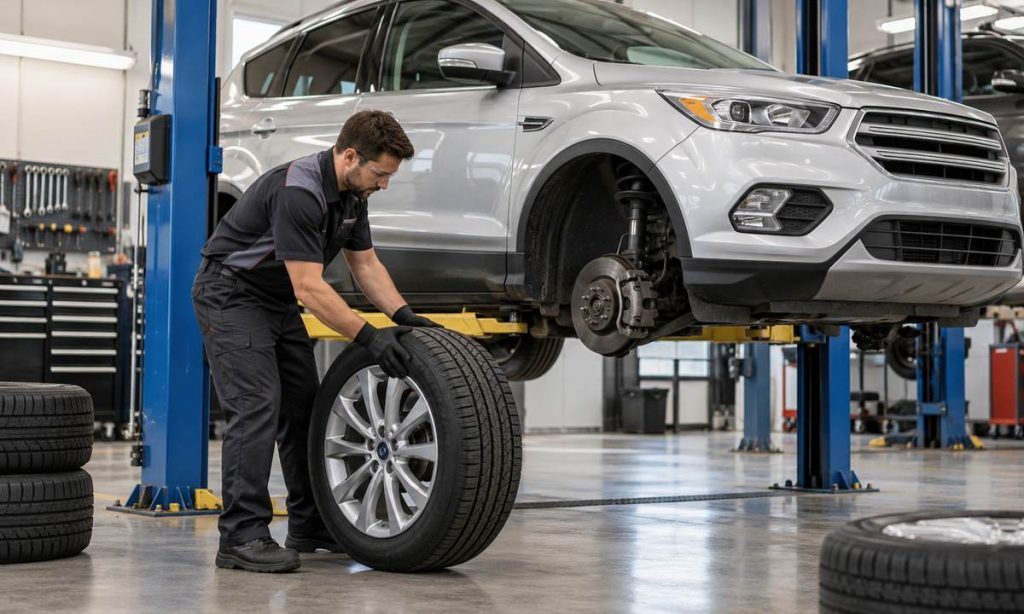
How tire rotation patterns affect tire life on a Ford Escape Titanium depends on the model year, drivetrain, tire design, and wheel package. Moving tires to different positions can help distribute wear because the front and rear axles do not carry out identical jobs. But the correct pattern is not determined by the Titanium badge alone. Escape generations include front-wheel-drive and all-wheel-drive configurations, and some tire setups may be directional or staggered. Ford’s owner manual for the specific model year provides the controlling rotation diagram and schedule. Rotation cannot repair damage, restore worn tread, or solve an alignment problem. Use the right pattern, check tire condition and pressure, and investigate uneven wear instead of simply moving it.
Why position affects tread wear
The front tires steer and, on front-wheel-drive versions, also transmit engine power. Braking and cornering add different forces at each corner. Road crown, inflation, alignment, tire balance, load, and driving habits further influence how tread wears. An AWD Escape has additional requirements around matching rolling circumference; follow its manual and service guidance rather than assuming a front-wheel-drive procedure is sufficient.
A timely, compatible rotation can spread position-specific wear among the tires and help the set wear more evenly over time. It does not make a tire last a guaranteed number of miles. NHTSA recommends regular tire inspections and rotation when the vehicle manufacturer calls for it; it also points out that uneven wear can indicate a need for rotation or alignment. If wear returns quickly after rotation, the underlying cause still needs attention.
Match the pattern to your Escape
Many Escape configurations with four same-size, non-directional tires use a cross pattern shown in Ford manuals, but the specific diagram varies by vehicle. Check whether your Escape is front-wheel drive or AWD, then follow its model-year owner manual. Do not apply a pattern from a newer or older Escape solely because the trim name is the same.
Directional tires are designed to rotate only one way and have arrows on the sidewall. Moving a directional tire across the vehicle can reverse its direction unless a shop remounts it on the wheel. A front-to-rear move on the same side may preserve direction if tire sizes allow it, but the manual and tire manufacturer’s instructions govern. Staggered front and rear sizes may rule out front-to-rear rotation altogether.
Do not include a temporary, dissimilar spare in a routine rotation unless the owner manual specifically instructs you to do so. Ford manuals identify some spare assemblies as temporary use only. Check the road tire sizes and sidewall markings before arranging service, and ask the shop to confirm the pattern when the setup is nonstandard.
Follow the model-year schedule
Find the tire-care schedule in the owner manual that matches your Escape’s year and powertrain. The service interval may differ by generation and maintenance schedule. NHTSA says to follow the manufacturer’s recommendation; it offers a general range only when the manufacturer recommends rotation. Use that as a prompt to check the book, not as a replacement interval that applies to every Escape Titanium.
Inspect tread and sidewalls before moving tires. If there is one-edge wear, cupping, a bulge, exposed cord, or a cut, rotation alone is not the right fix. Ford’s guidance for its vehicles says uneven wear should prompt checks for misalignment, imbalance, or a mechanical issue. Ask a qualified technician to inspect steering and suspension components when symptoms or wear patterns suggest a problem.
Pressure and TPMS after rotation
After rotation, check cold pressure at every wheel and use the front or rear pressure specified on the door label. Do not assume all four positions use the same value. Some model years may require a tire-pressure monitoring system relearn after tires are moved; follow the vehicle manual’s instructions and use the proper service procedure. If a warning light remains on, have the system checked rather than ignoring it.
For related fitment information, the guide to tires for Ford Escape Titanium explains why trim name alone does not establish a universal tire size. A separate Escape Titanium tire-pressure article covers placard and load considerations; check pressure again after rotation because each tire has changed position.
What rotation can and cannot do
A correct pattern can help equalize tread wear, but it cannot make mismatched or damaged tires suitable for AWD, return lost tread, or correct alignment. AWD systems can be sensitive to differences in rolling circumference, so follow the manual on allowable tread-depth variation and tire replacement. If one tire is substantially more worn or has been replaced with a different size or model, ask Ford or a qualified tire professional what the vehicle requires before driving normally.
Record each tire’s location and tread depth before service. If the same shoulder wears again, or the vehicle pulls or vibrates, have alignment, balance, tire pressure, brakes, steering, and suspension checked. NHTSA advises drivers to inspect for wear and damage routinely. Rotation is preventive maintenance; it is not a diagnosis.
Common rotation mistakes
- Using a generic pattern without checking the Escape’s year and drivetrain.
- Crossing directional tires so their arrows point the wrong way.
- Trying to rotate front and rear tires that have different sizes.
- Including a temporary spare that the manual says not to rotate.
- Ignoring unusual wear, pressure loss, vibration, or pulling before service.
- Skipping the pressure check or required TPMS relearn after wheels move.
Different Escape generations and trims can use different tire sizes or rotation instructions. For another model-specific example, see the Ford Escape XLT tire-rotation guide, then verify the pattern in the manual for your Escape Titanium.
Frequently Asked Questions
Does an Escape Titanium always use the same rotation pattern?
No. Model year, drivetrain, tire direction, and wheel setup can change the applicable pattern. Follow the owner manual for the exact vehicle.
Can AWD affect tire rotation or replacement?
Yes. AWD systems may require closely matched tire circumference or tread depth. Use the model-specific manual and ask a qualified professional if one tire is much more worn.
Can I rotate directional tires side to side?
Not without accounting for the direction arrow. A shop may need to remount the tire to preserve its intended rolling direction. Follow the tire manufacturer’s instructions.
Will rotation fix uneven tire wear?
It may redistribute some position-related wear, but it will not fix a bad alignment, imbalance, damaged component, or pressure problem. Diagnose the cause first when wear is pronounced.
What should I do after a rotation?
Check cold pressure at each position and follow the manual for TPMS relearning. Recheck for vibration or warnings and return for service if something changed unexpectedly.
Final Words
A Ford Escape Titanium needs a rotation pattern that fits its model year, drivetrain, tires, and wheels. Follow the owner manual’s interval and diagram, inspect for uneven wear, then verify pressure and TPMS operation after service. When wear is abnormal or the tire setup has changed, get the cause and fitment checked before relying on rotation alone.
References
- Ford 2008 Escape Owner’s Guide (illustrates a model-specific pattern; verify your year’s manual).
- NHTSA TireWise: Tire Safety Ratings and Awareness.
- NHTSA Summer Driving and Road Trip Tips.