
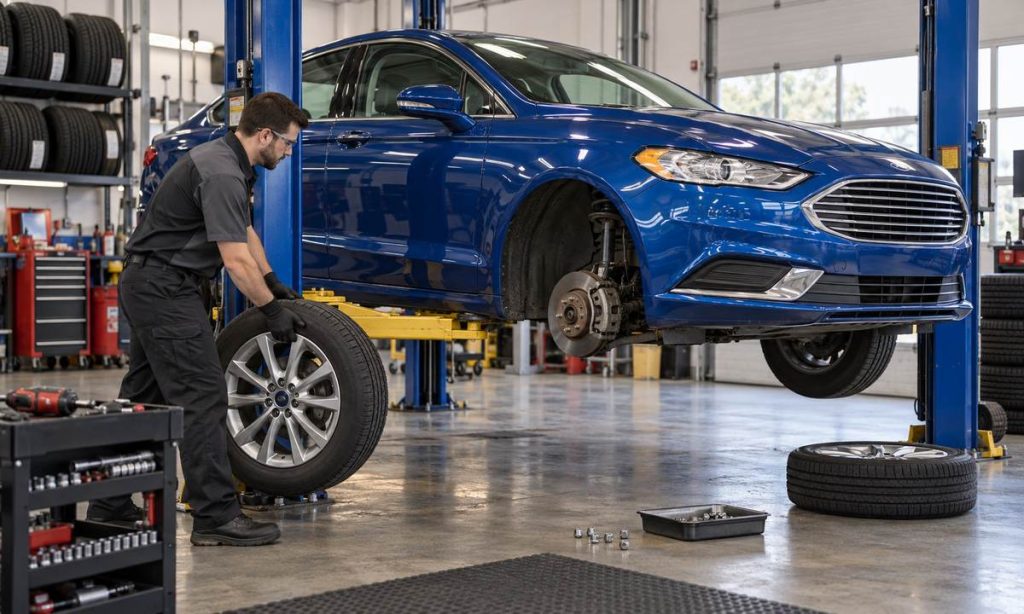
How tire rotation patterns affect tire life on a Ford Fusion comes down to matching the pattern to the car’s drivetrain, tire design, and wheel setup. Rotation can help the tires wear more evenly because the front and rear axles place different demands on them. Ford Fusion owner manuals show guidance for front-wheel-drive and all-wheel-drive models, identify directional tire limits, and call for checking pressure after service. Details vary by model year, trim, wheel package, and tire type, so use the manual supplied for your Fusion. Rotation cannot restore tread already lost or correct a worn suspension part, alignment problem, or damaged tire. A pattern that conflicts with directional arrows or staggered sizes may be unsafe or impossible. If you are also comparing all-season tires for Ford Fusion, confirm that the chosen size and design match your specific car.
Why rotation changes wear
Tires do not carry identical loads or perform identical work at every corner. A front-wheel-drive Fusion sends engine power through the front tires and asks them to steer as well, so front tires can wear differently from the rear pair. Braking, cornering, road crown, inflation, alignment, and driving style also influence wear. On an all-wheel-drive version, the system’s requirements and tire circumference consistency matter; follow that vehicle’s manual rather than assuming the front-wheel-drive pattern applies.
A suitable rotation moves each tire to a different position at the interval Ford specifies for the model year. That can distribute position-related wear across the set and help preserve usable tread more evenly. It does not guarantee a particular mileage life. The outcome also depends on correct pressure, wheel alignment, balancing, tire condition, and whether the tires are a matched set.
Choose a pattern for the Fusion configuration
For many Fusion front-wheel-drive and all-wheel-drive configurations with four matching, non-directional tires, Ford’s manuals illustrate a pattern that moves front tires rearward on the same side and crosses rear tires to opposite front positions. The exact diagram in the applicable manual controls. Do not treat this general description as a universal instruction: model years and tire setups can differ.
Directional tires have a tread designed to rotate in one direction. Their sidewalls show arrows indicating permitted rotation. A front-to-rear swap on the same side can preserve direction when all tires are the same size, but a cross-pattern may require remounting tires on wheels. Follow the tire maker’s direction markings and the vehicle manual. If you are unsure whether a tire is directional, do not guess.
Some wheel packages use different front and rear tire sizes, or a spare that is not equivalent to the road tires. A staggered setup may prevent front-to-rear rotation. Ford describes a dissimilar temporary spare as unsuitable for routine rotation. Check tire sizes on the sidewalls and the vehicle manual before scheduling service. A tire shop can identify directional designs and confirm whether the four road tires can exchange positions.
Follow the maintenance interval and inspect first
Use the maintenance schedule for your model year to determine when rotation is due. The interval can vary with year, service schedule, and driving conditions. If the car is driven frequently on rough roads, carries heavy loads, or shows wear changes, ask a technician whether more frequent inspections are appropriate. Do not invent a single interval and apply it to every Fusion.
Before rotating, look for uneven wear, damage, or a pressure problem. Ford’s manual says to have uneven wear evaluated for alignment, imbalance, or mechanical causes before relying on rotation. An alignment issue can rapidly wear new tread again. Rotation moves a tire; it does not repair bent parts, worn bearings, a dragging brake, or incorrect toe or camber. If a tire has a bulge, exposed cord, deep cut, or unusual vibration, stop and arrange professional inspection rather than simply moving it to another corner.
What to do after the tires move
After service, set inflation pressure to the requirement for each tire’s new position using the Fusion’s door label and manual. Front and rear specifications can differ. Some vehicles use tire-pressure monitoring sensors that need a relearn or reset after rotation; follow the model-specific instructions. Confirm lug nuts were tightened using the correct procedure and torque for the vehicle and wheels. If steering is off center, the car pulls, or a new vibration appears, return to the shop for diagnosis.
The site’s Ford Fusion tire-pressure guide explains why inflation should be checked at each position rather than assumed after tire service. The published tire-selection guide also notes that tire size changes with model year and wheel package. Rotation guidance depends on the tire’s directionality and the car’s setup, not whether a tread is marketed as all-season.
How rotation supports tire life—and where it cannot help
A correct rotation may slow the gap between the most-worn and least-worn tires, making it easier to replace a set together and maintain consistent handling. That benefit depends on starting with serviceable tires and keeping inflation and alignment in good condition. If a front tire already has little tread, swapping it rearward does not make it safe or restore traction. Replace tires when wear indicators or applicable safety guidance call for it, and follow the vehicle maker’s rules for matching tires, particularly on AWD models.
Do not use rotation to mask a persistent pull, vibration, or rapid wear on one edge. Record tread depth at several points across each tire and note the position before and after service. If wear is strongly uneven, have alignment, balance, suspension, steering, and tire pressure evaluated. NHTSA recommends routine checks for inflation, treadwear, and damage along with rotation and alignment maintenance.
Rotation intervals and patterns depend on the vehicle’s drivetrain, tire design, and wear. For a related Ford Escape example, see how rotation patterns affect tire life on a 2009 Ford Escape XLT; use the Fusion’s own manual for its pattern and interval.
Frequently Asked Questions
Does rotating tires make them last longer?
Rotation can help distribute position-related wear more evenly, which may help the set wear at a more similar rate. It cannot guarantee mileage or compensate for underinflation, misalignment, damage, or aggressive driving.
Can I use a cross pattern on any Ford Fusion?
No. The pattern depends on model year, drivetrain, tire direction, and whether all four tires are the same size. Use the exact manual diagram for your car.
Can a temporary spare be included?
A dissimilar temporary spare is not intended for routine rotation. Keep it for its specified temporary purpose and follow the manual’s spare-tire warnings.
Should tire pressure be checked after rotation?
Yes. Check each tire against the front or rear pressure listed on the vehicle label. Also follow the manual’s instructions for any TPMS relearn after the wheels change positions.
What if a tire is wearing on one edge?
Have the cause checked before relying on rotation. Alignment, inflation, balance, suspension, or steering problems can create uneven wear and continue damaging the tire after it moves.
Final Words
A rotation pattern can help your Fusion’s tires wear more evenly only when it matches the specific drivetrain, tire direction, and wheel setup. Follow the owner’s manual interval and diagram, check pressure after rotation, and investigate unusual wear before moving tires. When replacing a tire set, review all-season tire fitment for Ford Fusion separately; replacement tread still needs the correct rotation and maintenance plan.
References
- Ford 2016 Fusion Owner’s Manual (use the manual for your model year).
- NHTSA TireWise: Tire Safety Ratings and Awareness.