
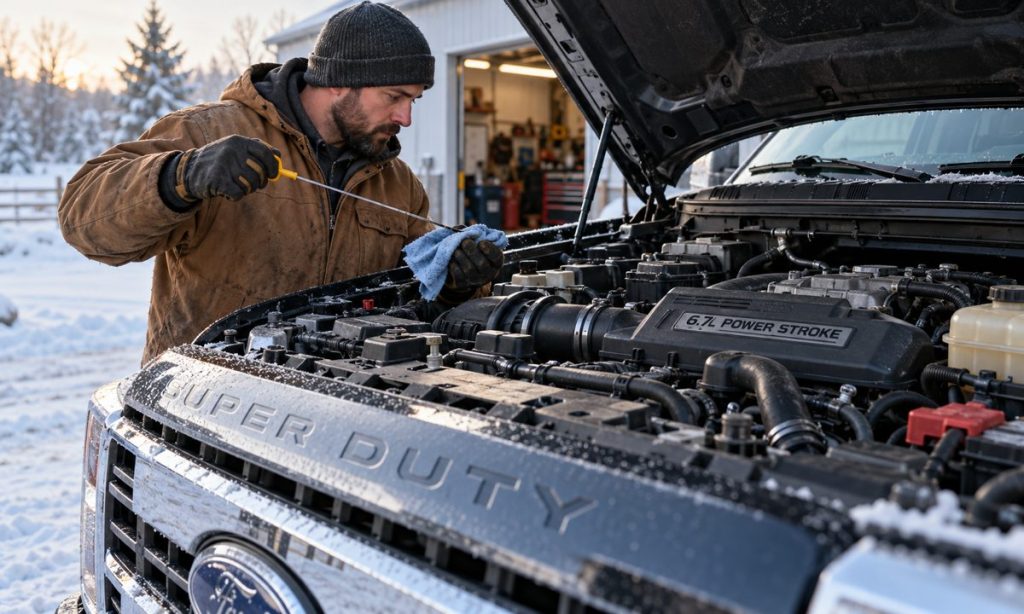
Oil viscosity and owner-manual guidance for Ford F250 73 Diesel in cold weather must be matched to the truck’s model year and 7.3-liter diesel specification. “7.3” can refer to different Ford engines across generations, including a later gasoline engine, but this guide concerns the diesel named in the keyword. Do not use an oil chart for a modern 7.3 gas engine or a different diesel merely because the displacement matches. Confirm the year, engine, and exact oil specification in the correct owner’s guide and diesel supplement.
Start with the right manual and oil specification
Find the truck’s model year from its registration, door label, or VIN, and check whether the diesel is the 7.3 Power Stroke generation for that year. Use the owner’s guide, diesel supplement, and service information that match that truck. Ford’s manuals identify viscosity grades and performance specifications together; viscosity alone is not enough. The specified oil must meet the required Ford or API standard for the engine and model year.
For example, Ford’s 2002 F-250/350 owner guide contains a 7.3L Power Stroke oil and filter section. It discusses operation in prolonged cold, short trips, and low-speed conditions as factors in maintenance. That document applies to the specified 2002 vehicle family; it is not a universal chart for every 7.3 diesel or every F-250. Use Ford’s owner-manual lookup or the correct archived guide for your own model year.
What viscosity means in cold weather
The first number and W in a multi-grade oil label indicate low-temperature viscosity performance under standardized test conditions; the second number describes the grade at operating temperature. The grade is only one part of the selection. The oil also needs the performance category and manufacturer specification required for that engine. A lower winter number is not automatically a safe substitute if the manual does not approve it.
Cold oil flows more slowly than warm oil, while a cold diesel also faces different starting and combustion conditions. The correct grade helps the engine operate within Ford’s design guidance across the expected temperature range. Use the manual’s ambient-temperature chart and oil specification instead of choosing by local habit, forum posts, or what worked in another truck. If the expected temperature falls outside the chart, ask a Ford diesel service professional or consult current service data before changing grade.
Check oil level and service history before winter
Inspect level and condition
Park on a level surface and check the dipstick using the procedure in the manual. If the level is low, add only oil meeting the required specification and viscosity. Avoid overfilling. Look for leaks, coolant contamination, fuel dilution, or an unusual increase in level; these conditions need diagnosis. A normal-looking dipstick does not confirm that the oil is still within its service life.
Review the last oil and filter service date, mileage, and driving pattern. A truck that makes frequent short trips, idles for long periods, works at low speed, or operates for extended periods in cold temperatures may fall under severe-service guidance in its manual. Towing or dusty operation may change other inspection needs as well. Do not convert a generic mileage interval into a universal recommendation for all model years.
Use the correct filter and procedure
Select an oil filter listed for the engine and year, and use the installation instructions in the service information. Filter dimensions or thread appearance do not prove fit. Fill amount and checking procedure vary; follow the manual and recheck the level after the engine has been run and allowed to settle as directed. Dispose of used oil and filter according to local requirements.
Cold-start habits and related systems
Use the cold-start and fuel guidance in the diesel supplement. A diesel may need the correct pre-start procedure and functioning cold-weather equipment; oil grade alone does not guarantee easy starting. Confirm battery condition, connections, glow-plug or intake-heater operation where fitted, fuel quality, and block-heater use according to the year-specific instructions. Never use starting fluid unless Ford expressly permits it for the exact vehicle and the procedure is followed; misuse can cause severe engine damage.
Do not rev the engine aggressively immediately after a cold start. Follow Ford’s warm-up guidance and monitor oil pressure and warning messages. If the oil-pressure warning remains on, shut down safely and investigate. Repeated hard starting, smoke, abnormal noise, or rising oil level should be diagnosed rather than treated by switching to an unapproved viscosity.
For related context, see our Ford 6.7 diesel cold-weather oil guide, which likewise ties oil choices to the correct manual, and our guide to towing and dusty driving maintenance for an F-250 diesel. The engines differ, so use these as examples of how to check service requirements, not as sources of 7.3 specifications.
For other supporting topics, review our Ford diesel oil-filter fitment guide, Ford diesel diagnostic scanner overview, and Ford F-150 4.6 cold-weather oil guidance. Each covers a different engine or tool; do not transfer its oil grades to a 7.3 diesel.
Cold starts can reveal a weak battery or charging issue, which is separate from oil choice. Our articles on battery drain from Ford diesel accessories and slow starts and weak batteries can help distinguish electrical symptoms from a lubrication question.
Frequently Asked Questions
Can I use the same oil grade in every 7.3 Ford engine?
No. The 7.3 diesel and later 7.3 gasoline engine are different, and model-year specifications can vary. Check the exact manual.
Does cold weather mean I should use a lower W grade?
Use a lower-temperature grade only if the correct Ford chart and oil specification permit it for your engine and climate.
Does towing change the oil viscosity I should use?
Towing may affect service conditions or maintenance intervals, but it does not authorize an unlisted viscosity. Follow the manual for the exact year.
How often should I change oil in cold conditions?
Use the model-year schedule and severe-service guidance. Frequent short trips or extended cold operation may change service needs.
Can the wrong oil cause hard starting?
Oil choice is one factor, but battery, fuel, and cold-start systems also matter. Diagnose persistent hard starts instead of changing grades by guesswork.
Final Words
For oil viscosity and owner-manual guidance for Ford F250 73 Diesel in cold weather, identify the exact model year and diesel engine, then follow that truck’s Ford viscosity chart, oil performance specification, and severe-service schedule. Check level and service history before winter, use the correct filter, and investigate persistent warning lights or hard starting. Never borrow a grade from a different 7.3 engine or model year.
Pingback: Check Oil Filter Compatibility for Ford F-250 6.7 Diesel